
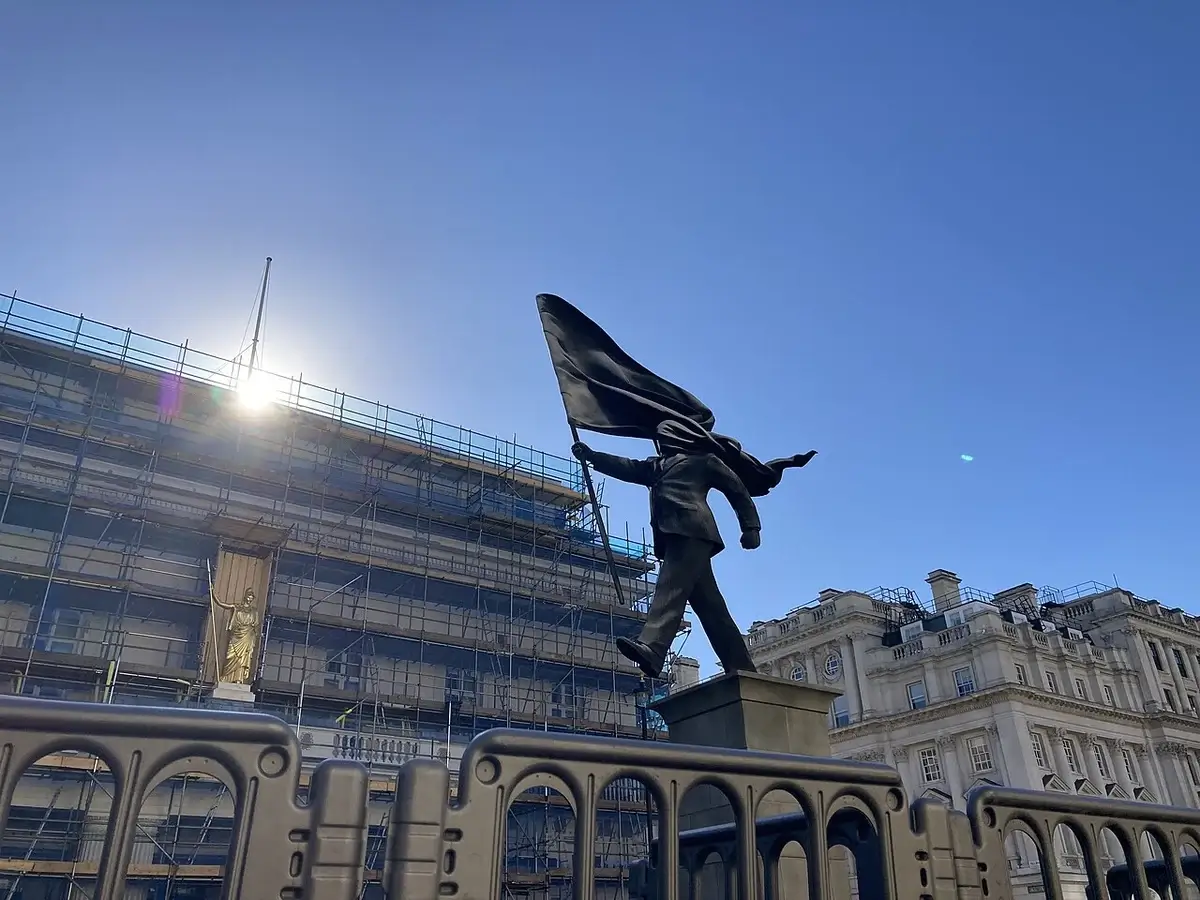

A new Banksy sculpture appeared overnight in central London this week, and its message lands like a gut punch in 2026: a suited man, mid-stride, hoisting a flag that has wrapped itself around his head and blinded him completely. He is walking off the edge of his plinth with no ground beneath him, and he can’t see it coming.
The statue showed up in the early hours of Wednesday, April 29, on a traffic island in Waterloo Place — a stretch of London just off The Mall, surrounded by monuments to King Edward VII, nurse Florence Nightingale, and the Crimean War.
Banksy, a political art genius, chose the spot, he said, because it had “a bit of a gap.” By Thursday, he had confirmed the work was his in a video posted to Instagram, set to Edward Elgar’s “Pomp and Circumstance March No. 1,” the same composition played at King Edward VII’s coronation.
The video shows workers installing the sculpture under cover of darkness and ends with an older British man walking up to it and saying flatly, “I don’t like it.”
The Flag Has No Country
The figure on the plinth is dressed in a businessman’s suit. The flag he holds is intentionally blank — no stars and stripes, no Union Jack, no tricolor. One Instagram commenter put it well: “The flag carries no identity — no country, no allegiance — just a form, making the figure universal.”
That is the point. The man could be any leader, any voter, any citizen of any nation walking proudly forward into ruin because the symbol he is waving has stopped covered his eyes.
It is a statement about blind patriotism, made at a moment when blind patriotism is doing a great deal of damage. The work arrived in London in the same week President Trump hosted King Charles III at a Washington state dinner (too bad the ballroom wasn't ready), and the same week the King addressed a joint session of Congress to argue for the importance of NATO — an alliance the Trump administration has repeatedly threatened, dismissed as “a paper tiger,” and used as a punching bag for the president’s grievance politics.
In Florida the next day, Trump told a Villages crowd that NATO countries should consider themselves “fired.” A statue of a man marching blindly off a ledge while wrapped in a flag of no country is, in that context, less abstract than it might first appear.
A Medium Banksy Rarely Uses
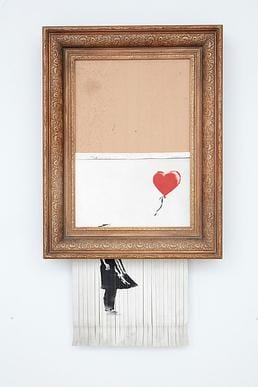
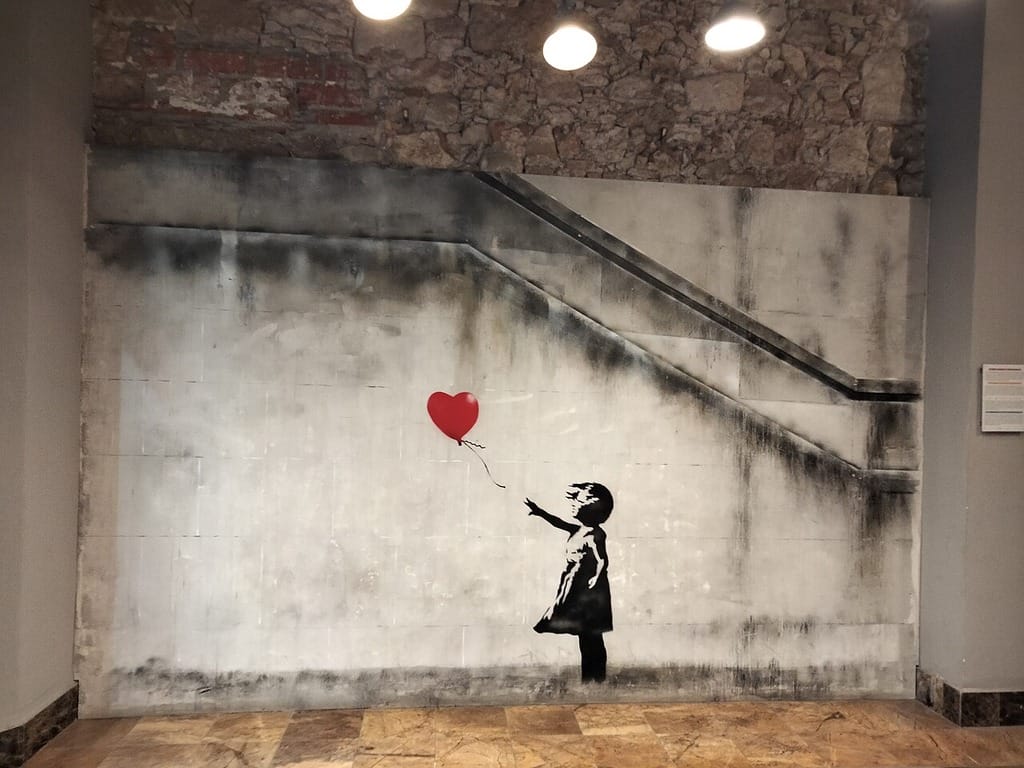
Banksy is best known for stencil murals — Girl with Balloon, the West Bank Wall paintings, the shredded Sotheby’s auction piece. Statues are unusual for him. His most famous earlier sculpture was 2004’s “The Drinker,” a satirical riff on Rodin’s “The Thinker” that depicted the iconic seated figure with a traffic cone on his head.
The choice of medium here matters. Statues are how nations decide who and what to memorialize. They are how an empire “writes itself” onto public space. By dropping a satirical sculpture of a blinded patriot among the actual heroic monuments of British imperial history — kings, generals, war dead — Banksy is doing what statues are supposed to do, but inverted. Instead of asking the public to admire, the work asks the public to recognize themselves and look away.
London Authorities are Letting it Stay
In an unusual move, the city is protecting the work rather than removing it. Westminster City Council, which oversees the area, said in a statement that it welcomed the sculpture as “a striking addition to the city’s vibrant public art scene” and had taken initial steps to protect it.
The office of London Mayor Sadiq Khan told the New York Times that the mayor “is hopeful that his latest piece can be preserved for Londoners and visitors to enjoy.” Authorities erected safety barriers around the statue on Thursday afternoon as crowds grew.
That stands in contrast to last September, when London’s Royal Courts Service scrubbed away a Banksy mural depicting a wigged judge attacking a protester with his gavel just two days after it appeared. The difference appears to be that institutions are happier to host a Banksy that critiques abstract patriotism than one that critiques the courts directly.
Banksy’s Identity Remains Unconfirmed
The statue arrives less than two months after a sprawling Reuters investigation in March identified Banksy as Robin Gunningham, a bespectacled middle-aged man from Bristol — a claim first made by The Mail on Sunday in 2008. Neither Banksy nor his representatives have confirmed or denied it.
The artist has gone to enormous lengths to preserve his anonymity since his work began appearing in the early 1990s, and the Reuters piece sparked debate among collectors and fans about whether unmasking him changes the meaning of the art.

The Waterloo Place statue is one answer to that question. Whether the world knows his legal name or not, the work itself keeps doing what it has always done: showing up uninvited, refusing permission, and forcing public space to host an argument that institutions would rather not have.
Why This Piece Resonates Now
Public art works when it makes a complicated feeling visible all at once. The flag-blinded patriot does that. It captures something specific about this political moment — across the United States, the United Kingdom, and beyond — when nationalism is being marketed as clarity but is functioning as a blindfold.
When voters are told the flag will protect them from seeing the consequences of the policies wrapped inside it. When leaders demand loyalty to a symbol (or a narcissistic President) while leading the people toward harm.
That’s one message being shared by the statue of a man in a suit, marching forward, certain of himself, completely unable to see where his next step is going to land. It’s a sculpture, and it’s also a description.