
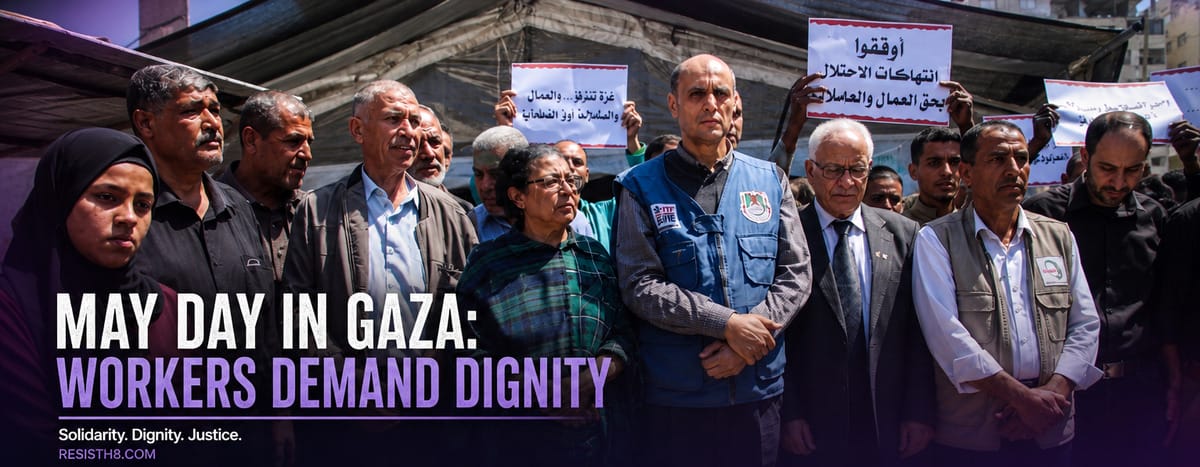

For most of the world, May 1 is a day for marches, banners, and the long-running tradition of workers asserting their dignity. In Palestine, where International Workers’ Day is observed as Labor Day, this year’s date arrived without anything resembling a celebration.
It arrived instead as a measure of how thoroughly years of war have hollowed out the conditions that make work possible at all.
The figures alone tell a grim story. The Palestinian Central Bureau of Statistics puts overall unemployment in the Palestinian territories at roughly 27.5 percent. Among young people, it climbs to nearly 40 percent — meaning roughly one in three young Palestinians cannot find a job. In the Gaza Strip, the official rate sits around 78 percent, and autonomous assessments place it even higher.
The International Labour Organization, working alongside the Palestinian Central Bureau of Statistics, has described the destruction of Gaza’s employment base as the most rapid and complete in modern history. By early 2025, real GDP in Gaza had contracted by more than 87 percent compared to the start of 2023.
These are not numbers in the abstract. They describe a labor market that has, for hundreds of thousands of people, simply ceased to exist.
A Generation Locked Out
For Ayman Abu Salama, a 28-year-old engineering graduate from the Islamic University of Gaza, the consequences are personal and ongoing. He spent years preparing for a career that, on paper, should have been within reach. The reality after graduation has been very different.
He has applied to dozens of positions and received almost no real responses. The engineering and construction sectors that once would have absorbed new graduates have been gutted, with many firms and offices either destroyed in Israeli bombing or forced to close. He watches former classmates abroad begin their careers while he remains stuck at the threshold, sending applications into what feels like a void.
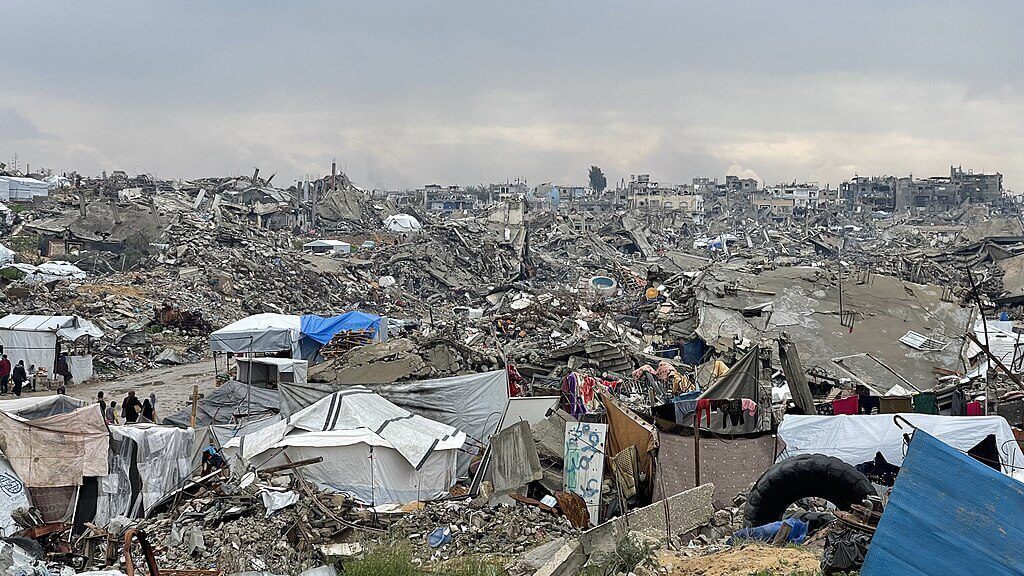
“Sometimes I lose hope, but I keep trying because I have no other choice,” he told Truthout reporter Eman Abu Zayed.
His situation is the rule, not the exception. The ILO estimates youth unemployment across the territories at 60 to 70 percent, and in Gaza approaching 95 percent — figures that describe an entire generation cut off from the chance to develop skills, build careers, or contribute to an economy that can no longer absorb them.
Twenty-Five Years, Erased in a Moment
Ghassan Abu Zayed, a goldsmith and the father of the Truthout reporter who covered this story, spent more than two decades building a workshop. He learned the craft of goldsmithing in Iraq, returned home, and over 25 years equipped a fully functioning shop with specialized machinery, some of it imported from abroad. He produced bracelets, necklaces, and rings, and the workshop became his family’s primary source of income.
Israeli shelling destroyed both his home and his workshop, reducing the equipment and tools of a lifetime to rubble.
“I worked in this profession for more than 20 years, and everything I built was gone in a moment,” he said. “It’s not just a financial loss — it’s the loss of a lifetime of hard work.”
He cannot resume the work. The machinery is gone, and rebuilding a specialized workshop under current conditions is, in his words, impossible. His story repeats itself across Palestine — small business owners and skilled professionals who have lost not just income but the physical infrastructure that made their livelihoods possible.
Structural Collapse
A Ministry of Labor official cited in the original Truthout report described conditions as unprecedented, with productive sectors closed across the board and recent graduates entering a market that has nothing to offer them. Vocational training and small temporary employment programs continue, but the official acknowledged they are nowhere near the scale of the crisis.

The pressures stretch beyond Gaza. In the West Bank, ILO projections put unemployment at 38.5 percent for 2025 — the worst sustained level in decades. The closure of the Israeli labor market to Palestinian workers has been a significant driver. Before October 2023, roughly 150,000 West Bank Palestinians worked inside Israel or in settlements at wages two to three times higher than those available locally.

The mass revocation of those permits, combined with more than 800 Israeli checkpoints and gates restricting movement, has gutted incomes across the territory. The World Bank estimates the lost annual income at $1.5 to $2 billion.
Meanwhile, real per capita income in the West Bank has dropped more than 20 percent compared to before the war. Among workers who remain employed, more than half have seen reduced hours and over 60 percent have taken pay cuts.
What Labor Day Looks Like Without Labor
May Day exists to honor work and the people who do it. In Palestine this year, it cannot perform that function. The graduates have nowhere to apply their skills. The skilled tradespeople have lost their tools. The small business owners have lost their shops. The workers who once crossed into Israel for higher wages have lost that access.
What remains is the documentation — the official statistics from the Palestinian Central Bureau of Statistics, the assessments from international labor bodies, and the personal testimonies of people like Abu Salama and Abu Zayed, whose stories make the numbers concrete. Together they describe an economy that has not just contracted but been systematically dismantled, alongside the lives built around it.
The future of work in Palestine, and whether young people will ever have the chance to build stable livelihoods in their own communities, remains a question without an answer.