

The man in charge of the Israeli military in the occupied West Bank told a closed-door meeting of soldiers that his troops are killing Palestinians at rates the Israeli army hasn’t reached since 1967 — and he said it like he was proud of it.
Major General Avi Bluth, head of the Israeli military’s Central Command, made the remarks in a private forum that was first reported by the Israeli newspaper Haaretz on May 4, 2026. The quote that has now circled the globe:
“We’re killing like we haven’t killed since 1967.”
For Palestinians, 1967 isn’t a year. It’s a wound. That’s the year of the Naksa — the Arabic word for “setback” — when Israel’s war on its neighbors displaced more than 300,000 Palestinians from their homes and began the military occupation of the West Bank, Gaza, and the Golan Heights that has now lasted nearly six decades.
Bluth, who is himself a settler and has commanded the West Bank since 2024, was telling his soldiers that the killing rate today rivals the killing rate of a war.
“Limping Monuments”
Bluth then explained, in detail, how he gets those numbers up.
He told the room he had loosened the rules of engagement so that Israeli soldiers can shoot Palestinians from the knee down when they approach the “seam line” — the barrier Israel has built that cuts deep into West Bank territory beyond the internationally recognized 1949 Green Line.
The point, he said, was to create what he called “barrier consciousness.”
Then came the line that has appalled even some Israeli commentators. “There are a lot of ‘limping monuments’ in Palestinian villages,” Bluth said, referring to the men who have been shot in the legs by his soldiers and now walk with a permanent limp. “There is a price being paid.”
That phrase — “limping monuments” — describes human beings as warning signs. People reduced to a visible deterrent for the next person who might try to cross.
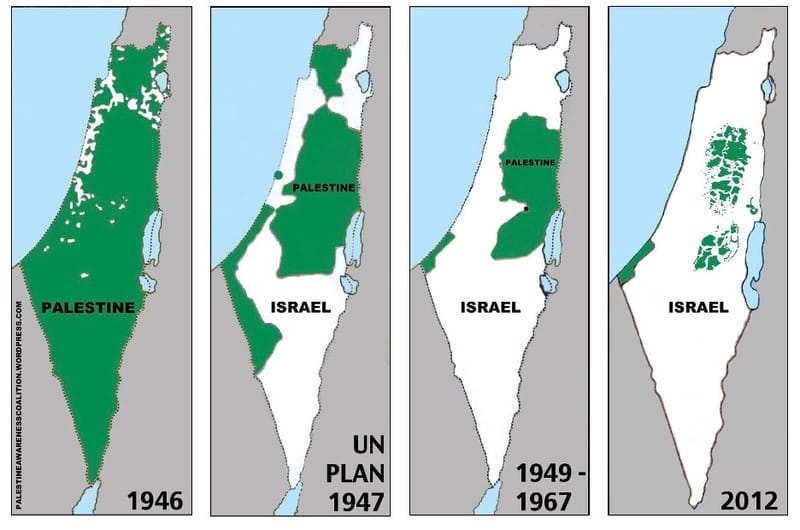
Map of Palestine Land Loss Over the Years
Most of the Palestinians attempting to cross the seam line are not attackers. They are workers. After October 7, 2023, Israel suspended more than 100,000 work permits for West Bank Palestinians, cutting off families from the wages they had relied on for decades.
The Israeli economy has been built around Palestinian day labor since the occupation began. Bluth did not mention any of that. He attributed the increase in crossings to “high unemployment” — without saying who caused it.
Two Sets of Rules
Bluth was also unusually candid about something Palestinians have said for years and Israel has long denied: the army applies one set of rules to Palestinians and a completely different set to Jewish Israelis.
When Palestinians throw stones, he said, that’s “terrorism.” He boasted that in 2025, Israeli forces killed 42 Palestinian stone-throwers.
When Israeli settlers throw stones — including documented attacks on Israeli soldiers themselves — Bluth said his troops do not shoot back, because firing on Jews carries “profound sociological consequences.”
He recalled an incident in which two masked settlers were shot and the public outcry that followed. “We prefer to resolve these with other means,” he said. Then, in the most clinical admission yet from a senior Israeli officer: “Yes, it involves discrimination.”

He also confirmed that Israel currently holds more than 4,000 Palestinians in administrative detention — meaning indefinitely, without charges, without trial, without seeing the evidence against them.
Zero Israelis are held under the same system.
The Body Count
According to the United Nations Office for the Coordination of Humanitarian Affairs, Israeli forces and settlers have killed at least 1,080 Palestinians in the occupied West Bank since October 7, 2023. At least 235 of them were children. Another 35 Palestinians have been killed since the start of 2026.
Bluth himself put the three-year number at 1,500 dead. He claimed 70 percent of them were armed, a figure he provided no evidence for.

Then he said something that should be read carefully: “We’ve killed 1,500 terrorists in three years. So how come there is no intifada? Why don’t they take to the streets?”
The senior commander of an occupying army was puzzled, in front of his own troops, that the people he was killing in such numbers had not yet risen up.
Killing the Witnesses, Funding the Perpetrators
What makes Bluth’s remarks even more damning is the context surrounding them. Settler violence in the West Bank has reached levels described by the Israeli press as daily — fatal shootings, sexual assaults, arson, and mass intimidation campaigns aimed at driving Palestinians off their land.
Bluth himself has called this violence “Jewish terror” and warned that it could trigger a Palestinian uprising.



And yet, Peace Now reported this week that the Israeli government has just allocated roughly 130 million shekels — about $35 million — to the very settler organizations responsible for that violence, under the cover of “reducing risk situations” for settler youth.
The same hands that the army’s own commander is calling terrorists are now being filled with public money.
For their part, far-right Israeli politicians are not angry that Bluth is killing Palestinians at historic rates. They are angry that he is occasionally critical of settlers. Knesset Member Limor Son Har-Melech has already called on Defense Minister Israel Katz to fire him.
What Bluth Said Out Loud
Strip away the military jargon and what Major General Bluth confessed, in a room full of his subordinates, was this:
I have ordered my soldiers to shoot unarmed people in the legs to scare other unarmed people. I treat Palestinian children who throw stones as terrorists and Israeli settlers who throw stones as kids who need a different intervention.
I am killing at a rate not seen since the war that started this occupation. And I want to know why the people I am killing have not yet revolted.”
He said this not as a confession but as a defense of his record.
The occupation does not hide what it is anymore. It admits it, in closed rooms, to the soldiers it expects to keep doing the work. The only thing left is whether the rest of the world is willing to keep pretending it can’t hear.