
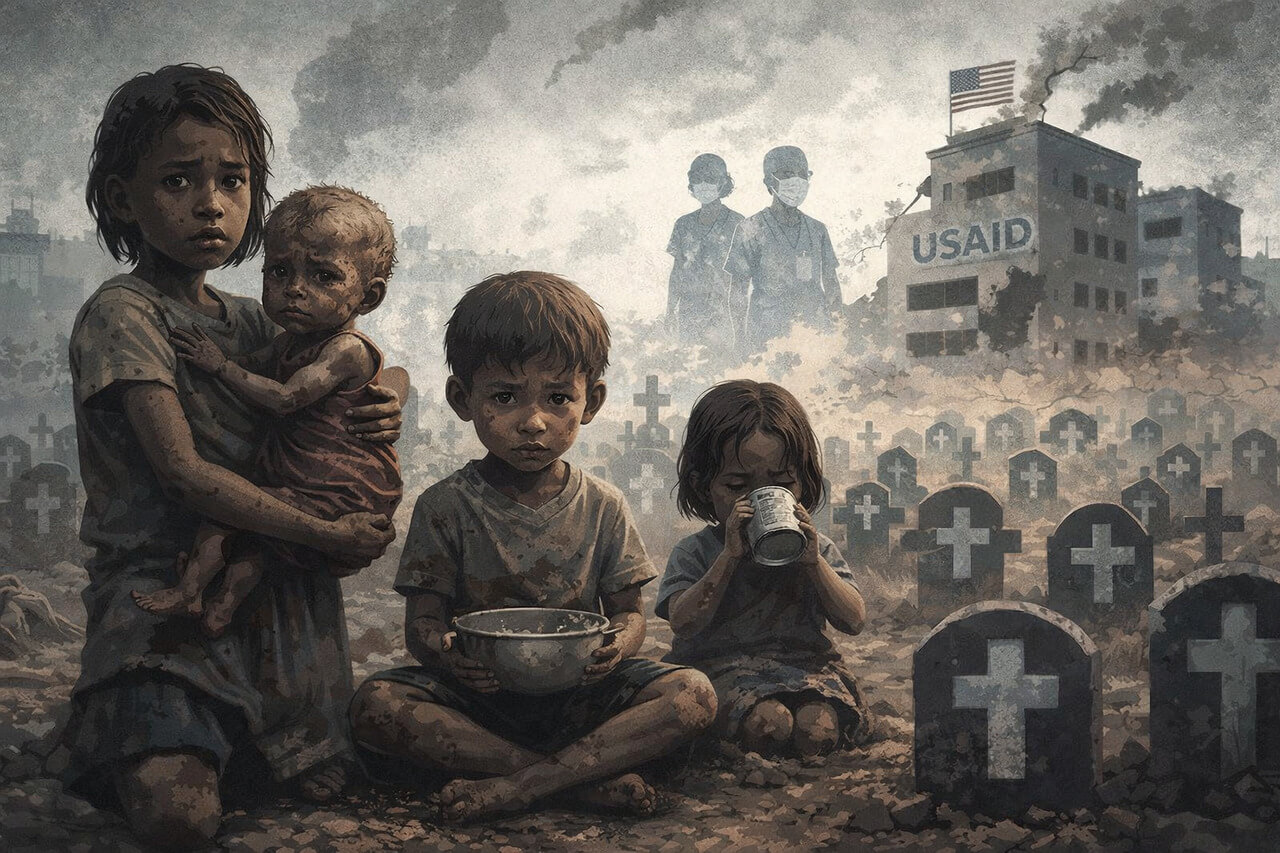

Somewhere in the world, roughly once every 40 seconds, a person dies because the United States decided to stop helping. More than a year after the Trump administration froze and then gutted it, independent researchers estimate the USAID shutdown has already cost around 750,000 lives. Most of them were children.
That is the arithmetic behind the destruction of the U.S. Agency for International Development (USAID) — the agency that for more than six decades paid for the vaccines, clean water, HIV medicine, and emergency food that kept tens of millions of people alive.
When we first covered this, the deaths were still mostly a projection. Now they are a body count.
What USAID Actually Did
Before it was dismantled, USAID was the largest single funder of humanitarian and development aid on Earth.
In 2024 alone it disbursed roughly $68 billion — more than 40 percent of all global aid — to some of the poorest communities in the world.
That money bought results that are hard to comprehend.
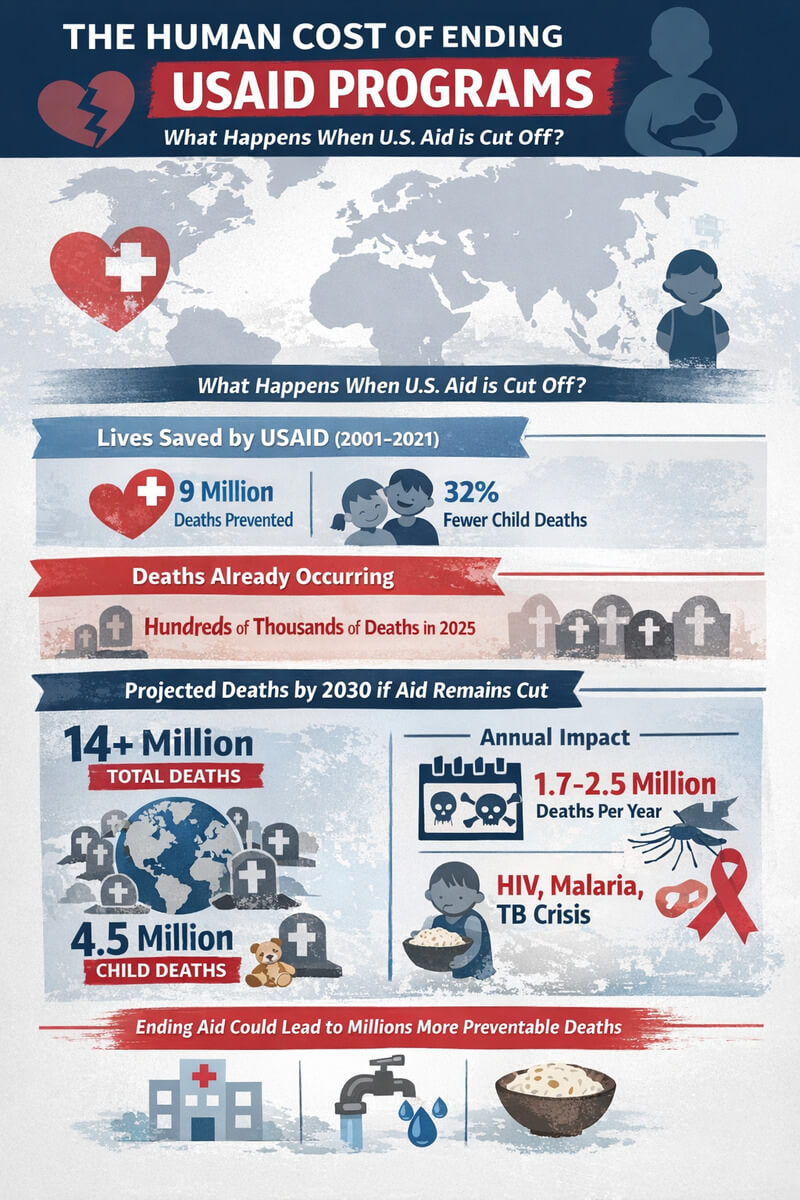
A landmark study published in The Lancet found that between 2001 and 2021, USAID-supported programs prevented an estimated 91 million deaths in low- and middle-income countries — about 30 million of them children.
Researchers linked USAID funding to a 15 percent drop in all-cause mortality and a 32 percent drop in deaths among children under five.
In the countries it supported most heavily, deaths from HIV/AIDS fell by 74 percent, malaria by 53 percent, and other tropical diseases by roughly half.
As one of the study's co-authors pointed out, the average American contributed about 17 cents a day — around $64 a year — to fund all of it.
How It Was Destroyed
On Inauguration Day 2025, the administration paused all foreign aid for 90 days.
Within weeks, Elon Musk's Department of Government Efficiency (DOGE) had canceled 83 percent of USAID's contracts.
Clinics received "stop-work" letters and shut their doors within days.
Staff were locked out of their email.
By July 1, 2025, the agency was formally erased, its surviving programs folded into a State Department with little expertise in running global health operations.
Former President Barack Obama called the gutting a "travesty."
The World Health Organization's director-general, Tedros Adhanom Ghebreyesus, described it as the greatest disruption to global health finance in memory.
The Deaths That Have Already Happened
The clearest real-time accounting comes from ImpactCounter, a peer-reviewed modeling project built by Boston University global health economist Brooke Nichols and her team.
By the one-year mark in January 2026, the tracker estimated that more than 757,000 people had died as a direct result of the cuts — including over 500,000 children.
That works out to 88 deaths every hour.
The team then froze the death toll counter at that one-year horizon, a quiet acknowledgment that the true toll had become impossible to keep tallying in real time.
The breakdown is its own indictment.


The suspension of PEPFAR, the bipartisan HIV/AIDS program that once kept some 20 million people alive on antiretroviral drugs, is linked to roughly 158,000 adult deaths and 16,000 child deaths.
Terminated funding is tied to an estimated 164,000 additional child deaths from pneumonia, 125,000 from diarrhea, 70,000 more deaths from malaria, and 48,000 from tuberculosis — a disease that has now reclaimed its title as the deadliest infectious illness on the planet.
Some peer-reviewed models put the figure even higher.
A microsimulation published in The Lancet estimated that as many as 1.8 million excess deaths may have occurred in 2025 alone once indirect deaths from malnutrition and collapsing supply chains are counted.
The Center for Global Development landed on a range of 500,000 to more than a million for the year, depending on how the spending is measured.
These Are Real People
Behind every model are individual lives.
Terminated awards had been supporting an estimated 2.3 million people on lifesaving HIV treatment.
In Yemen, U.S. cuts to the World Food Programme ended food assistance for 2.4 million people and stopped nutritional care for 100,000 children.
In Sudan — where more than half the population needs humanitarian aid — the WHO estimates 5 million people may lose access to lifesaving health services.
Dr. Joia Mukherjee of Partners in Health described what this looks like on the ground.
On a recent trip to Sierra Leone, she watched children arrive at the hospital in comas from severe malaria because the testing kits and medicine USAID once supplied were simply gone.
One child went blind from an illness that early treatment would have cured completely.
What Comes Next — and Who's Denying It
The long-term projections are worse. The Lancet team forecasts more than 14 million additional deaths will be added to the death toll by 2030 if the cuts hold, including over 4.5 million children under five — roughly 700,000 extra child deaths every year.
Later analyses reported by outlets like CNN and The Guardian have modeled cumulative death tolls ranging from 9.4 million to as high as 22 million by decade's end as other wealthy nations pull back their own aid budgets rather than filling the gap.
To replace what it destroyed, the State Department rolled out an "America First Global Health Strategy" that ties future aid to bilateral deals and demands recipient countries hand over rapid access to data on emerging disease outbreaks.
In Congress, Senator Brian Schatz has cited more than 360,000 aid-related deaths, and Representatives Brad Sherman and Gregory Meeks have led House Democrats in an investigation into the human cost.
Through all of it, Elon Musk and administration officials have denied that anyone died as a result of the cuts — a claim contradicted by every major modeling effort and by the doctors watching children die in front of them.
These deaths were not a natural disaster.
They were a choice, made in Washington, that can still be reversed.
Restoring even part of this funding would save lives immediately. The people making these decisions know that. Now, so do you.