

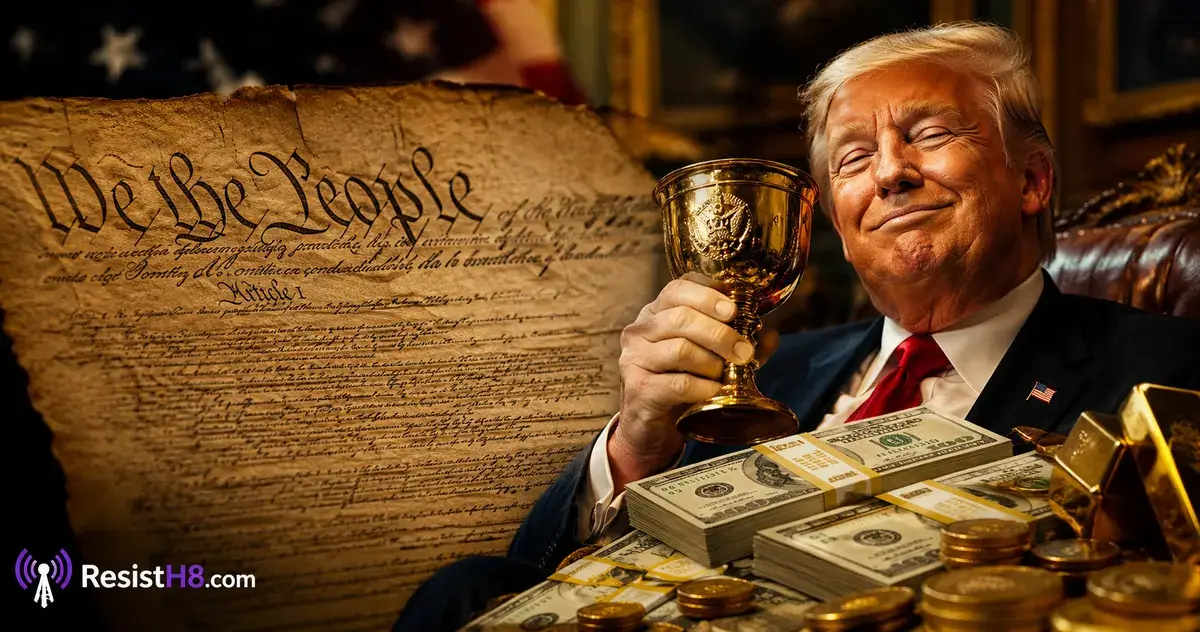

What are the Emoluments Clauses? They were often discussed during Trump’s first term, with lawsuits filed over what some considered violations of the Constitution's prohibition on self-enrichment while in office.
On June 30, 2026, the Office of Government Ethics released Donald Trump's annual financial disclosure. It ran 927 pages and showed that the president pulled in more than $2 billion in 2025 — his first year back in office — with more than $1.4 billion from cryptocurrency ventures alone.
For scale: Barack Obama's final disclosure was eight pages.
Days earlier, Trump took his first flight aboard a roughly $400 million Boeing 747 that the government of Qatar handed to the United States.
Both stories land on the same corner of the Constitution most people have never heard of: the Emoluments Clauses.
Here's what they are, why the Framers wrote them, and why constitutional scholars, ethics watchdogs, and members of Congress say Trump is breaking them on a scale the country has never seen.
What is an "Emolument," and What Does the Constitution Actually Say?
An emolument is an old-fashioned word for a profit, payment, or benefit that comes with holding an office. The Constitution has two separate rules about them.
The Foreign Emoluments Clause (Article I, Section 9) says no federal officeholder may accept "any present, Emolument, Office, or Title" from a king, prince, or foreign state — unless Congress approves it first.
The Domestic Emoluments Clause (Article II, Section 1) locks in the president's salary and bars him from accepting any additional compensation from the federal government or the states while he's in office.
The reason was simple. The Framers had just fought a revolution against a monarchy, and they built these clauses as guardrails against corruption — so a president couldn't be quietly bought by a foreign power.
So Congress couldn't buy his loyalty with a raise or a bonus.
The core idea is that the president works for the public, not for the highest bidder.
Why You've Barely Heard About It
For more than two centuries, the clauses sat mostly untested. Most presidents sold off their businesses or set up genuine blind trusts, so courts never had to define exactly what counted as an "emolument."
That changed in Trump's first term. Three lawsuits — CREW v. Trump, Blumenthal v. Trump, and a case brought by Maryland and Washington, D.C. — argued that foreign diplomats booking rooms at the Trump International Hotel amounted to illegal foreign payments.
One court ruled, for the first time in American history, on what "emolument" means, reading it broadly to cover nearly anything of value.
But in January 2021, after Trump left office, the Supreme Court dismissed the cases as moot and erased the lower rulings.
The result: no definitive decision, and the clauses went dormant again.
The Foreign Emoluments Case, Second Term
Trump's second term has produced a much bigger set of concerns — and this time the money is spelled out in his own filing.
Crypto. The Trump family owns a majority stake in World Liberty Financial, a crypto company, and pockets roughly 75% of the proceeds from its token sales.
Four days before Trump's inauguration, a firm tied to the United Arab Emirates' national security chief agreed to a $500 million investment in the venture, routing an estimated $187 million straight to Trump family entities.
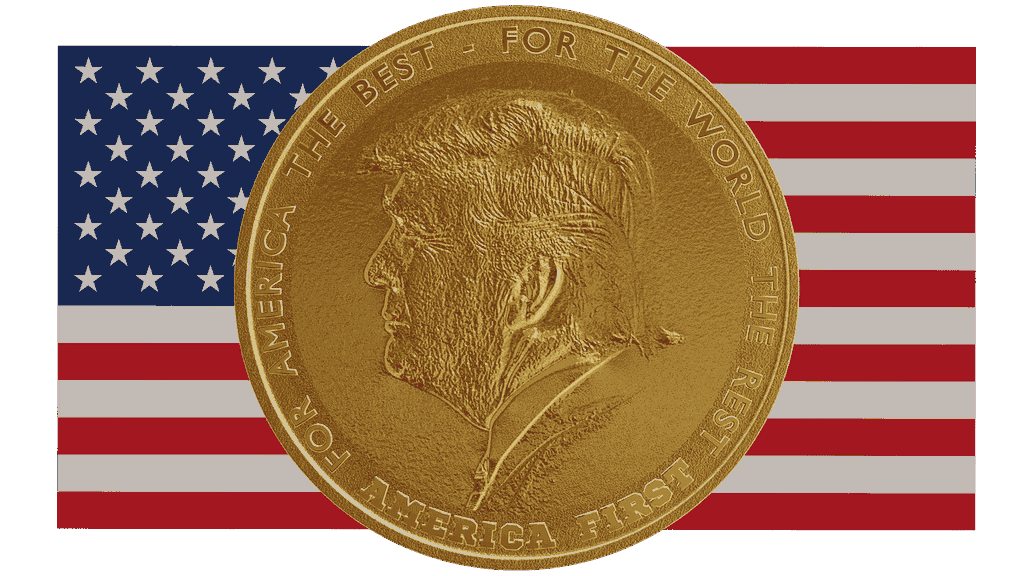
The same Emirati network later used World Liberty's "stablecoin" to settle a $2 billion deal — right around the time the administration reversed export controls to ship advanced AI chips to a UAE company that U.S. officials had flagged as a security risk.
Trump also promoted a memecoin bearing his name and, per the new filing, banked $635 million in royalties from a related coin business.



Because a foreign buyer can grab these tokens anonymously through an exchange, watchdogs warn the clause becomes nearly impossible to enforce: a foreign government can enrich the president without ever leaving a paper trail.
Foreign real estate. Unlike his first term, Trump has kept signing overseas licensing deals. The filing lists $52 million from licensing the Trump name to developers abroad, most of it in the Middle East.
The Qatar jet. In May 2025, Qatar offered a luxury 747, valued at around $400 million, to serve as Air Force One.
Lawmakers in both parties called it a textbook Foreign Emoluments violation.
The White House structured it as a gift to the Defense Department, with the plane set to pass to Trump's presidential library after he leaves office — a workaround the president's lawyers signed off on.
Trump said only a fool would refuse it and flew on it for the first time days before July 4.

The Domestic Emoluments Case
The domestic ban gets less attention, but Rep. Jamie Raskin and other Democrats argue Trump is testing it too. In January, Trump personally sued the IRS for at least $10 billion — meaning his own administration could approve an enormous payout to him from the Treasury.
When the judge asked for more information about the lawsuit, his lawyers moved quickly to settle it. Instead of Trump receiving $10 billion, Todd Blanche created a $1.776 billion “weaponization fund” to pay anyone who claimed they had been harmed by the “weaponization of the Biden DOJ,” especially January 6th defendants.
Federal agencies have kept spending at Trump-branded properties, and his investment accounts began buying stock in the private-prison company GEO Group, one of ICE's largest contractors, days after he took office.
What Trump's Team Says
The president distances himself from all of it. He has said that outside funds manage his money, that he doesn't get involved in his personal finances, and that his assets are technically held in a trust run by his children.
The Trump Organization calls the nearly 1,000-page disclosure a model of transparency.
Critics counter that the trust isn't blind — Trump remains the beneficiary, stays in contact with the family members running the ventures, and continues to profit from them in real time.
The Scale, and Whether Anyone Can Stop It
The through-line is size.
Watchdogs estimate Trump's net worth jumped from about $4.3 billion in 2024 to $7.3 billion months into his term. His crypto income alone dwarfed his earnings from real estate and legal settlements combined.

Here's the catch.
The Emoluments Clauses have real force on paper but almost no enforcement mechanism.
The Constitution leaves it largely to Congress to approve or reject foreign payments.
Democrats have introduced resolutions declaring the UAE crypto deal an unconstitutional foreign emolument and demanding that the profits be turned over to the Treasury.
Raskin has filed companion measures on both clauses.
With Trump's party controlling Congress, none is likely to pass.
And no court has ever definitively ruled that the clauses can be enforced against a sitting president.
That's the uncomfortable bottom line.
The Constitution plainly forbids a president from cashing in on his office — foreign or domestic.
Trump's own financial filing shows him doing exactly that, in the open, at a scale the Framers could never have imagined.
Whether anything is done about it is now a political question, not a legal one.