

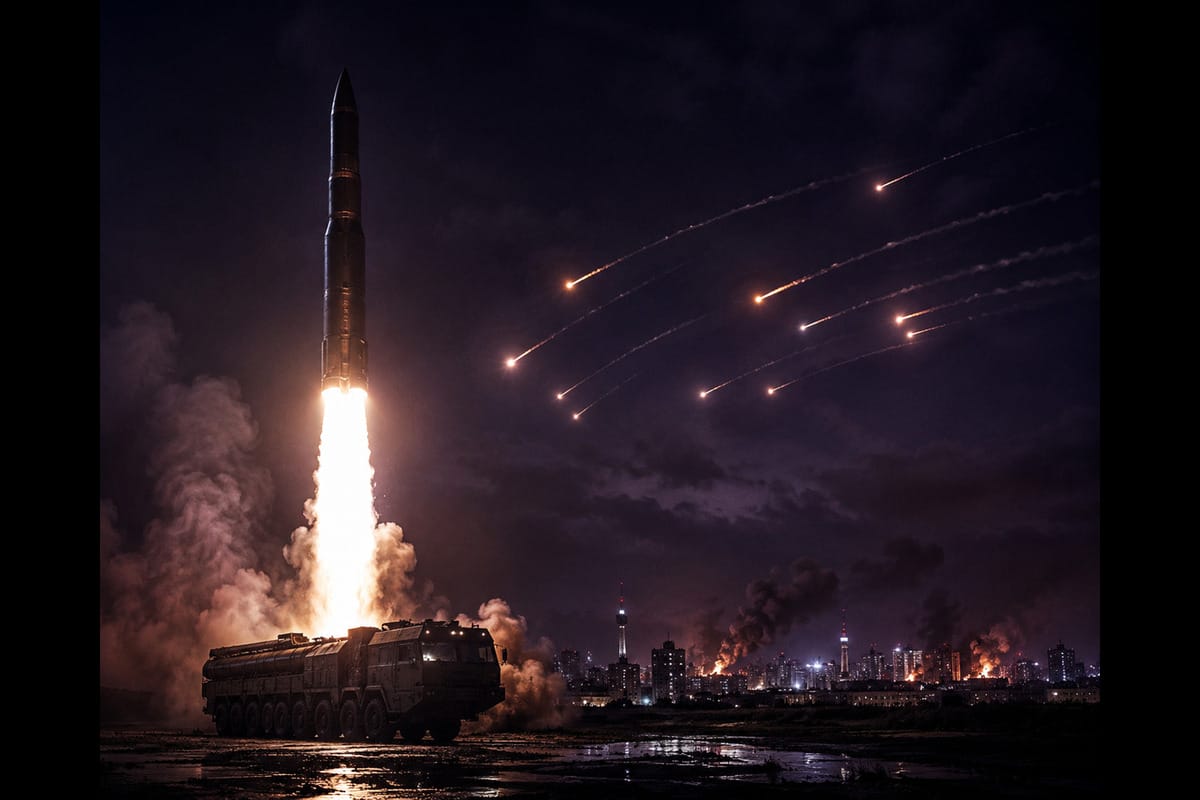

On Sunday morning, May 24, Russia launched a hypersonic Oreshnik ballistic missile — a weapon capable of carrying a nuclear warhead — at the Kyiv region. The Oreshnik struck Bila Tserkva, a city about fifty miles south of the capital. It traveled alongside roughly 90 other missiles and 600 attack drones in what Ukrainian officials called one of the heaviest combined assaults of the four-year war.
At least two people were killed and at least 81 injured, according to Kyiv mayor Vitaliy Klitschko, who said there was damage in "every district of the city." (NPR)
Two weeks ago, Donald Trump told the world he had personally asked Vladimir Putin and Volodymyr Zelenskyy to honor a 72-hour ceasefire from May 9 to May 11. Fighting continued through all 72 hours, though reportedly at reduced intensity. Then Russia hammered Ukraine for three straight days starting May 12. Nine civilians died when a Kyiv apartment block collapsed on May 14.
A Weapon Designed to Terrify
The Oreshnik ballistic missile is not a routine munition. It is an intermediate-range missile that releases multiple independent hypersonic warheads, and Putin has publicly claimed it cannot be intercepted by existing air defenses.
Russia has used it against Ukraine only three times in nearly four years of full-scale war: once on Dnipro in November 2024, once on Lviv in January 2026, and now on Bila Tserkva.
Each deployment is a message, not a military necessity. Russia has thousands of cheaper cruise missiles and Shahed drones that can flatten apartment buildings just as effectively. The Oreshnik nuclear-capable missile exists to remind Europe and Washington what Moscow is willing to escalate.
EU foreign policy chief Kaja Kallas read the message correctly and called it what it is — a political scare tactic and reckless nuclear brinkmanship.
Zelenskyy mocked Putin. “[He] cannot even pronounce the word “hurray” properly anymore — he mumbles — and still hits residential buildings with his missiles. Three Russian missiles aimed at a water supply facility. An Oreshnik at Bila Tserkva. [He’s] truly out of his mind.”
What Was Hit

Russia’s Defense Ministry claims it struck Ukraine’s “military-industrial complex.”
The reality on the ground:
- A school building in Kyiv’s Shevchenko district, with people sheltering inside
- The Foreign Ministry building in central Kyiv
- The National Chernobyl Museum, heavily damaged in the overnight strike
- Residential apartment blocks across every district
- Supermarkets and warehouses
- A water supply facility hit by three separate missiles
This is what Russia’s Defense Ministry means when it says “all designated targets were hit.” A school. A museum dedicated to the worst nuclear disaster in history. Apartments where people were sleeping. The same playbook Russia has run since February 2022 — call civilian infrastructure “military,” call terror “retaliation,” and dare anyone to stop you.
The Manufactured Pretext
Putin justified the attack by blaming Ukraine for a drone strike on a college in Starobilsk, in Russian-occupied eastern Ukraine, where Russia’s Ministry of Emergency Situations claims 21 people were killed and 42 injured on Saturday. Ukraine denies targeting the college.
The pattern is familiar. Russia announces a Ukrainian “terrorist attack” on Russian territory or Russian-occupied territory. Russia then launches massive strikes on Ukrainian cities far from any frontline.
The strikes were already planned — Zelenskyy publicly warned less than 24 hours before the hypersonic Oreshnik missile launch that U.S. and European intelligence had flagged the attack as imminent. The pretext arrives on schedule.
Dmitry Medvedev, the former Russian president now serving as deputy chairman of the Security Council, made no secret of the framing. He posted that the attacks were retaliation for Ukrainian long-range strikes on Russia. The retaliation killed civilians sleeping in their beds in a country Russia invaded.
Europe Steps Up. Washington Goes Quiet.
British Defense Secretary John Healey accelerated UK deliveries of air defense systems after the May 14 strike. European Commission President Ursula von der Leyen announced more EU support for Ukraine’s air defenses after Sunday’s attack, calling Russia’s assault evidence of the Kremlin’s brutality and disregard for both human life and peace negotiations. Poland scrambled fighter jets to protect its airspace during the bombardment.
Ukrainian Foreign Minister Andrii Sybiha asked allies to double down, not back down. He called for additional defense capabilities, full use of frozen Russian assets, an entry ban for Russian combatants, and stronger political decisions on Ukraine’s EU accession.
The conspicuous absence from the response list is the country that spent six months claiming it had the only diplomatic leverage that mattered.
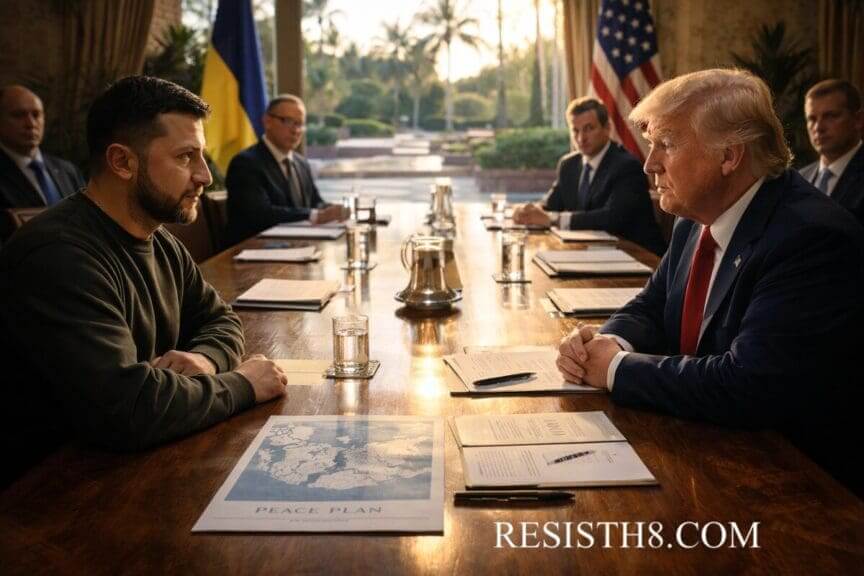
Trump’s “peace process” — the one that demanded Zelenskyy make concessions, the one that produced a 72-hour ceasefire Russia ignored, the one Trump kept insisting was working — has produced exactly this: a nuclear-capable missile in a Kyiv suburb and a museum to nuclear disaster in ruins.
Putin sees no cost. He is calibrating his violence to what he can get away with, and what he can get away with appears to be a lot.
The Pattern Has a Name
Russia has waged this aerial campaign for almost four years. The numbers have climbed steadily — 430 drones and 18 missiles on November 14, 2025; 690 targets on May 24, 2026. Each “largest attack of the war” becomes the baseline for the next one. Each ceasefire produces three days of escalation. Each peace summit produces a new weapon test on a sleeping city.
Ordinary Ukrainians are paying the cost of a war they did not start, dictated by a man who cannot pronounce his own propaganda. The people sheltering in Kyiv’s metro stations on Sunday morning, the parents who got their children to a school basement before the strike hit, the rescuers pulling neighbors from rubble — they are not collateral in a great-power negotiation. They are the point of the negotiation.



Putin is demonstrating, over and over, that civilian lives are the currency he is willing to spend.
The question is whether the rest of the world will keep accepting his price.