

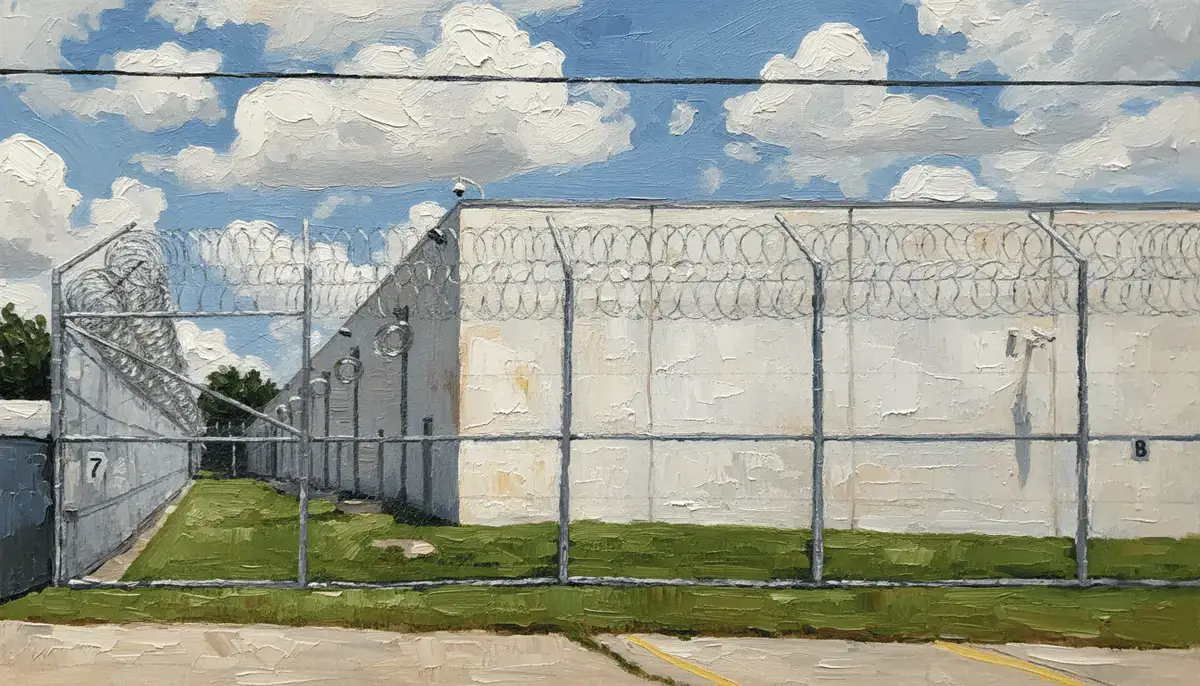

The federal government just spent nearly $1.5 billion taxpayer dollars for two immigration prisons run by CoreCivic in California. CoreCivic and GEO Group are private prison companies that have contracts with ICE.
Days earlier, the public learned that President Donald Trump personally owns stock in CoreCivic — and has been trading it since the first weeks of his second term.
His administration is pursuing the largest expansion of immigrant detention centers in American history.
The president holds a financial stake in a private prison company.
And that company just closed a $1.47 billion sale to the government the president runs.
The deal
CoreCivic announced that the sale closed on July 2.
The federal government purchased the 2,560-bed California City Detention Facility in California City and the 1,994-bed Otay Mesa Detention Center in San Diego, according to the company's SEC filing and reporting by Moneywise.

Here's the thing: CoreCivic isn't going anywhere. The company will keep managing both facilities under its existing ICE contracts.
Taxpayers bought the buildings. The private prison company keeps the business — and says those contract terms may now be renegotiated.
CoreCivic has also confirmed it's in ongoing talks with ICE about selling even more facilities.
Otay Mesa is not just any detention center.
It has been the subject of years of complaints over medical care and conditions, and in 2020 it became the site of the first known COVID-19 death in ICE detention.
The president's portfolio
Trump's 2025 financial disclosure, released roughly a week before the sale closed, revealed that he owns stock in both CoreCivic and GEO Group — the two largest private prison contractors working with ICE.
The timeline is damning.
According to the disclosure, Trump started buying GEO Group shares just ten days after his inauguration.
He first purchased CoreCivic stock in February 2025 and kept trading shares in both companies throughout the year — the same year his administration poured billions into the detention machine those companies operate.
Both companies have profited handsomely.
GEO Group's net income exploded from $31.9 million in 2024 to $254.3 million in 2025.
CoreCivic's full-year income jumped roughly 69 percent to $116.5 million.
Detention, under this administration, is a growth industry — and the president is an investor.
CoreCivic insists there's nothing to see here.
A company spokesperson told Moneywise the facility valuations came through the federal government's standard appraisal process.
But "standard process" is doing a lot of work in a transaction where the buyer's chief executive holds stock in the seller.



A $38 billion buildout — with cracks showing
The California purchases are part of the "ICE Detention Reengineering Initiative," a more than $38 billion federal push to expand detention capacity, with additional properties acquired in Arizona, Pennsylvania, Georgia, and Maryland.
The buildout is already faltering. In June, The New York Times reported that ICE planned to sell or transfer seven of the eleven industrial warehouses it had purchased to convert into detention sites.
The government is buying prisons faster than it can figure out what to do with them.
The human cost of the expansion
Behind every bed count is a person — and people are dying in this system at a rate not seen in a generation.
Human Rights Watch documented 52 deaths in ICE custody between Trump's inauguration and June 4, 2026, as the detained population hit a record high of more than 71,000 people in January.
During the administration's first year, someone died in ICE custody an average of every nine days.
Researchers writing in JAMA found that the fiscal year 2026 death rate is the highest in the 22 years studied — worse than the peak of the COVID-19 pandemic.
These are not statistics.
They are fathers found unresponsive in their bunks, a 19-year-old whose family disputes the official account of his death, an Afghan man who worked alongside the U.S. military and died less than 24 hours after being detained.
Advocates tracking every death warn that 2026 is on pace to break last year's record toll.
Human Rights Watch found the deaths have risen far faster than the detention population itself — meaning the system isn't just bigger, it's deadlier.

Resist Hate has documented ICE detention deaths and the accountability vacuum surrounding them.
Follow the money
Every dollar of that $1.47 billion is public money.
It flowed to a company whose stock sits in the president's portfolio, to expand a detention system where the death rate has reached a 22-year high, under an initiative already shedding properties it can't use.
There is a word for a government purchasing assets from companies its leader personally invests in and it’s not "standard process."