
Amal Khalil knew the south of Lebanon the way a person knows the streets they grew up on. For more than fifteen years, the Al-Akhbar correspondent reported from villages most foreign reporters never set foot in, returning again and again to document Israeli bombings, occupations, and the people trying to survive them.
On Wednesday, April 22, she was killed in Tyre under circumstances that her colleagues, press freedom advocates, and Lebanese officials all describe as a deliberate strike on a journalist taking shelter from Israeli fire.
She was 14 of the journalists Israel has killed in Lebanon since October 2023. According to the Committee to Protect Journalists, as of April 2026, Israel has killed 260 journalists in Gaza. The CPJ maintains an up-to-date timeline of press freedom violations that begins the day the U.S. and Israel attacked Iran. View the CPJ Press Freedom Violation Timeline.
A Double-Tap Strike on the Shelter
Amal Khalil and freelance photojournalist Zeinab Faraj had been covering Israeli attacks on the southern village of Bint Jbeil. According to a timeline published by Al-Akhbar, an Israeli drone struck the car traveling in front of theirs at 2:45 p.m., killing the two men inside. The two women ran for cover in a nearby house.
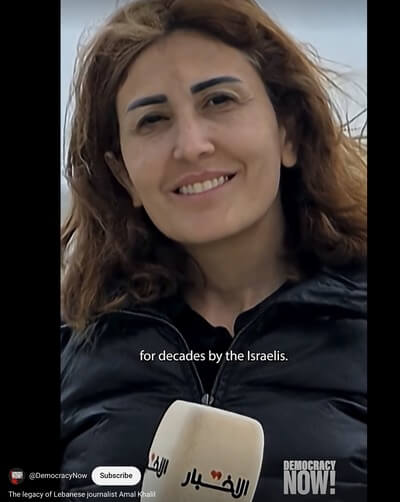
Five minutes later, Khalil reached out to her editors and her family to tell them she was alive but trapped. Word spread quickly. Lebanese President Joseph Aoun publicly called on the Red Cross, the Lebanese Army, and the United Nations to coordinate a rescue.
At 4:27 p.m. — roughly an hour and a half after the journalists had taken shelter — the Israeli military bombed the very house where they were hiding. Communication with both women cut out.
What happened next is, in many ways, the part that should haunt anyone reading this. Israel refused to grant access to rescuers. A Lebanese military official told Al Jazeera that the obstruction was deliberate. When the Red Cross was finally allowed in under limited conditions, they came under active fire.
They managed to evacuate Faraj, who was critically wounded with severe head injuries, and to recover the bodies of two other civilians. They were forced to retreat before they could reach Khalil because Israeli forces kept shelling the area and firing directly on rescue crews.
The ambulance carrying Faraj to a hospital in Tubnin was hit by Israeli gunfire, with bullet holes documented in its frame by Lebanon’s National News Agency.
When the Red Cross was finally able to return, Amal Khalil was dead.

The Committee to Protect Journalists called it what it was. Their regional director, Sara Qudah, said the repeated strikes on the same location, the targeting of a shelter where journalists were known to be hiding, and the blocking of medical and humanitarian access amount to a grave breach of international humanitarian law.
Israel did not respond to requests for comment.

“Destined for Death”
Khalil was not killed at random. In September 2024, she received explicit death threats by phone from Gideon Gal Ben Avraham, a media commentator who runs a Middle East analysis YouTube channel, appears on Israeli television, and openly describes himself as a retired military officer who continues to “help” Israeli intelligence.
The messages told her to flee the country “if you want to keep your head on your shoulders” and asked, pointedly, whether her house was “still standing.”
When Drop Site News contacted Ben Avraham on Wednesday — before news of Khalil’s death broke — he confirmed he had sent the 2024 threats and doubled down. “Send greetings to all journalists affiliated with Hezbollah, for anyone who works for the organization should know that they are destined for death,” he wrote.
He clarified that he considered Al-Akhbar to be Hezbollah-affiliated, and that Maronites and Sunnis had nothing to fear — only Shiites associated with the resistance. When asked whether he had been a soldier when he sent the original threats, he answered: “No comment.”
When pressed about Khalil being trapped under rubble created by an Israeli airstrike, he answered: “We don’t share our intel with journalists.”
The boundary between an Israeli military commentator and the Israeli military itself, in moments like this, becomes very thin.
A Pattern, Not an Incident
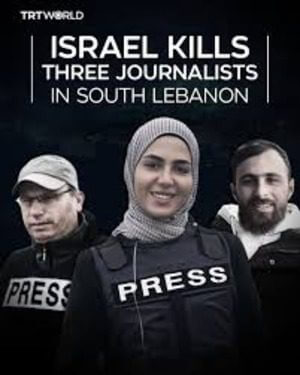
Less than a month before Khalil’s death, the Israeli military openly admitted to assassinating Ali Shoeib, a longtime Al-Manar correspondent who had covered southern Lebanon for nearly thirty years.
Israel falsely claimed he was a Hezbollah intelligence operative. In the same March 28 strike, Al-Mayadeen reporter Fatima Ftouni and her brother Mohammed, also a journalist, were killed. Their car — clearly marked with press equipment — was hit multiple times. Ftouni initially survived the first strike and tried to flee on foot. She was killed in a second, targeted strike.
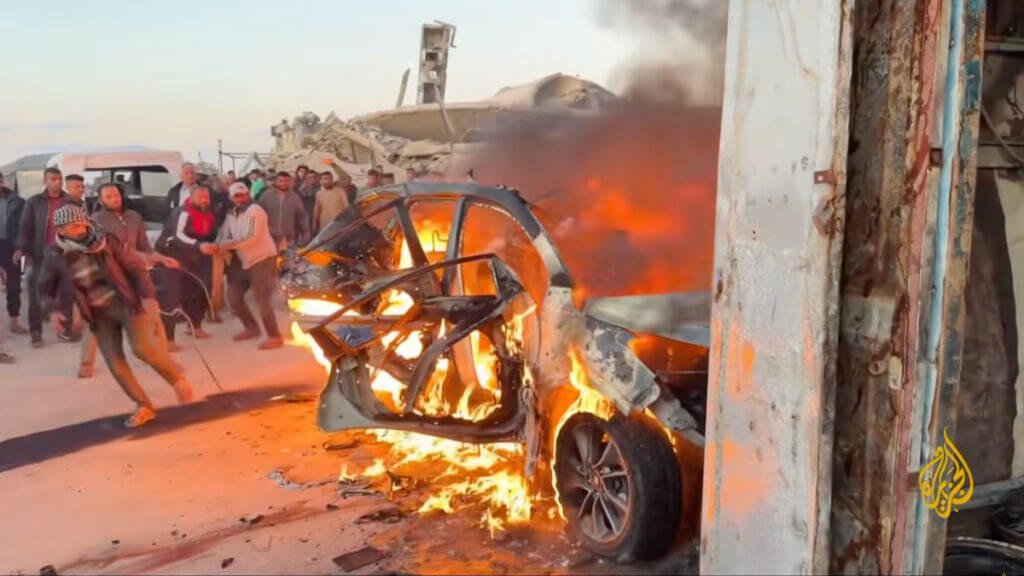
In Gaza, the Israeli military has killed more than 260 Palestinian journalists since October 2023, making it the deadliest war for reporters in modern record. Lebanon has now joined that list at 14.
The pattern is not subtle. Press vehicles. Press vests. Marked rescue vehicles. Houses where reporters have publicly announced they are sheltering. None of it appears to function as protection. In several cases, including this one, it appears to function as a target.


What Khalil Covered
Amal Khalil grew up in Baysariyyeh, a coastal town in the Saida district about a 45-minute drive from the Israeli border. She was Al-Akhbar’s “correspondent of the south” — the person sent in when others wouldn’t or couldn’t go.
She covered Israel’s wars on Lebanon, the families displaced by them, and the slow, grinding occupation of border villages that rarely makes it into Western coverage.
Al-Akhbar, founded in 2006, identifies itself as a secular, independent progressive outlet, though it is widely understood to be sympathetic to Hezbollah and the broader Shiite resistance — a political reality that does not, under any reading of international law, make its journalists legitimate military targets.
Khalil was a witness. That is what journalists are supposed to be. She spent nearly her entire adult career making sure that what happened to people in southern Lebanon would be on the record somewhere, in some form, for someone to find later.
That is what got her killed.
When governments target journalists — when they bomb their shelters, fire on the ambulances trying to reach them, and openly tell the world that reporters from disfavored outlets are “destined for death” — they are not just killing individual people.
They are trying to close off the future’s view of the present. They are trying to make sure that when the histories of these wars are written, there is no one left who saw what actually happened on the ground.
Amal Khalil already wrote some of those histories. Her byline survives her. So does the question her death leaves behind: what does it mean, in 2026, that a journalist can be bombed into a house, prevented from being rescued, and finished off by sustained shelling — and that the country responsible faces no consequence at all?