
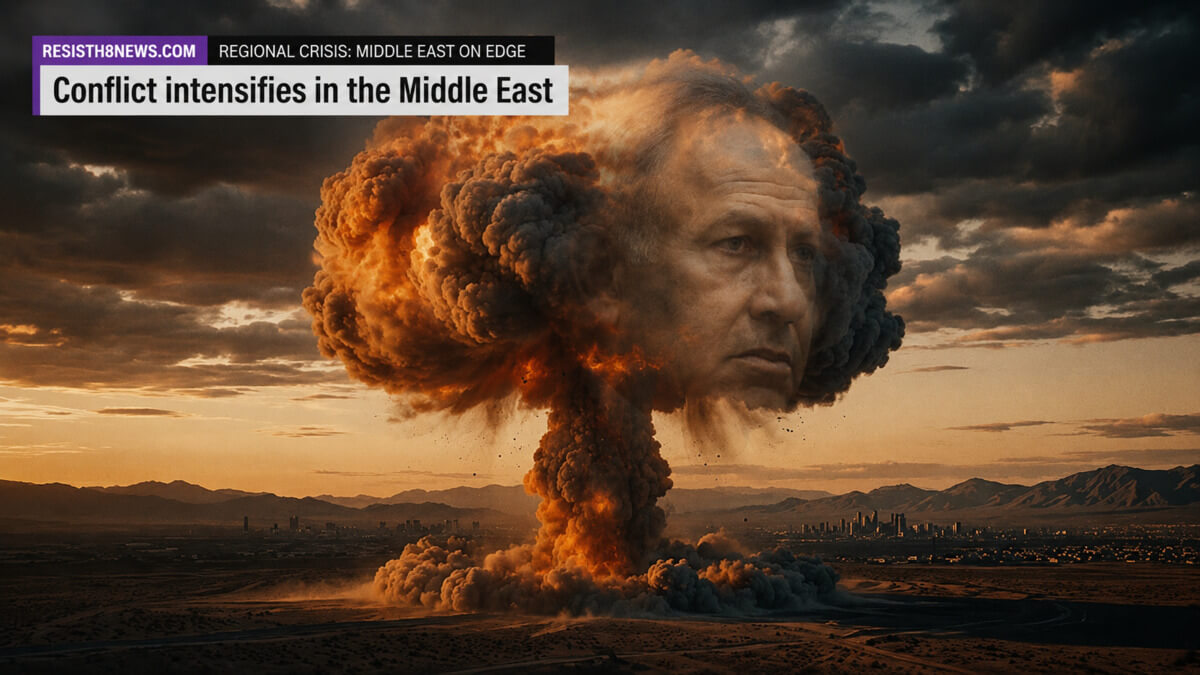

There’s one aspect of the Israel-Iran war that rarely makes the news, even as the conflict drags into its fourth month: only one of these countries has nuclear weapons, and it’s not Iran.
It’s Israel. Our “special ally” has had a nuclear weapons program for decades. And a growing number of analysts now warn that if Israel finds itself cornered — unable to win the war it started — it may consider using them.
That’s the uncomfortable argument journalist Arron Reza Merat made in a recent piece for Jacobin, and it’s worth thinking about, because the conditions he described in March have not improved. They’ve only gotten worse.
A War Israel Can’t Seem to Win

Israel and the United States launched the war against Iran on February 28, 2026, opening with a strike that killed Iran’s supreme leader, Ali Khamenei, and triggered a torrent of retaliatory missile and drone strikes across the region.
The fighting has since killed thousands in Iran and Lebanon, dozens in Israel and the Gulf states, and has displaced millions — including more than a sixth of Lebanon’s population.
Israel saw the distraction caused by the Iran war as the perfect opportunity for the IDF to occupy southern Lebanon. They currently control 60% of the land in Gaza, with Netanyahu ordering the IDF to expand that to 70% in March 2026. That doesn’t include the occupied West Bank.
Now they’re applying “the Gaza model” in Lebanon, according to the government official who said it out loud.
The Israeli military is bulldozing homes — in some cases flattening entire small villages — in preparation for Israeli Settlers’ occupation of southern Lebanon.
Resist Hate brings you the facts you don’t get from watching cable news. We always “bring the receipts” in the form of links to authoritative sources, video evidence, and social media posts with direct quotes.
The video below documents Israel’s ongoing destruction of southern Lebanon.

The destruction of homes in southern Lebanon began after the IDF pushed millions of Lebanese citizens up north and proceeded to bomb every bridge to prevent them from returning to their homes (yes, Israel is fighting Hezbollah, but the targeting of civilian infrastructure and bombing of healthcare facilities makes it clear it’s more about border expansion.
A brief ceasefire between Iran and the U.S. held through April, but has since collapsed. Over the past week, Israel and Iran have traded their worst strikes in months, and as of this week the two sides are again exchanging fire even as both publicly claim they want to step back.

On June 8, Prime Minister Benjamin Netanyahu said he would halt attacks on Iran “for now” — hardly the language of a man confident he’s winning.
That lack of confidence is at the heart of the problem. Despite near-total air superiority over Tehran, the U.S. and Israel haven’t destroyed Iran’s ability to strike back.
Iran’s missiles keep getting through. Merat points to the work of Ted Postol, an MIT professor emeritus and former Pentagon adviser, who argues that Israel’s missile-defense systems have intercepted far fewer incoming missiles than officials claim — a point that is contested by other analysts, but one that fits reality: salvos of Iranian missiles have repeatedly lit up the skies over Tel Aviv.
Defending Israel has also drained American stockpiles. During the 12-day war last summer, the U.S. burned through roughly a quarter of its THAAD interceptors — weapons that are expensive, slow to build, and not easily replaced.
The “Samson Option”
Israel maintains an undeclared arsenal of at least 90 warheads, built quietly with French help and hidden for years from the United States.

Israeli strategists have long referred to it as the “Samson option” — a reference to the biblical figure who pulled down the temple, killing himself along with his enemies.
The doctrine’s logic is bleak: if Israel believes its very existence is at stake, it may bring everything down with it.
A Trump adviser, David Sacks, recently warned that Israel might use a nuclear weapon against Iran.
Merat’s analysis pushes the point further: a victorious Iran could be even more dangerous than a defeated one, because success on the battlefield is exactly what might convince Israeli officials that the country itself is threatened.
And Iran is not without options of its own. Before international inspectors left the country, Iran had stockpiled 440 kilograms of uranium enriched to 60 percent — and US intelligence has assessed that Tehran still has access to it.


Nuclear scientists estimate Iran could assemble several crude bombs within weeks if it chose to. As Postol put it, if Israel goes nuclear, Iran will respond, with or without a finished weapon of its own.
Why This Matters
It’s easy to treat all of this as distant — someone else’s war, some other region.
The United States launched this war beside Israel, and it supplies the interceptors that keep Israeli cities standing,
Behind the strategy and the acronyms are thousands of people who are already dead and millions more who have been displaced.
The nuclear threshold hasn’t been crossed. But the conditions that could push a cornered leader toward the option, have not gone away — and pretending otherwise does’t make anyone safer.
He was right to warn us in March. The danger hasn’t passed. It’s only gotten worse.