
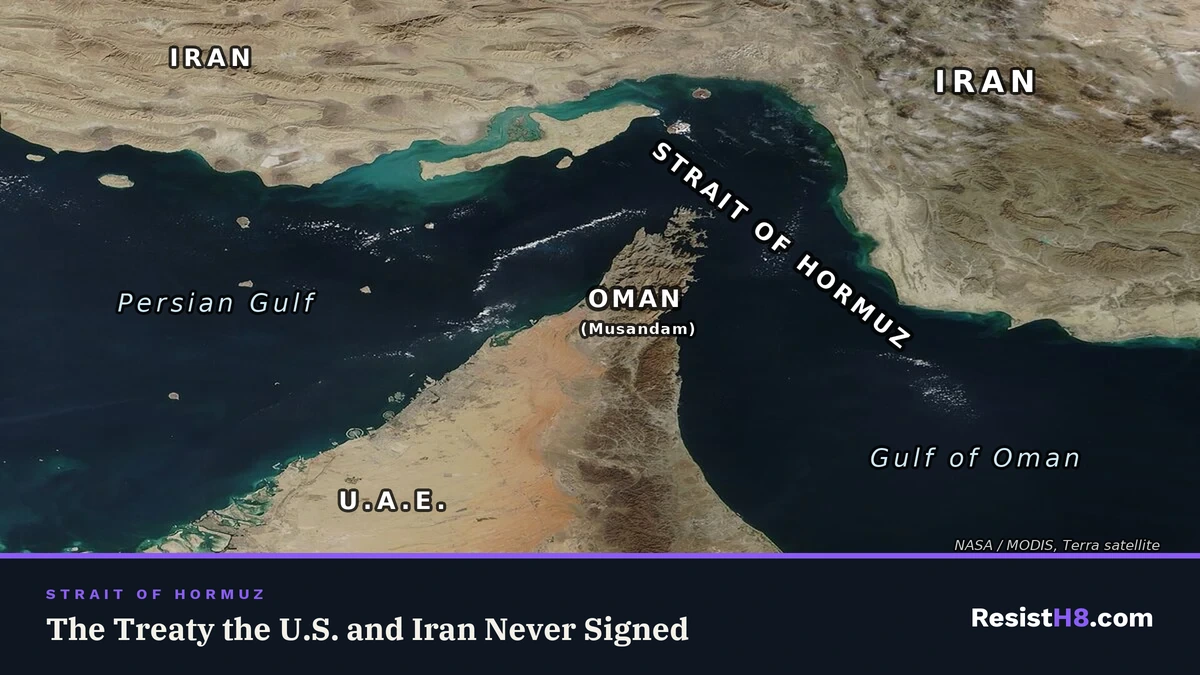

There is a treaty at the center of the fight over the Strait of Hormuz, and almost no one covering the war with Iran mentions it. It's called the United Nations Convention on the Law of the Sea, or UNCLOS.
It was finished in 1982, took effect in 1994, and 171 countries plus the European Union have ratified it.
The United States is not one of them. Neither is Iran.
Oman is.
That single fact — three neighbors on the same waterway, two outside the rulebook and one inside it — explains more about the current crisis than any cable news segment about aircraft carriers.
What UNCLOS Does
Think of UNCLOS as the traffic law for the world's oceans.
It sets how far out a country's waters extend, who owns what fish and oil beneath the seabed, and — critically here — what happens when a country's waters swallow up a shipping lane the whole planet depends on.
That last part was a trade. Before UNCLOS, a country controlled three nautical miles of sea off its coast. Countries wanted more. UNCLOS gave them 12.
But as Chatham House explains, stretching every coastline out to 12 miles closed off roughly 138 straits that used to have a strip of open international water running down the middle.
The Strait of Hormuz is one of them. At its narrowest, it's about 21 nautical miles wide — meaning Iran's waters and Oman's waters meet with nothing left over.
So the deal was: coastal countries get their 12 miles, but they must honor a stronger right called transit passage.
Ships and aircraft of every nation get to move through, continuously and quickly, and the countries on either shore are not allowed to suspend it — not even for national security.
Why the U.S. Walked Away
In July 1982, President Ronald Reagan announced the U.S. would not sign.
He liked the navigation rules fine. What he objected to was Part XI, the section on mining minerals from the deep seabed, which required technology sharing and gave the U.S. no veto on the governing body.
A 1994 side agreement fixed most of those complaints, and Washington signed that.

But the Senate has never ratified the treaty itself. Every president since Reagan has asked it to.
Senators keep reintroducing resolutions urging ratification.
Forty-four years later, it still sits there.
Why Iran Walked Away
Iran signed it in 1982 but never ratified it. And when it signed, it attached a declaration that matters enormously right now: Tehran said transit passage was a bargained-for benefit that only treaty members get to claim, not an existing rule of international custom.
In plain terms, Iran's argument is: you didn't join the club, so you don't get the membership perks.
What non-members get instead is the older, weaker rule — innocent passage, drawn from the 1949 Corfu Channel case and the 1958 Geneva Convention.
Under innocent passage, ships can still pass, but there's no right of overflight, submarines have to surface and show their flag, and the coastal country has far more room to decide a ship isn't behaving "innocently".


Washington's counterargument is that transit passage became binding custom for everyone regardless of who signed.
Iran says it has objected consistently since day one, which under international law can exempt a country from a custom it never accepted.
Legal scholars are genuinely split on this. It is not a settled question.
Oman is the Problem in Iran's Plan
Here's where it falls apart for Tehran.
The shipping lanes — the traffic separation scheme the two countries jointly proposed and the International Maritime Organization adopted in 1968 — sit primarily in Omani territorial waters.
And Oman ratified UNCLOS. It is unambiguously obligated to allow transit passage through its side.
Iran can argue all day about what it owes non-members in Iranian water. It does not argue at all for interfering with ships in Omani water.
Doing so isn't a legal gray zone — it's a violation of another country's sovereignty.

What That Means in 2026
Since the U.S.-Israeli air war began on February 28 and Iranian forces declared the strait closed on March 4, Iran has laid mines, boarded ships, and told the UN that only "non-hostile vessels" coordinating with Tehran may pass.
The Security Council condemned the interference as a threat to international peace and security.
The June 21 memorandum of understanding between Washington and Tehran left the question wide open — free passage for 60 days, then "dialogue" with Oman about the strait's future management, with the U.S. not at the table.
Four days later, Iran struck a Singapore-flagged cargo ship inside Omani waters.
Then came the part that undercut America's own case.
On July 13, President Trump declared the U.S. the "GUARDIAN OF THE HORMUZ STRAIT" and announced a 20% toll on all cargo passing through — a waterway the United States does not border, in waters it does not own, under a treaty it never joined.
Secretary of State Marco Rubio had previously called such tolls a violation of international law.
Analysts noted the obvious: charging for access validates the exact argument Iran had been making.
Trump dropped the toll the next day after Gulf leaders called him.
The People Nobody is Negotiating For
Lost in the sovereignty arguments are the merchant crews.
These are working seafarers — deckhands and engineers from the Philippines, India, Bangladesh, and Ukraine, on months-long contracts, who did not choose a war and cannot leave their ships.
Vessels have been struck, burned, and abandoned in both lanes. Crew members have been killed and left missing.
Others have been stranded aboard anchored ships for months while the IMO's evacuation efforts stalled under fire.
They are not parties to UNCLOS. They are not parties to the memorandum.
They are simply the people stuck where the law ran out.
As of early August, the strait remains effectively closed — roughly 10 transits a day against a normal 88 — while Tehran and Muscat work on a framework that would keep Oman's southern corridor open freely and require Iranian permission in the northern one.
Now you understand what legacy media means when an anchor says, “Iran and Oman are negotiating” in discussions about who controls the Strait of Hormuz.
The treaty everyone is fighting over is still sitting in the U.S. Senate, unratified.