

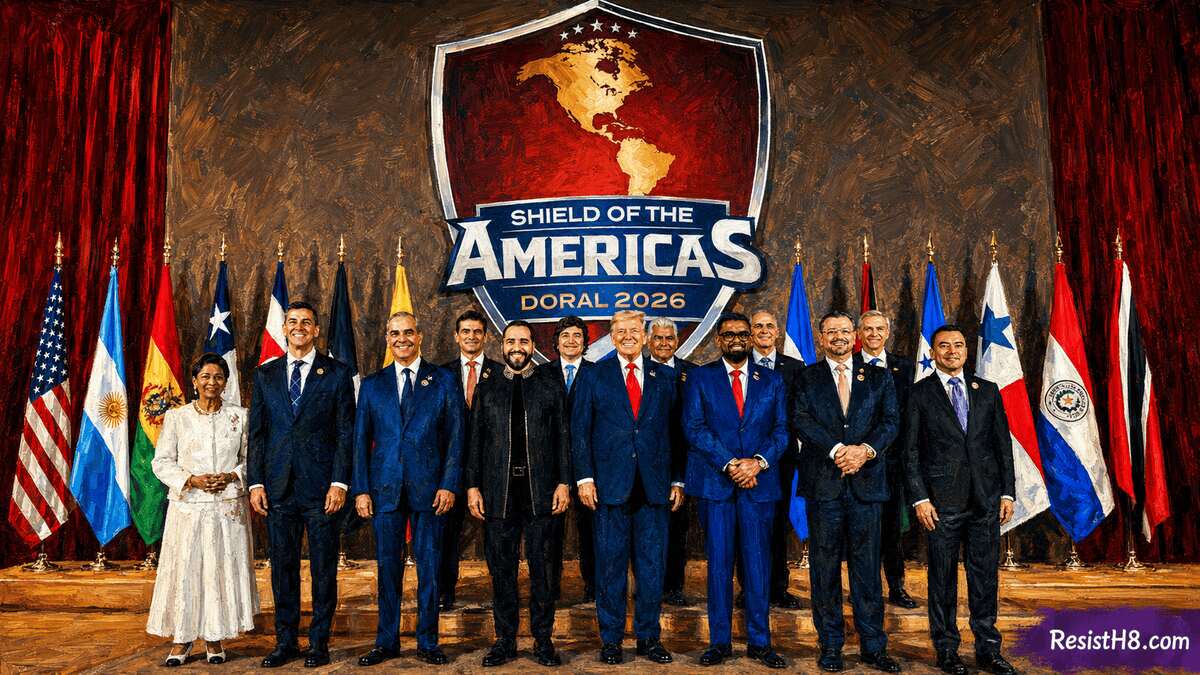

For a year now, the United States has been blowing up boats. More than 200 people are dead.
Most of them were on small, civilian-style vessels in the Caribbean and the eastern Pacific, hundreds of miles from any declared war zone.
The Pentagon calls them "narco-terrorists." It released dramatic explosion videos but nothing else — no tracking data, no cargo analysis, no names.
Southern Command told Congress it can't publicly release how it calculates whether any of this is working, because the mission statement itself is classified.
“Calling an organization a terrorist group does not, by itself, give a president legal authority to kill people.”
Now Trump’s Drug War is Coming ashore.
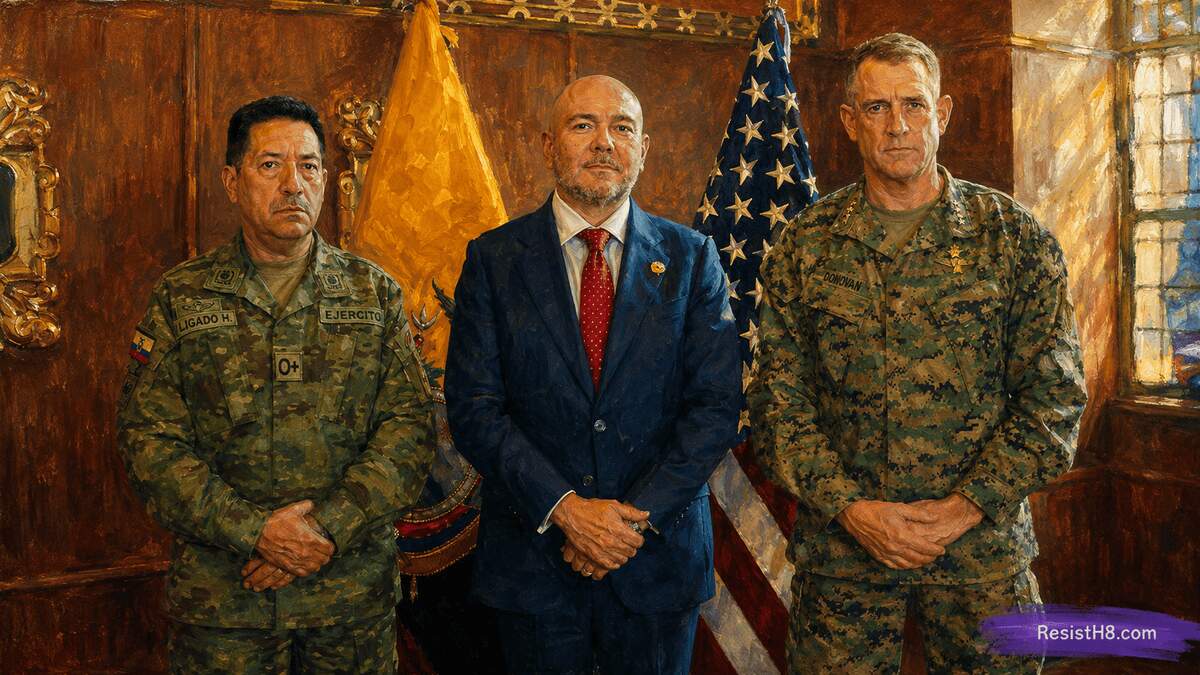
On Aug. 27, U.S. Southern Command chief Gen. Francis L. Donovan sat down with the defense ministers of Colombia and Ecuador in San Lorenzo, a port town on Ecuador's northern border.
The three agreed to significantly expand joint military operations along the Ecuador-Colombia frontier — moving away from occasional one-off missions and toward something permanent.

Retired Army Col. Andrew M. Leonard, who spent 32 years in uniform and served as the top U.S. defense official at the embassy in Mexico, wrote an article in Responsible Statecraft explaining that this shift matters more than the press release suggests.
Under what legal authority?
Four rungs on a ladder
Leonard's description offers the most transparent public account of what "military cooperation" actually means.
Rung one: Training and Equipping American troops teach foreign soldiers and provide them with gear. This is routine, it happens all over the world, and it comes with guardrails — 10 U.S.C. 333 requires human rights vetting under the Leahy Laws and mandates instruction on the laws of war and civilian control of the military.
Rung two: Advise and Assist Longer-term teams are embedded with a partner force.
The U.S. has done this twice before in Latin America — El Salvador in 1984 and Colombia in 2003.
Neither is a particularly comforting precedent.
Rung three: Flipping the Relationship Under 10 U.S.C. 127e, foreign forces stop being students and start acting as the support staff for American special operations.
Leonard points out one crucial catch: 127e is a funding authority, not a war authority. It does’t give anyone permission to deploy U.S. military troops into combat.
Rung four: American Forces Fghting That requires either an act of Congress or a presidential claim to Article II authority.
Under the War Powers Resolution of 1973, Congress must be notified within 48 hours.
The Trump administration spent a year “climbing” this ladder while pretending it's still on the bottom rung.
The paperwork problem
On March 3, 2026, U.S. and Ecuadorian forces launched joint operations under the super subtle name: "Operation Total Extermination," including a coordinated strike inside Ecuadorian territory against the armed group Comandos de la Frontera.
Six days later, President Trump notified Congress —- invoking a provision dealing with the "substantial enlargement" of troops already inside a country, rather than the provision addressing the deployment of American forces into hostilities.
Then on Aug. 7, Ecuador's defense ministry announced Operation "Piraña del Norte" and posted photos of Ecuadorian troops destroying a clandestine facility in Esmeraldas with U.S. support.
As of Leonard's writing, no War Powers Resolution addressing that operation has gone public at all.

Meanwhile, U.S. forces already have boots on the ground with Ecuadorian troops in Esmeraldas — and the precise nature of that cooperation is unknown.
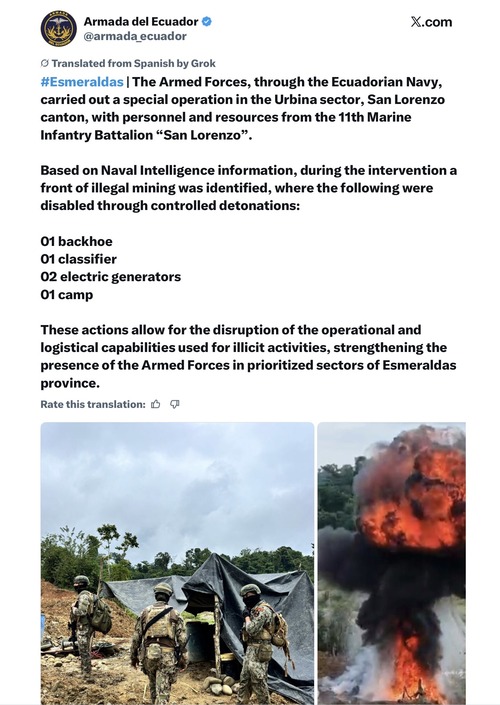
From a blog post on Adamisacson.com:
U.S. military personnel are actively participating in operations in Ecuador, one of the most advanced parts of the Trump administration’s new “joint operations” framework for Latin America military activities. The U.S. military isn’t just equipping and training Latin American counterparts anymore: now, the goal is to be on (or adjacent to) the battlefield as they fight armed criminal groups.
An X post from Ecuador’s Defense Ministry indicates that U.S. personnel accompanied Ecuadorian troops on a mission upriver in Esmeraldas, a province bordering both Colombia and the Pacific Ocean. They found “a clandestine cache” of unclear significance.
"Same effect on land"
Defense Secretary Pete Hegseth wasn’t subtle when he talked about what happens next.
Speaking at a jungle exercise in Panama in mid-August, Hegseth announced that Colombia, Guatemala and Honduras agreed to joint operations on their soil — Guatemala promptly denied it — and promised the same approach used at sea. "Same effect on land," he said.

The "effect" at sea has been more than 200 people killed without charges, no trials, no evidence, and no way for anyone's family to contest any of it.
Transplanting the boat-strike model onto dry land means it stops being boats in open water and starts being houses, villages, and people who live near someone the U.S. has designated.
Colombia's new president, Abelardo de la Espriella, has already prepared the runway.
On Aug. 23 he announced that all illegal armed and criminal groups will be classified and treated as "terrorists" under a new security strategy — a legal reclassification that gives Washington a much wider target list.
Colombia is also set to host a coalition intelligence and operational headquarters in Medellín.
And in Ecuador, all of this is happening despite voters rejecting foreign military bases in a November 2025 referendum.
Bonus section for the “conspiracy” lovers
Pay attention to what’s happening in Ecuador and Colombia, because there are simply too many similarities to ignore.
Daniel Noboa and Abelardo de la Espriella are both extraordinarily wealthy businessmen with deep ties to the United States, particularly South Florida.
Noboa was born in Miami and is a U.S. citizen. De la Espriella is also a U.S. citizen with extensive business and real-estate interests in South Florida. Both have been on the receiving end of praise and support from President Donald Trump.
Both Noboa and de la Espriella received enthusiastic support from President Trump.
After Noboa won a full four-year term in 2025, Trump called him a “great leader.” Trump later endorsed De la Espriella during Colombia’s extraordinarily close 2026 presidential election.
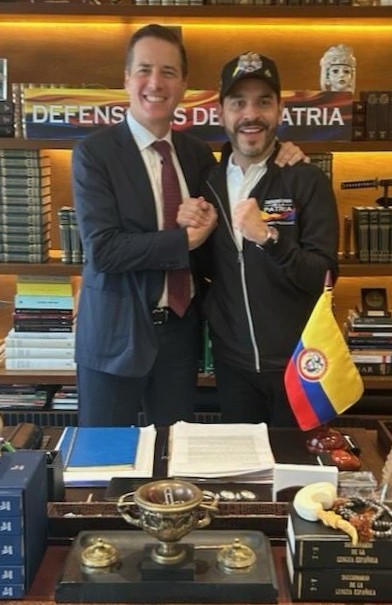
He later celebrated his election “victory” (Trump claims he won every election “in a landslide,” but he only beat Kamala Harris by 1.5 percentage points in 2024.
De la Espriella won by a razor-thin margin. We’re talking less than 1 percentage point — 0.96 of a percentage point to be precise.
All three leaders seem to share some remarkably similar political interests: fighting drug cartels, militarizing the war on drugs, demonizing undocumented immigrants, portraying the political Left as an existential threat, and liberally throwing around words like “terrorists,” “communists” and “Marxists.”
But this gets much more interesting when you look beyond the rhetoric.
Under Noboa, Ecuador has become a key U.S. military partner in Trump’s expanding war against so-called “narco-terrorists.” American and Ecuadorian forces are now conducting joint military operations. U.S. troops have participated in operations inside Ecuador, and U.S. forces are carrying out maritime operations in coordination with Noboa’s government.
Then came Colombia.
Abelardo de la Espriella was inaugurated president on August 7, 2026.
One day later, the Trump administration announced plans to provide his government with $1 billion in security assistance.
Five days after his inauguration, Colombia was welcomed into the U.S.-led Americas Counter-Cartel Coalition as American officials discussed the possibility of joint U.S.-Colombian military strikes against armed groups inside Colombia.
That’s quite a honeymoon.
And there’s another piece of this puzzle that deserves considerably more attention.
Trump has explicitly revived the Monroe Doctrine and even given his version a name: the “Trump Corollary.” His administration says one of its goals is dismantling “narco-terrorist networks all across the Western Hemisphere.”
So we’re not merely watching three wealthy right-wing presidents who happen to use remarkably similar rhetoric.
Both of these leaders look like they belong at Mar-A-Lago, don’t they?President Noboa is channeling Don Jr. in this photo.
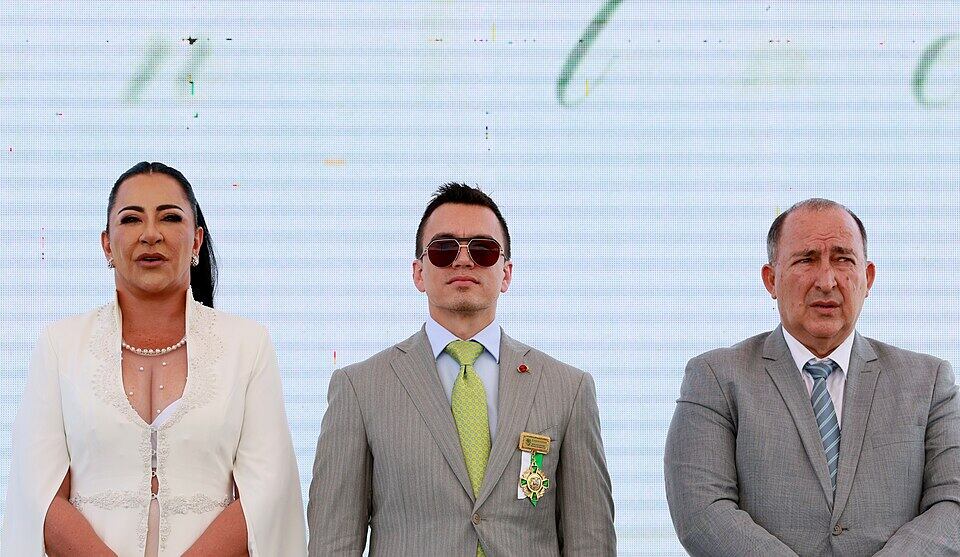
We’re watching an explicitly declared U.S. strategy for the Western Hemisphere take shape while two Trump-friendly governments in South America rapidly deepen their military and security relationships with Washington under the banner of fighting Trump’s Drug War and “narco-terrorism.”
We know this is exciting. It feels like we discovered some super-secret cabal of ped — wait, no, that’s the Epstein files cover-up.
In all seriousness, though. None of this proves corruption or a secret arrangement.
But the speed, timing and similarities are difficult to ignore.
And when enormous sums of money, military operations, political alliances and an expanding U.S. security apparatus all begin converging in the same place, journalists should start to ask questions.
It’s unclear if legacy media will look into these ties and ask Trump or Hegseth the difficult questions. But, if they do, whether or not they share their findings with the American people is another question.
We are going to dig deeper and we will always share anything we discover with you (Unless we're locked up in a foreign gulag and never had the chance to hit publish).
Let us know what you think in the comments. You may see this section pop up again with it’s own headline on the front page
Congress had chances
None of this snuck up on anyone. Sens. Tim Kaine, Adam Schiff, Rand Paul and Chuck Schumer have forced repeated war powers votes since September 2025 — on the boat strikes, on Venezuela, on Cuba.
One measure fell just two votes short.
Another advanced 52-47 before Senate Republicans ultimately blocked it.
The core argument in those resolutions was straightforward: calling an organization a terrorist group does not, by itself, give a president legal authority to kill people.
Republicans said no, repeatedly. So the campaign expanded — from strikes at sea, to the January 2026 capture of Nicolás Maduro, to American boots patrolling a border in the Andes.
Leonard, who isn’t a peace activist, but a career officer writing for the Quincy Institute, ends with a question: will the administration keep leaning on presidential war powers, or will it finally ask Congress?
This administration doesn't have to ask Congress. President Trump has made it this far with needing to go to Congress.
Besides, the Executive Branch has been told, again and again, that it doesn't have to ask Congress for permission. A war nobody voted for is spreading across a hemisphere, one "cooperation framework" at a time — and the people who end up paying for it in blood are the farmers, fishermen, and families in border towns that most Americans couldn't find on a map.