

For decades, Western governments have followed the same exact “script” every time Israel expands settlements in the occupied West Bank.
- Condemn the decision.
- Express “deep concern.”
- Reaffirm support for a two-state solution.
- Urge Israel to reconsider.
- Move on.
- Rinse and repeat.
The script is becoming increasingly difficult to defend as Israel moves forward with the E1 Project — one of the most consequential settlement projects in the history of the occupation.
Plans to build on the so-called E1 area east of Jerusalem have long been internationally condemned. All settlements are illegal under international law.
Yesterday, UK Foreign Secretary Ed Miliband promised what he calls a “comprehensive response” to Israel’s expanding settlements, including the controversial E1 project. The British government is considering measures that could restrict trade and block British businesses from financially supporting settlement activity.
Israel deciding to move forward could be the “straw that broke the camel’s back,” forcing Britain to consider a different strategy: consequences.
If Britain follows through, the shift would be significant.
It would indicate action beyond declaring settlements illegal, while still allowing British money, businesses and trade to stay connected to the system sustaining them.
And E1 may be the project that finally forced the issue.
The E1 project is about far more than housing
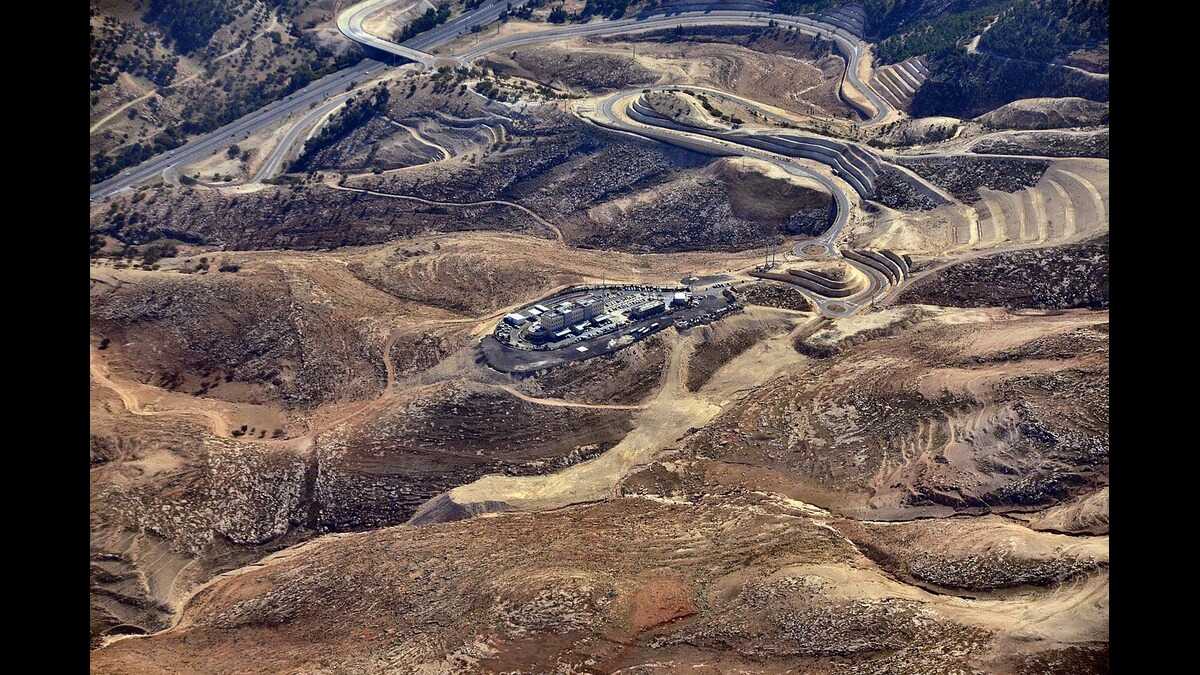
Israel recently published construction tenders for more than 1,200 homes in E1, part of a larger plan for 3,401 settlement units between occupied East Jerusalem and the Israeli settlement of Ma’ale Adumim.
Look at a map and the significance becomes obvious.
The development would in effect divide the West Bank in two and isolate East Jerusalem. It would drive an Israeli-controlled corridor through an area critical to connecting the northern and southern portions of a future Palestinian state while further separating the West Bank from East Jerusalem.
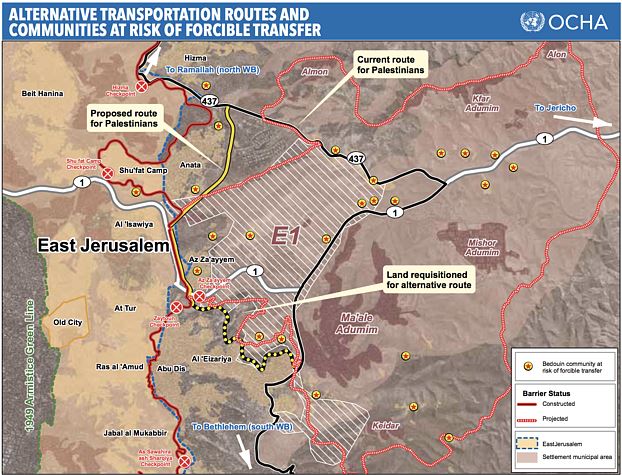
Map of the E1 project area that shows the location, access, road and barrier (United Nations)
Foreign Secretary Miliband warned that it risks separating the West Bank from East Jerusalem, endangering the viability of a two-state solution.
Ahhh.
And therein lies the truth. Israel wants to end the incessant calls for a “two-state solution.”
The E1 Project could be Benjamin Netanyahu’s version of a “Mission Accomplished” moment.
Israeli Finance Minister Bezalel Smotrich made the political objective explicit when the plan was revived in 2025. His office said the development would “bury” the idea of a Palestinian state.
Smotrich told reporters that governments recognizing Palestine would receive Israel’s answer not through diplomatic statements, but through “facts” created on the ground.

That makes the usual diplomatic language about E1 “threatening” the possibility of a two-state solution sound polite, doesn’t it?
Regardless, the position of the United Nations and the overwhelming majority of the international community is clear.
International law is not particularly ambiguous here
UN Security Council Resolution 2334 states that Israeli settlements established in Palestinian territory occupied since 1967, including East Jerusalem, have “no legal validity” and constitute a flagrant violation of international law.
The resolution also instructs countries to distinguish between Israel itself and the territories occupied since 1967 when dealing with anyone in that region.
The International Court of Justice went considerably further in its July 2024 advisory opinion.


The court concluded that Israeli settlements in the West Bank and East Jerusalem are being maintained in violation of international law and found that Israel’s settlement policies, infrastructure and extension of governmental control have helped create irreversible conditions amounting to annexation of large portions of occupied Palestinian territory.
The ICJ said Israel must immediately halt new settlement activity.
Yet settlement construction has accelerated.
A June 2026 UN report found that Israeli authorities had advanced or approved 4,750 housing units in the West Bank, including East Jerusalem, during just one three-month reporting period.
In March alone, Israel’s cabinet approved 34 settlements across Area C, which the UN described as the largest number approved in a single cabinet decision.
Britain itself told the UN Security Council in August that Israel had approved 104 settlements in four years and dramatically increased government funding for settlement construction.
At some point, calling something illegal while doing nothing to stop it, can’t be called “foreign policy.”
Instead, refusing to demand accountability or issue consequences allows illegal activity to continue — with your blessing.
Settlements aren’t appearing on empty land
Settlement expansion is sometimes discussed as though the controversy involves zoning maps, planning boards and housing permits.
Palestinians living there experience something completely different. The UN says settler violence has reached unprecedented levels.

By the end of July, the UN Office for the Coordination of Humanitarian Affairs had documented more than 1,380 settler-related incidents during 2026 affecting more than 250 Palestinian communities.
About 900 Palestinians had been injured, while more than 2,300 had been displaced because of settler attacks and related restrictions on access.
By late August, OCHA reported more than 1,040 Palestinians injured in the context of settler attacks during the year.
The agency said the rate of Palestinians directly injured by settlers had climbed from approximately one person every three days in 2020 to more than three people every day in 2026.
The acts of violence included arson, attacks on homes, destruction of agricultural land, vandalism of water and electricity infrastructure, intimidation, and repeated attacks against some of the same Palestinian communities.
The United Nations has also documented entire communities being driven from their land. Between March and April alone, nine Palestinian communities were completely depopulated following sustained settler violence, bringing the number displaced under similar circumstances since January 2023 to 45.
In the E1 area itself, hundreds of Palestinians living in the Bedouin community of Khan al-Ahmar face the threat of displacement. The UN Human Rights Office warned in May that plans for the area could replace 18 Palestinian communities with Israeli settlers.
That’s why the settlement debate can’t be about houses.
It’s about who is allowed to live on the land, who is forced off of it, and who controls the roads and other infrastructure, like access to clean water, electricity, etc.
It’s also about whether a Palestinian state will ever have enough contiguous territory left to exist.
Britain already knows what it could do
The UK doesn’t have to pull a response out of thin air.
Spain prohibits imports originating from Israeli settlements in occupied Palestinian territory.
The law also treats advertising for settlement goods and services as unlawful. In America, pro-Israel groups hold events in Synogogues where homes in the illegal settlements are sold to Americans. Not only is it legal, but anyone who protests what’s going on inside is smeared as antisemitic for “protesting Jews as they worship” inside. They are vilified on legacy media.
Those groups deserve a tiny bit of credit for coming up with such a diabolical method of both stopping the events from being protested and attacking anyone who dares to dissent.
Norway has proposed legislation that would go further, prohibiting settlement imports and exports along with certain real estate purchases and services connected to settlement construction and property transactions.
Britain has already warned companies not to bid on E1 construction contracts, telling businesses that participation could expose them to legal and reputational consequences, including the risk of becoming involved in serious violations of international law. So far, more than 20 governments have now joined Britain in condemning the E1 project.
The question is whether those warnings will become enforceable policy.
Israel has responded angrily to the possibility of British sanctions. Foreign Minister Gideon Sa’ar has warned that Israel would retaliate if Britain imposed punitive measures over settlement expansion.
But the threat exposes the central contradiction Britain now has to resolve.
If the UK genuinely believes the settlements violate international law, and genuinely believes E1 could destroy the possibility of the Palestinian state Britain says it supports, then continuing business as usual is also a political decision.
Neutrality disappears when one side is gerrymandering the map while everyone else issues statements asking them not to.
Why you should care
The E1 settlement may look like another construction project in a conflict filled with maps, acronyms and diplomatic statements. It’s much larger than that.
Israel’s own far-right leadership has openly presented settlement expansion as a method of preventing Palestinian statehood. At the same time, Palestinian communities are being displaced, settler violence is reaching record levels and international institutions have repeatedly declared the settlement system unlawful.
Britain says it supports a Palestinian state.
It says settlements are illegal.
It says E1 threatens to make that Palestinian state impossible.
Those three statements eventually require a fourth:
What is Britain willing to do about it?
After decades of warnings, condemnations and expressions of concern, another strongly worded statement will not stop bulldozers, houses or roads from changing the landscape.
The changes happening on Palestinian land are becoming permanent.
If Britain intends to defend the international law it repeatedly invokes, the era of merely watching those settlements appear may finally have to end.