
The United States has been at war with Iran since February 28, 2026. U.S. and Israeli strikes killed Supreme Leader Ali Khamenei in the opening hours, a ceasefire broke down over the summer, and the two countries are still fighting over the Strait of Hormuz while peace talks are stalled.
So here's a piece of US-Iran relations history that sounds made up: for the better part of a century, many Iranians saw America as the one Western country that was actually on their side. One of Tehran's most fashionable streets is still known as Jordan, after an American schoolteacher. The city of Tabriz honors a 24-year-old from Nebraska who died defending Iran's first parliament.
That goodwill didn't fade on its own. It was spent in a single week in August 1953, when the CIA, working with British intelligence, overthrew Iran's democratically elected prime minister, Mohammad Mosaddegh. Here's what the friendship looked like before that, and how Washington threw it away.
Why Iranians looked to America
For most of the 1800s and early 1900s, Iran (called Persia in the West until 1935) was squeezed between two empires. Russia pushed down from the north. Britain, guarding its colony in India, pushed in from the south.
In 1907, the two powers carved Iran into spheres of influence without asking the Iranians.
The United States looked different, mostly because it was far away and didn't seem to want anything. The two countries signed a treaty of friendship and commerce in December 1856 promising a "sincere and constant good understanding."
When the Council on Foreign Relations surveyed historians of American foreign policy, they ranked the Iran coup the fourth-worst foreign policy decision in U.S. history.
A 2002 study in Iranian Studies argues that between 1856 and 1921, Iranians came to see America as a sympathetic power, and that when those hopes were crushed later, the letdown turned into much deeper anger.
Americans who built schools, not colonies
The first Americans most Iranians met were Presbyterian missionaries. They came to preach, but their lasting mark was education.
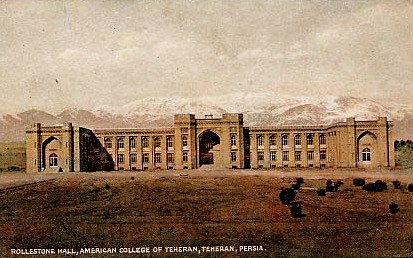
Samuel Jordan, a farm kid from southern Pennsylvania, arrived in Tehran in 1898 and took over a mission boys' school with fewer than 150 elementary students.
Over four decades, he built it into the American College of Tehran, later renamed Alborz, and ran it until 1940. Alborz became Iran's most respected high school, and its graduates include some of the country's best-known scholars and scientists.
Howard Baskerville: The American who died for Iran's democracy
In 1906, Iranians forced their king to accept a constitution and an elected parliament, a first for the Middle East. Two years later, a new shah turned his cannons on that parliament. The northwestern city of Tabriz refused to give in, and royalist troops surrounded it.
Howard Baskerville, a Nebraska-born Princeton graduate, was teaching science and English at the American Memorial School in Tabriz when the siege began. As food ran out and people began starving to death, he joined the constitutionalists.
When American officials pressed him to stay neutral, he reportedly answered that the only difference between him and the people of Tabriz was his birthplace, "and this is not a big difference."
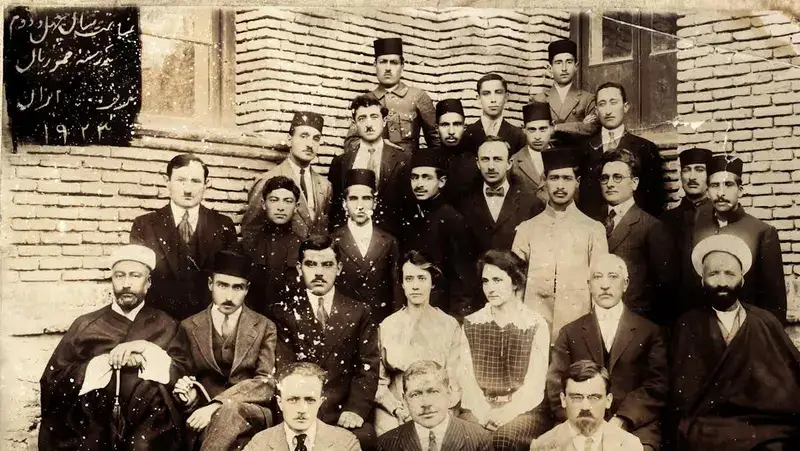
In April 1909, Baskerville led a band of volunteers, many of them his own students, to break the siege lines and bring food into the city. A sniper killed him. He was 24. Iranians still call him the "American Martyr" of their constitutional movement.
Morgan Shuster: Hired by Iran, run out by Russia
In 1910, Iran's new government asked President William Howard Taft for help fixing its broken finances. Taft picked W. Morgan Shuster, a lawyer, who became Iran's treasurer-general in 1911.
Shuster did the unthinkable: he tried to make powerful, well-connected officials pay their taxes, including men under Russia's protection. Russia answered with ultimatums demanding his firing.
Iran's parliament refused. Russian troops already inside the country committed atrocities in Tabriz and advanced toward Tehran.
On December 24, 1911, the regent's cabinet shut down parliament and did what Russia wanted.
Shuster went home and wrote a book with a title that says everything: The Strangling of Persia. The lesson Iranians took from it was simple. When an American stood with them, a European empire crushed him.
"Oh, Dr. Millspaugh!"
In 1922, Iran tried again. Economist Arthur Millspaugh arrived with a team of Americans and a contract that gave him complete charge of Iran's finances, including a veto over government spending.
His power was so sweeping that petitions in Persian newspapers opened with a line straight to the top: "Oh, Allah! Oh, Shah! Oh, Dr. Millspaugh!" He left in 1927 when the government moved to shrink his authority, then came back during World War II.
The trust ran deep. In 1942, Iran's government asked Washington for a long list of American experts: insect specialists, a public health director, irrigation engineers, a teacher for farm machinery, and someone to lead Iran's Boy Scouts.
Iran asked America for a scoutmaster. Eleven years later, America sent Kermit Roosevelt.
World War II and the Soviet standoff
In August 1941, Britain and the Soviet Union invaded Iran and forced out its ruler to protect a supply route to the Soviets. American troops soon arrived to help run it.
At the Tehran Conference in December 1943, Franklin Roosevelt, Winston Churchill, and Joseph Stalin signed a declaration committing to Iran's independence, sovereignty, and territorial integrity.
America's top diplomat in Tehran wrote home that it was the first time the United States had formally and publicly declared an interest in Iran's welfare.
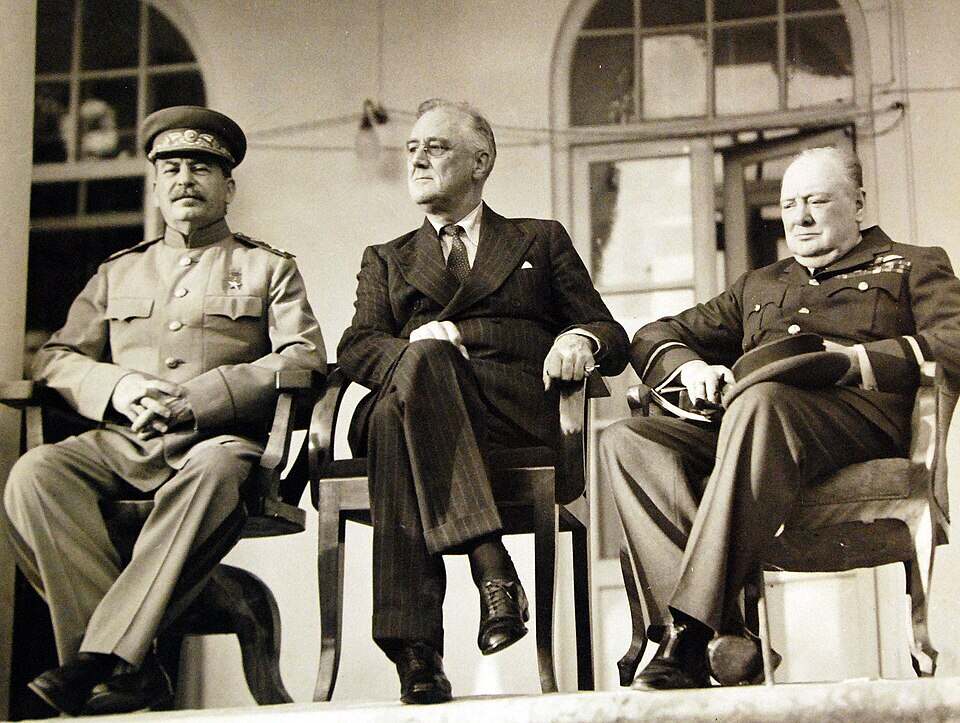
Washington backed that up. When the war ended and Stalin kept Soviet troops in northern Iran past the March 1946 deadline, the U.S. encouraged and supported Iran's complaint at the brand-new United Nations.
Combined with sharp bargaining by Iran's prime minister, the pressure worked. The Soviets pulled out that spring. To many Iranians, America had just stood up for their country against a superpower.
Mosaddegh, oil, and Independence Hall
The one thing Britain still held tight was Iran's oil. The Anglo-Iranian Oil Company, known today as BP, had a monopoly on production and never let Iranian officials see its books. In 1947, the company paid the British government £14.8 million in taxes and paid Iran £7.1 million in royalties.
The British government collected about twice as much from Iran's oil as Iran did.
Mohammad Mosaddegh, a European-educated lawyer and veteran member of parliament, led the fight to change that. A quick note on his title: Iran was a constitutional monarchy, so the shah was head of state, and the elected parliament chose a prime minister to run the government.
In the spring of 1951, parliament voted to nationalize the oil industry, and Mosaddegh became prime minister. Britain answered with a blockade of Iranian oil exports that wrecked the economy.
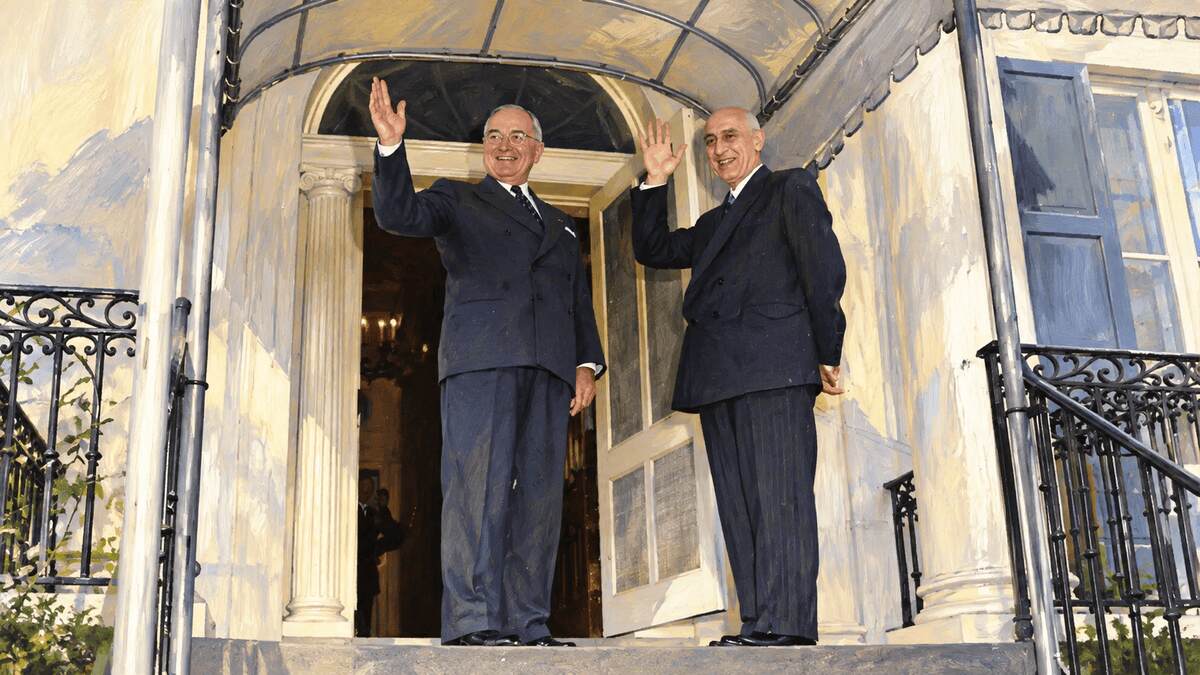
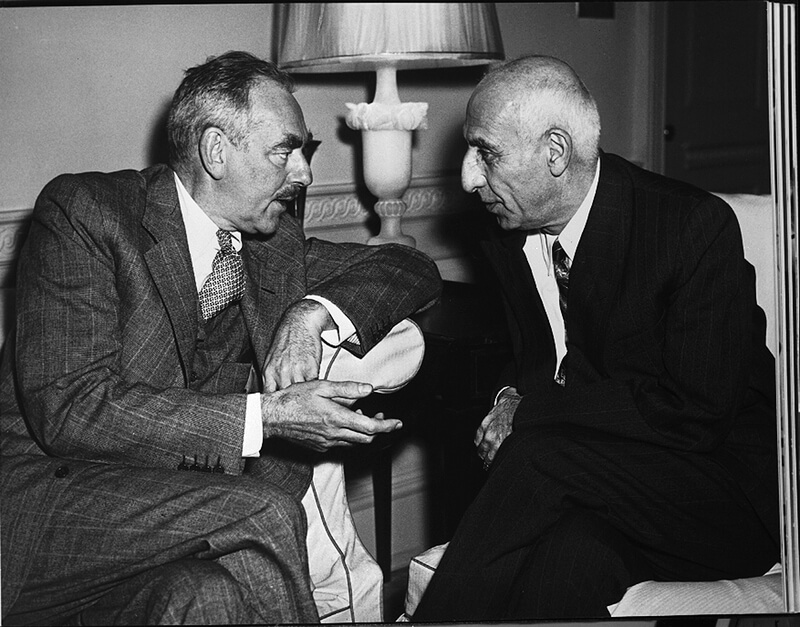
Mosaddegh bet that America would understand. Time named him its Man of the Year for 1951. That fall, he spent six weeks in the United States, defending nationalization at the UN Security Council and meeting President Harry Truman.
Outside Independence Hall in Philadelphia, beside the Liberty Bell, he told Americans that Iran's oil fight was a fight for liberty, the same kind they had waged against Britain.
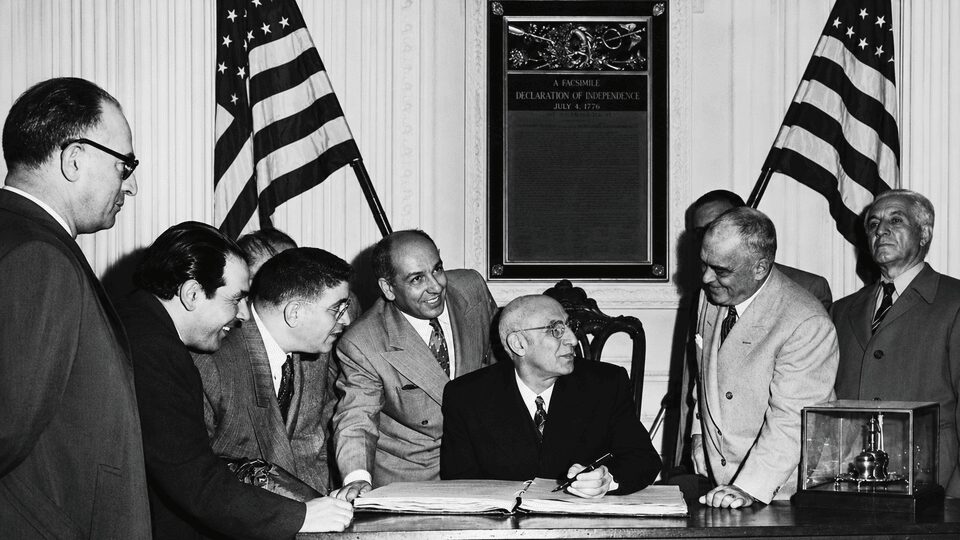
Truman rejected British proposals to invade Iran and tried to broker a deal instead. The talks failed, but Iran still had a friend in the White House.
How a friendship became Operation Ajax
Then the White House changed hands. Dwight Eisenhower took office in January 1953 promising to roll back communism, with John Foster Dulles running the State Department and his brother Allen running the CIA.
British officials pitched Mosaddegh as a doorway to a communist takeover, even though he had kept communists out of his government. As late as March 1953, Eisenhower privately described Mosaddegh as the West's only hope in Iran.
By June, he had approved a joint U.S.-British plan to overthrow him.
The CIA's man on the ground was Kermit Roosevelt Jr., Theodore Roosevelt's grandson. The plan, known as Operation Ajax, was to pay journalists, clerics, and politicians to attack Mosaddegh, pay street gangs to spread chaos, and pressure the young shah into signing a decree firing him.
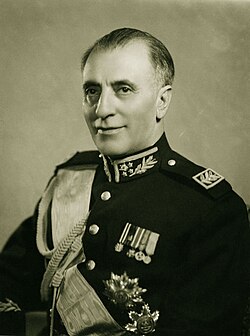
The first attempt, on August 15, flopped. Mosaddegh had been warned, refused to step down, and the shah fled the country for Baghdad and then Rome.
CIA headquarters told Roosevelt to leave Iran. He stayed.
On August 19, paid crowds and army units that had been recruited to the plot poured through Tehran. Roughly 300 people died in the fighting. By nightfall, Mosaddegh had fled his home, and General Fazlollah Zahedi was announced as prime minister. The shah flew home days later.
Was Mosaddegh a perfect Democrat?
No, and honest history says so. He pushed parliament for emergency powers, and in the summer of 1953 he held a referendum to back his government and dissolve parliament that is widely regarded as rigged.
He won 99.4% of the vote. Some scholars, like Ray Takeyh, argue that his Iranian enemies did most of the work and the CIA's role has been overstated.
But the CIA's own internal history says the coup was "carried out under CIA direction as an act of U.S. foreign policy". Iran's young democracy was flawed. It was also Iran's to fix.
The cost of the 1953 coup
Mosaddegh was convicted of treason, served three years in prison, and lived under house arrest until he died in 1967.
His foreign minister, Hossein Fatemi, was arrested, stabbed by a knife-wielding gang while in police custody, and executed by firing squad in 1954, along with more than a dozen military officers and student leaders who had supported his government.
The oil went back to Western companies, with a twist: a new consortium gave American firms a 40% share. The shah ruled as a dictator for the next 26 years, propped up by U.S. aid, U.S. weapons, and a brutal secret police force, SAVAK, trained with CIA help.
In 1979, Iranians overthrew the shah. That November, students stormed the U.S. embassy in Tehran and took American diplomats hostage.
The friendship had turned into open hostility, and the Islamic Republic has invoked 1953 ever since to justify it.
The damage spread beyond Iran. Washington read Ajax as proof that cheap covert operations could remove governments it disliked, and it ran the playbook again in Guatemala in 1954 and Chile in 1973.
When the Council on Foreign Relations surveyed historians of American foreign policy, they ranked the Iran coup the fourth-worst foreign policy decision in U.S. history.
America took decades to admit what it did. In 2009, President Barack Obama told an audience in Cairo that the United States had "played a role in the overthrow of a democratically elected Iranian government."
In 2013, George Washington University's National Security Archive published declassified CIA records that confirmed it in the agency's own words.
This history matters now more than ever
None of this makes Iran's current government a hero. President Masoud Pezeshkian backed the crackdown on Iran's 2026 protests, and the Islamic Republic has a long record of jailing, torturing, and killing its own people for demanding freedom. Remembering 1953 excuses none of it.
What it does explain is why so many Iranians, including people who can't stand their own rulers, don't trust Washington to decide what's best for their country. They've seen what happens when Washington decides it knows best for Iran.
In 1953, it ended with paid mobs, about 300 dead, and 26 years of dictatorship. The same war-hawk thinking our neocons explainer traces from Iraq to Iran still treats Iranian lives as a variable in someone else's strategy.
The friendship before 1953 wasn't built by presidents or oil companies. It was built by a young teacher who died trying to feed a starving city, a lawyer who tried to make the rich pay their taxes, and a missionary who spent 40 years running a school.
It was destroyed by spies, oil money, and a government that decided Iranian democracy was negotiable.
Trust between two peoples takes generations to build. Washington showed in 1953 that it can wreck that trust in a week, and ordinary Iranians have paid the steepest price for it ever since.
Every bomb dropped in this war is writing the next chapter Iranian kids will learn about America.
Follow our ongoing coverage in the Iran war content hub, and read how a treaty neither country signed shapes the fight over the Strait of Hormuz.