
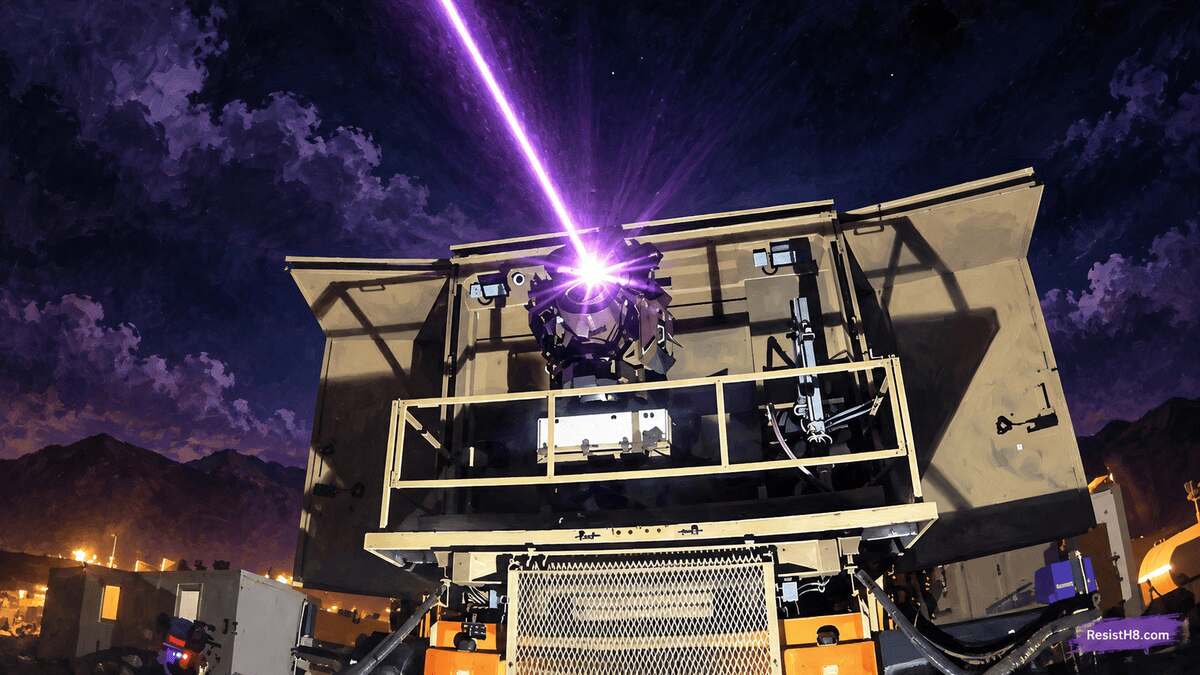

When Israel switched on its Iron Beam laser last December, the headlines practically wrote themselves. A sci-fi weapon that zaps drones and rockets out of the sky, built by Israeli defense giants Rafael and Elbit Systems, held up as proof of Israeli tech genius.
There's one problem with that story. American taxpayers paid for a huge chunk of it.
A new Drop Site News investigation by Ryan Grim and Murtaza Hussain, published Sept. 16, traces both Iron Beam and Israel's Arrow missile-defense system back to U.S. research, U.S. money, and acts of Congress that handed the results to Israel. That history matters right now, because supporters of Section 219 keep pointing to these exact weapons as proof that America gets the better end of the deal.
What Section 219 Would Do
Section 219 is tucked inside the House version of the $1.15 trillion defense bill. It would create a United States-Israel Defense Technology Cooperation Initiative and require the Defense Secretary to name a Pentagon "executive agent" to drive joint weapons research, testing, and production with Israel. The list of covered areas includes missile defense, drones, AI, cyber, quantum computing, and directed-energy weapons like lasers.
The House passed the bill 216-212 on July 22 after the Rules Committee blocked a bipartisan amendment from Reps. Thomas Massie and Ro Khanna to strip the provision. The Senate's version, Section 1217, stalled when a motion to begin debate failed 50-46 on July 14. Sens.
Chris Van Hollen, Bernie Sanders, Elizabeth Warren, Ed Markey, Jeff Merkley, and Peter Welch have demanded a real floor debate, and Van Hollen filed amendments to strike it. Final House-Senate negotiations aren't expected before November or December.
AIPAC calls the provision a critical tool for keeping both militaries ahead. Sen. Tim Sheehy (R-Mont.) went further, arguing in a Fox News op-ed that opposition is a misinformation campaign fueled by antisemitism.
So let's look at the receipts.
Arrow: America's Checkbook, Israel's Product
Arrow started in the late 1980s under Ronald Reagan's "Star Wars" missile-defense push. By fiscal year 2021, Congress had put just over $4 billion into it, and later spending brings the public total to roughly $5 billion. The meter is still running. The Missile Defense Agency's 2026 budget request asks for another $100 million for Arrow 3 components.
On paper, the program was split roughly 50-50. In practice, Drop Site reports, Israel paid much of its half with foreign military financing, which is U.S. aid money.
David Pyne worked as a civilian in the Pentagon office overseeing Arrow 2 in the early 2000s. He told Drop Site that Israel "didn't contribute a dime into the program." What angered him most was that Israel wouldn't share the finished product.
Pyne said he flew to Tel Aviv to negotiate U.S. access to technology American taxpayers had funded, got turned away repeatedly, and ended up signing a lopsided agreement in June 2001.
In his view, that was business as usual for every missile-defense system the two countries built together.
Iron Beam: A U.S. Laser With a New Name

Iron Beam's story starts in 1996. That February, at White Sands Missile Range in New Mexico, a U.S.-managed laser program called Nautilus destroyed a warhead in mid-flight for the first time. Two months later, President Bill Clinton and Israeli Prime Minister Shimon Peres agreed to build a Tactical High-Energy Laser, or THEL, to shoot down Hezbollah rockets.
Congress used the 1999 and 2000 defense bills to lock the program in, and the U.S. had spent more than $100 million by the late 1990s. THEL knocked down dozens of Katyusha rockets in testing, but costs climbed past $300 million and its chemical fuel was toxic and corrosive. The Pentagon killed it in 2005.
The research kept going, though, funded almost entirely by Americans. In 2019, Rep. Ted Lieu (D-Calif.) introduced the United States-Israel Directed Energy Cooperation Act, which became law through the next year's defense bill and named THEL as its model.
A former Pentagon contractor on the project told Drop Site that THEL turned into Iron Beam. Then in April 2024, Congress approved $1.2 billion specifically for Iron Beam inside a $5.2 billion Israeli missile-defense package.
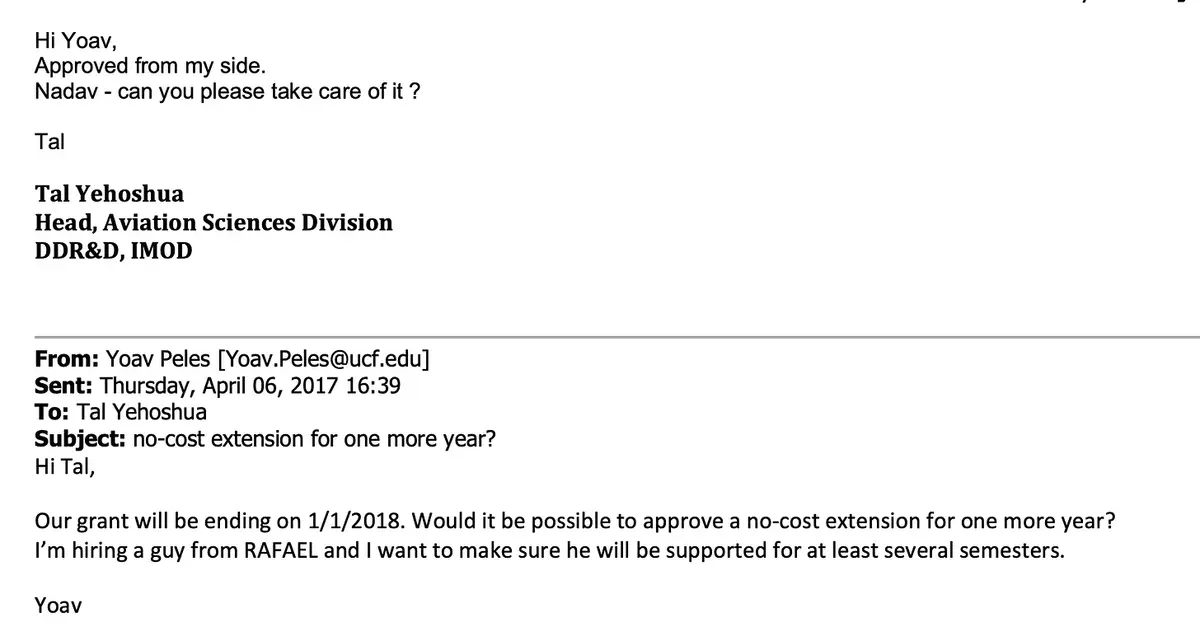
American universities pitched in too. Volunteers with The Anti-War Initiative traced Rafael engineer Anatoly Parahovnik to the University of Central Florida, where he started in 2017 working on a cooling problem Rafael needed solved.
A 2020 paper he co-authored says the work was funded mainly by the U.S. Office of Naval Research. Mila Halgren's reporting for Responsible Statecraft surfaced an email showing Israel's Defense Ministry paid for his university position.
It's part of a broader pattern of Israel tapping elite U.S. research labs.
Rafael, which the Israeli government owns outright, controls the intellectual property and collects the applause. It did not respond to Drop Site's request for comment.
The Warnings Congress Ignored
None of this was a secret inside the government. A 1999 Defense Intelligence Agency report found that Rafael had obtained restricted U.S. laser technology from contractor TRW in 1996, and that Israel was passing technology to China while hiding it from Washington.



The former contractor told Drop Site that intelligence analysts refused to sign off on sharing program details, warning the tech would end up in Chinese hands. They even brought Israeli sales brochures to meetings as evidence. Pentagon leadership overrode them anyway, because Congress had ordered the transfers.
Lobbying helped keep those orders coming. Rafael and Israel's Defense Ministry spent more than $4.4 million lobbying Washington between 1997 and 2001. After 2001, Rafael stopped registering as a foreign agent and switched to ordinary lobbying disclosures, which reveal far less, even though it's a state-owned company.
Why Every Taxpayer Should Care
Section 219's defenders say the partnership pays America back. The paper trail shows money and know-how flowing the other way: the U.S. funds the breakthroughs, Israel owns them, and our own intelligence warnings get waved off because Congress said so.
It also means American dollars keep building weapons for a government whose forces have killed tens of thousands of civilians, as Israel showcased Iron Beam during its recent war in Lebanon. And the laser isn't a miracle fix. It struggles in bad weather and needs a steady lock on a moving target.
Even analysts who think critics overstate Section 219 see a real gap. The Stimson Center points out that these cooperative projects have long run without adequate safeguards, oversight, or accountability. Section 219 would pour more money into that same leaky system.
Opposition is crossing party lines. Sen. Bernie Moreno (R-Ohio) told Drop Site he doesn't think the U.S. should merge its military "with anybody, not even the Bahamas."