
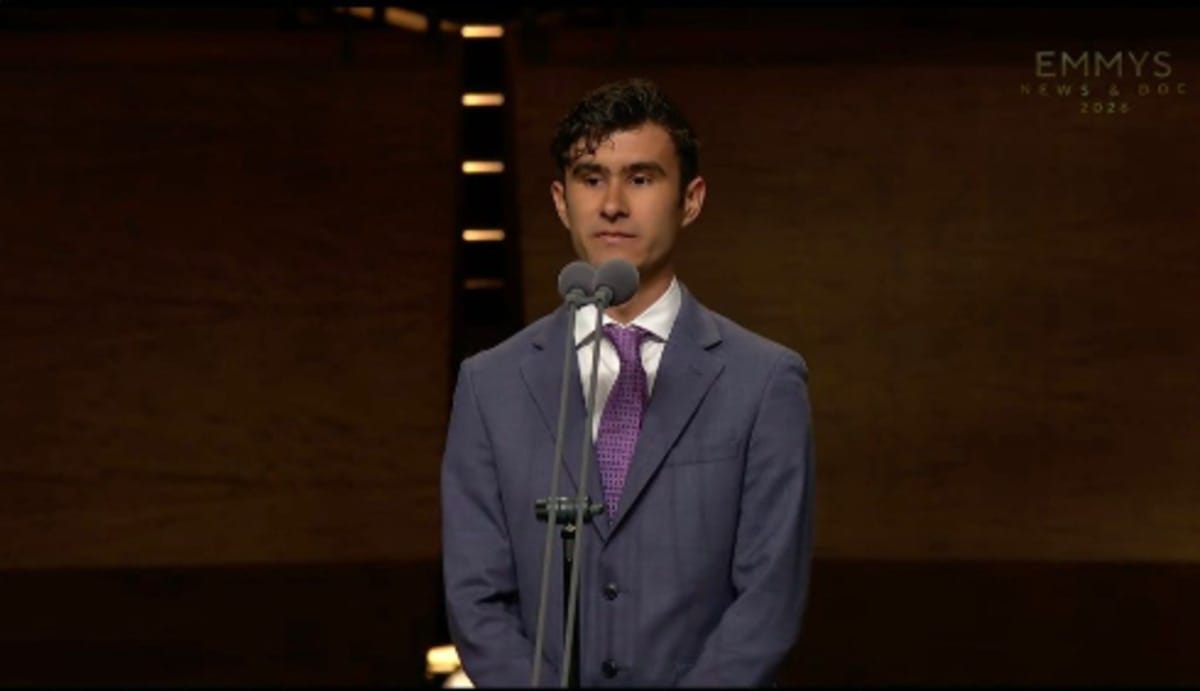

A high school senior from Washington, D.C. walked onto a News and Documentary Emmys stage in New York Wednesday night, accepted a $10,000 scholarship funded by CBS News, and then — in front of the assembled industry — told the network that what it has become disgraces the man the scholarship is named after.
His name is Santiago Campos. He is a kid. He just won the Mike Wallace Memorial Scholarship for a documentary about his own family’s deportation. And he used that microphone to do what most of the adults in that room have not done: he named the rot.
“While I want to thank CBS News for funding this generous gift towards my education,” Campos said, “I want to also acknowledge how the recent direction of the outlet stains the legacy of Mike Wallace.”
The room broke into loud applause. They knew exactly what he meant.
What he said
Campos didn’t soften it. He didn’t bury his point in pleasantries. He laid out his thoughts in plain sentences a high schooler could write because a high schooler did write them:
“As corporate elites take hold over the very pipes through which our information flows, journalism that serves the people becomes increasingly harder to come by, yet ever more crucial. And what the people want is the truth.”
Then he closed with the line that should haunt every news executive watching:
“So if at any time you hesitate to utter the word genocide, or remain silent in the face of blatant lies, remember to ask yourself, who is this for? I hope you choose us.”
Genocide. He used the word a teenager apparently has more courage to say into a network microphone than the network itself does.
His winning submission was the kind of journalism CBS used to be famous for: a documentary called “My Family’s Deportation Story,” produced through PBS News Student Reporting Labs, drawing on the deportations of his own relatives. He has also written about the long history of mass deportation in Teen Vogue.
This is a young person who understands, intimately, what it means when a federal government decides your family doesn’t belong here. And he stood up at the Emmys and told the people running American television that he sees what they are doing.
The killed segment that explains everything
To understand why his speech detonated in that room, you have to understand what CBS just did to Sharyn Alfonsi.
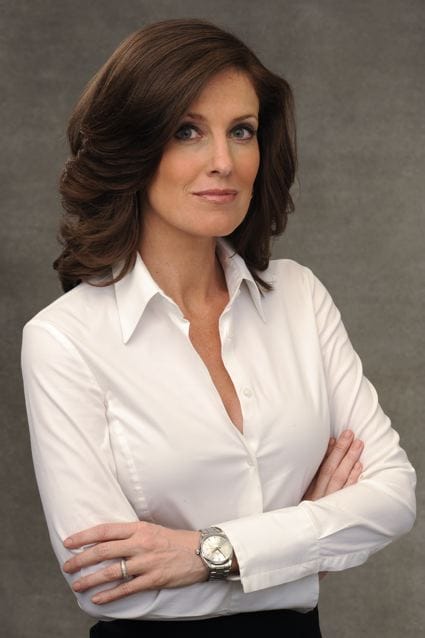
Alfonsi is a “60 Minutes” correspondent — a serious one, by every measure. She reported and anchored a segment called “Inside CECOT,” investigating abuse at the notorious Salvadoran mega-prison where the Trump administration unconstitutionally shipped nearly 300 migrants. That prison is one of the most important immigration accountability stories in the country. It is exactly the kind of work that justifies the existence of broadcast journalism.
In December, CBS News editor-in-chief Bari Weiss — installed at the network in October 2025 after the Trump administration approved the Paramount-Skydance merger handing the company to pro-Trump billionaire David Ellison — pulled the segment. She demanded it be re-edited to include the Trump administration’s perspective on its own black-site deportations. Alfonsi pushed back publicly.
This week, CBS quietly declined to renew her contract. She is now an at-will employee with no offer for the fall season. In her statement Wednesday, Alfonsi refused to let them call it routine: it was, she said, a deliberate choice to punish a journalist for refusing to sanitize accurate reporting, and a chilling signal to the rest of the newsroom.
“The wall between editorial independence and corporate interest at CBS,” she wrote, “is being methodically torn down.”
The award Campos accepted was presented by Scott Pelley, the longtime “60 Minutes” correspondent who has himself spoken out against Weiss’s installation. Pelley made a point of acknowledging Alfonsi in the audience. So when Campos took the mic and named what was happening, he was speaking to a room that included the journalists CBS is in the process of pushing out, in front of cameras, on a stage CBS itself was paying for.
You could not write a more perfect scene if you tried.
This is not a media-industry story. It is a civil rights story.

Stay with me here, because it would be easy to file this under “corporate media intrigue” and move on.
Don’t.
What’s happening at CBS is the visible end of a much bigger machine. In July 2025, the Trump administration approved Skydance’s takeover of Paramount, the parent company of CBS. The new chief executive, David Ellison, is openly aligned with Trump.
Within weeks of installing Weiss as editor-in-chief, the network gutted its climate team and brought in a new foreign editor more aligned with her pro-Israel agenda. The CECOT segment got killed. Alfonsi got pushed out. And similar pressure campaigns — threats to NBC, NPR, PBS, local broadcasters — are unfolding in parallel.
This is what state capture of a free press looks like in real time. It does not require the government to censor anyone. It requires the government to bless the corporate transactions that put compliant owners in charge of the megaphones. The owners then handle the censoring themselves and call it modernization.

The stories that get killed are not random. The CECOT segment was killed because it documented what is being done to deported migrants. Climate coverage was gutted because the new owners have political reasons to hide it. The “genocide” word Campos called out is not being said because saying it would embarrass an administration that has spent two years arming and protecting the people committing it.
The people who pay the cost when a network goes quiet are not the network executives. They are the families like Campos’s, whose deportations happen in the dark when no national correspondent is filming. They are the men inside CECOT, whose abuse Alfonsi was about to show the American people.
They are the Palestinians in Gaza whose deaths the word “genocide” actually describes. When the corporate pipes get clogged with administration-friendly framing, those are the people who disappear from the conversation.



What Campos understood
Watch the video. The most striking thing isn’t the courage. It’s the clarity.

He is seventeen, maybe eighteen years old. He has clearly thought hard about what journalism is for. He is not asking CBS to be a partisan outlet. He is asking it to do the thing it claims to do. He told them what the people want is the truth, and asked them which side they are choosing.
The people in that room applauded loudly because they know the answer. They know what’s happening to their colleagues. They know what was on the cutting-room floor of “Inside CECOT.” They know that the line about hesitating to say genocide is not abstract.
They also know that Campos got to say all of this because he is not yet on the inside. He has no contract to renew. He has no executive to please. He is a young person whose family lived through what CBS is now afraid to fully report on, standing in a suit at the Emmys saying it out loud.
The grown-ups in that room should be ashamed it had to be him.