

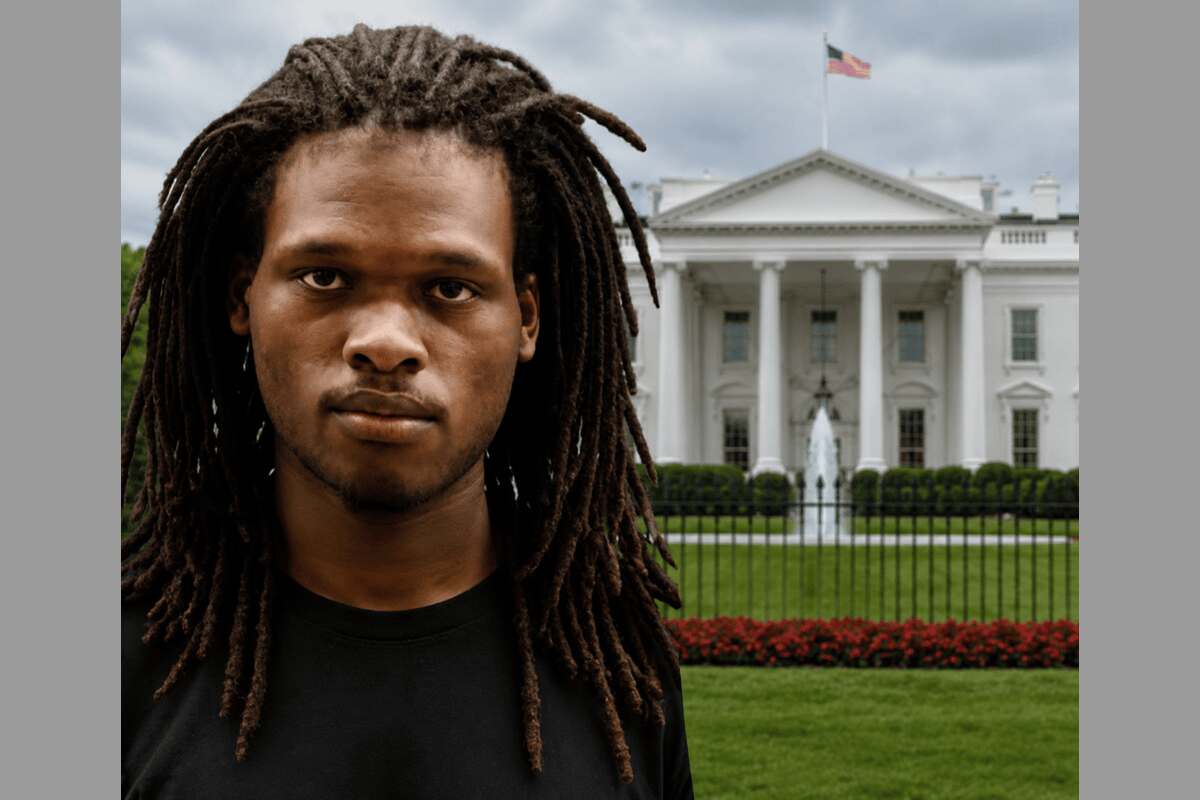

Nasire Best was 21 years old. He had been involuntarily committed to a psychiatric hospital. He told police he was Jesus Christ. He posted on social media that he was “the son of God.” A court had ordered him to stay away from the White House.
The Secret Service knew him by name — he had been detained by agents twice in the summer of 2025, once for “obstructing vehicle entry” to the complex, and once for walking past warning signs into a restricted area and telling officers he wanted to be arrested.
On Saturday evening, he walked back to 17th Street and Pennsylvania Avenue, pulled a revolver out of a bag, and started shooting at the security booth he had been ordered to stay away from. Secret Service agents returned fire.
Best was hit. He was taken to George Washington University Hospital. He passed away at or en route to the hospital (there are conflicting reports). A bystander, struck during the exchange, is in critical condition and undergoing surgery. It’s still unclear if they were shot by Best or Secret Service.
This is the story everyone will tell about Saturday: a deranged gunman attacked the White House, the Secret Service neutralized him, the president was safe, the lockdown lifted at 7:30. End of file.
That is not the whole story. The whole story is that a young man in obvious, sustained psychiatric crisis was waved through every system designed to catch him — a hospital, a court, a federal protective agency, a family, a city — until the only intervention left was the bullet from a Secret Service agent’s gun.
What we know about Nasire Best
Best was from Maryland and had been living in Washington, D.C., for about 18 months. Court records and law enforcement sources reviewed by CNN, NBC, and CBS, paint a consistent picture of a young man whose illness was visible to everyone who encountered him:
- June 26, 2025: Secret Service involuntarily committed him after he “obstructed vehicle entry” to part of the White House complex. He had been seen repeatedly walking around the perimeter “inquiring how to gain access at various entry points,” according to a court affidavit.
- July 10, 2025: He ignored warning signs and walked into a restricted area outside the White House. He told officers he was Jesus Christ and said he wanted to be arrested. He was sent to a psychiatric ward.
- After his release: A court issued a stay-away order barring him from the White House area.
- On social media: Posts threatening Trump. Posts declaring himself the son of God.
- Saturday, May 23, 2026: He was back at the checkpoint with a revolver.
The gap between “involuntarily committed for delusions about the White House” and “able to obtain a firearm and return to the White House” is the entire story. Somewhere in that gap, every protection a society is supposed to offer a young man in crisis simply did not exist.

The systems that failed before Saturday
The mental health system discharged him. We do not yet know what aftercare, if any, was arranged after either of his 2025 hospitalizations. D.C.’s outpatient psychiatric infrastructure has been chronically underfunded for decades, resulting in severe staff shortages, long wait times, and frequent reliance on emergency rooms.
Budget constraints and low Medicaid reimbursement rates have severely restricted community-based mental health services, leaving vulnerable populations without consistent access to care. The average wait for a public-clinic appointment runs weeks, sometimes months.
Long-acting medications, intensive case management, and assertive community treatment — the interventions known to keep people with serious psychotic illnesses stable — exist on paper. In practice, they reach a fraction of the people who need them.
The court system issued a stay-away order and then, apparently, did not pair it with any enforceable mechanism to keep him in treatment. Stay-away orders are paper. They do not administer antipsychotics. They do not prevent someone in active psychosis from boarding a Metro train.
The lack of common sense gun reform allowed a young man with two psychiatric hospitalizations, a documented history of grandiose religious delusions, and posts threatening the president to obtain a revolver. The federal background check question about being “adjudicated as a mental defective or committed to a mental institution” exists.
Whether it caught him, whether he bought the gun legally at all, whether anyone tried to flag the prior commitments — none of this is yet public. What is public: he had the gun.
The Secret Service had encountered Best so many times that the court affidavit describes him as “known to” the agency. Knowing him did not produce a coordinated mental health response. It produced two arrests, two hospital drop-offs, and a stay-away order. When he came back Saturday, the only tool available was the one in a holster.
The bystander
A person whose name has not been released is in critical condition tonight. They were on a public sidewalk on a Saturday evening. They were not a target of anyone — not the gunman, not the Secret Service. They were simply present at 17th and Pennsylvania during a shootout.
It still is not clear whose bullet hit them. The Secret Service has not said. NBC and CBS sources have said it cannot yet be determined. When federal officers fire 15 to 30 rounds at a target in a dense urban corridor — across the street from the Eisenhower Executive Office Building, blocks from the World War I Memorial — civilians in the crossfire are not a freak occurrence. They are the predictable cost of armed confrontation in public space.
The official statements emphasize that the president was unharmed. They do not yet emphasize that someone walking past the World Bank on a Saturday evening is currently in surgery.
The pattern Washington is refusing to see
Saturday was the third high-profile shooting at or near the seat of the executive branch in roughly six months:
- November 26, 2025: Two West Virginia National Guard members were shot near Farragut Square, blocks from the White House, in what authorities called a targeted attack. Both were critically wounded. The shooter, an Afghan national who came to the U.S. in 2021, was taken into custody after being shot by a third guardsman.
- April 25, 2026: A 31-year-old California man, Cole Tomas Allen, opened fire near the security screening area at the White House Correspondents’ Dinner at the Washington Hilton. A Secret Service officer was struck in his bullet-resistant vest. Allen has been charged with attempting to assassinate the president and pleaded not guilty on May 11.
- May 23, 2026: Nasire Best.
Three shooters. Three completely different profiles — a man motivated by foreign-policy grievance, an alleged ideological attacker with a manifesto, a young man in psychotic crisis. The point is not that these incidents share a cause. The point is that they share a country: one where guns are easy, mental health care is hard, political rhetoric is violent, and the response of those in power is always to fortify their own perimeter while leaving everyone outside it to fend for themselves.
What the administration will not say
When Trump spoke after the April Correspondents’ Dinner shooting, he said attempts on his life happened because he was “impactful.” He posted shirtless photos of the suspect bound on the floor. He framed the night around himself.
By the time press was allowed back on the North Lawn Saturday, no senior administration official had said anything about Nasire Best’s documented mental illness. No one had called for stronger community mental health funding. No one had asked how a young man under a court order to stay away from the White House had obtained a firearm. No one had said anything about the bystander still in surgery.

The script is familiar now: lockdown, all-clear, “the president is safe,” investigation pending, photo op pending, press conference pending. A young man in psychosis is dead. A civilian is fighting for their life. And the political class in the building Best could not stop returning to will, by morning, have moved on to the next news cycle — the Iran negotiations Trump announced hours before the shooting, the next domestic crisis, the next thing.
Nasire Best was not a soldier in a war. He was not an assassin with a cause. He was a sick young man who needed help and could not get it, who told everyone what he believed about himself and was sent home anyway, who was failed so completely and so consistently that the only system that finally responded to him on Saturday evening was one armed with handguns and orders to fire.
The corner of 17th and Pennsylvania will be cleaned by morning. The questions about who failed Nasire Best — and who his bullet, or someone else’s, left in a hospital bed — will not be.