
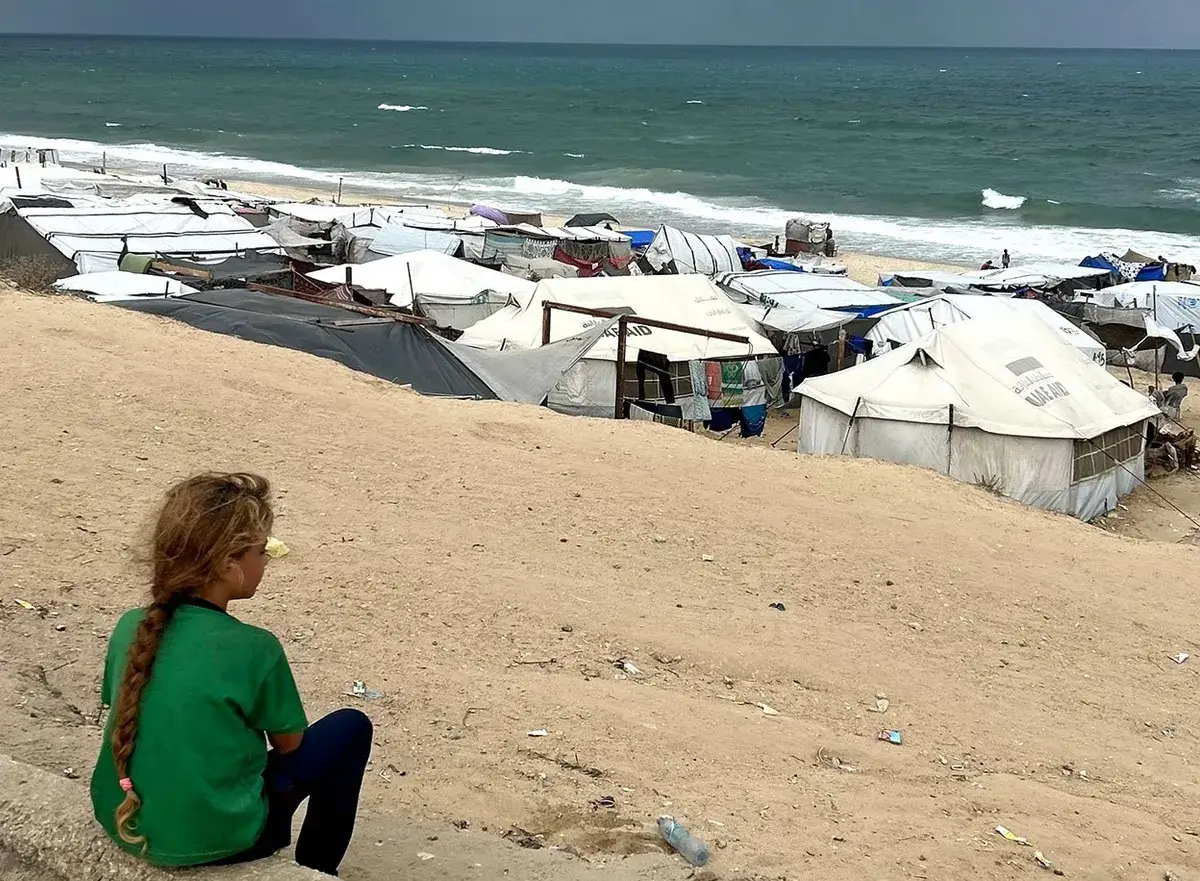

Eleven-year-old Ahmed Al-Raqab was playing outside near the beach tents in Gaza, an encampment of displaced Palestinians along the coastline, holding a watermelon, when an Israeli missile struck on June 24.
As Drop Site News reported, the strike in Al-Mawasi, west of Khan Younis, killed the boy and severely wounded several others.
His father, Sabri Al-Raqab, knelt on the floor of Nasser hospital with his arms wrapped around his son's body. "He's not a fighter. He's a child," he said.
In a nearby room, a six-year-old boy wounded in the same attack lost his right eye, carried in by a teenage relative pleading with staff to save him.
The child's grandfather, struck in the chest, stood by in a bloodstained robe. They had been sheltering in one of the beach tents in Gaza — the kind of makeshift encampment that now lines the beaches, where tens of thousands of displaced Palestinians live in the barest, most exposed part of the enclave.
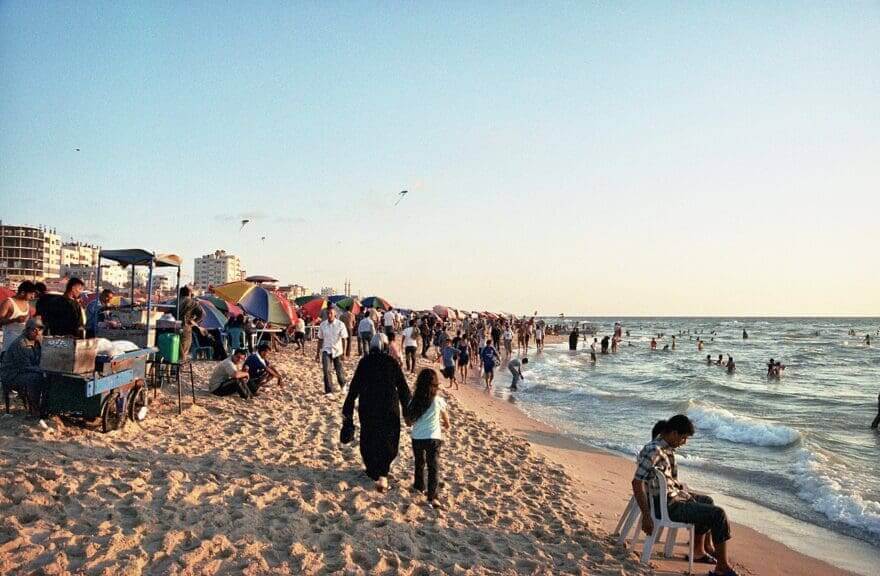
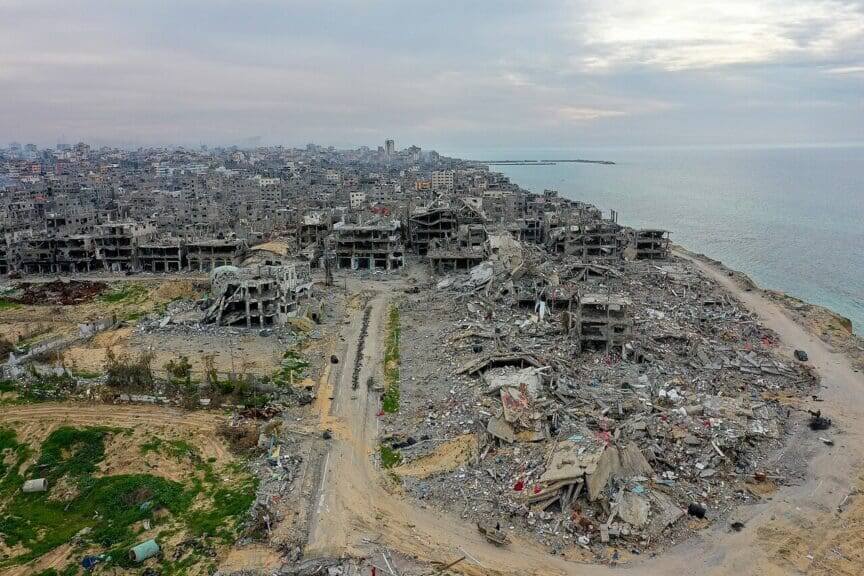
The Beach Tents in Gaza — Not Safe From Bombs in a Genocide
These coastal camps sit as far as possible from the yellow line where Israeli troops are stationed under the October 2025 ceasefire.
Their distance has not spared them.
Israel has bombed Gaza's shoreline repeatedly, and Wednesday's strikes hit several stretches of coast at once.
The attacks landed one day after the UN Independent International Commission of Inquiry concluded that Israeli forces have "deliberately targeted and killed" Palestinian children — conduct the commission found amounts to genocide, crimes against humanity, and war crimes in Gaza.
The body, which first determined Israel was committing genocide in September 2025, documented at least 20,179 children killed and 44,143 wounded since October 2023.
Its chair said children continue to be killed even after the ceasefire, with Israel showing continued disregard for the protection they are owed under international law.
The so-called truce has not stopped the killing of children. Since the ceasefire took hold in October 2025, the UN children's agency UNICEF has counted at least 265 children killed in Gaza.

A spokesperson said a child has died, on average, "every single day" for more than eight months — a figure he called absurd and devastating.
For the families living along the coast in beach tents in Gaza, displacement has become a way of life with no end.
Ahmed Yassin fled his five-story home in Gaza City's Al-Zeitoun neighborhood early in the war, was displaced repeatedly across the south, and returned north after the ceasefire — only to end up in two tents on the beach west of Gaza City.
When the warning came minutes before an overnight strike, the family scrambled toward the sea; Yassin said his mother is elderly, disabled, and ill, and they escaped only in the final moments.
The missile destroyed several tents and left a crater in the sand. His wife, Rana, surveyed the wreckage afterward: everything the family owned was gone, and the children had only the clothes they fled in.
The promised ceasefire, she said, had brought no end to the bombing.
Survival is its own daily ordeal. The Israeli military has struck water pipelines, sewage systems, and desalination plants, damaging or destroying nearly 90 percent of Gaza's water infrastructure, according to Doctors Without Borders (MSF).
In an April report titled Water as a Weapon, the medical charity described an "engineered water scarcity" it said forms an integral part of Israel's genocide, with the price of privately produced water rising as much as 500 percent.
Families ration drinking water over washing and cooking, and some living in the beach tents in Gaza have resorted to digging their own wells.
One man, displaced from Beit Lahia, built a small well beside his tent and used it to grow eggplants and zucchini, sharing fresh water with neighboring families — a fragment of dignity carved out of deprivation.


Israel has rejected the UN findings, with its Foreign Ministry dismissing the report as propaganda and its ambassador to the UN calling it a "blood libel."
But the evidence — from the commission, from UNICEF, from humanitarian organizations working inside Gaza, and from the bodies arriving at Nasser hospital — continues to accumulate.
On a stretch of beach that should have been the safest corner left, a child picked up a watermelon, and a missile was dropped on him.