
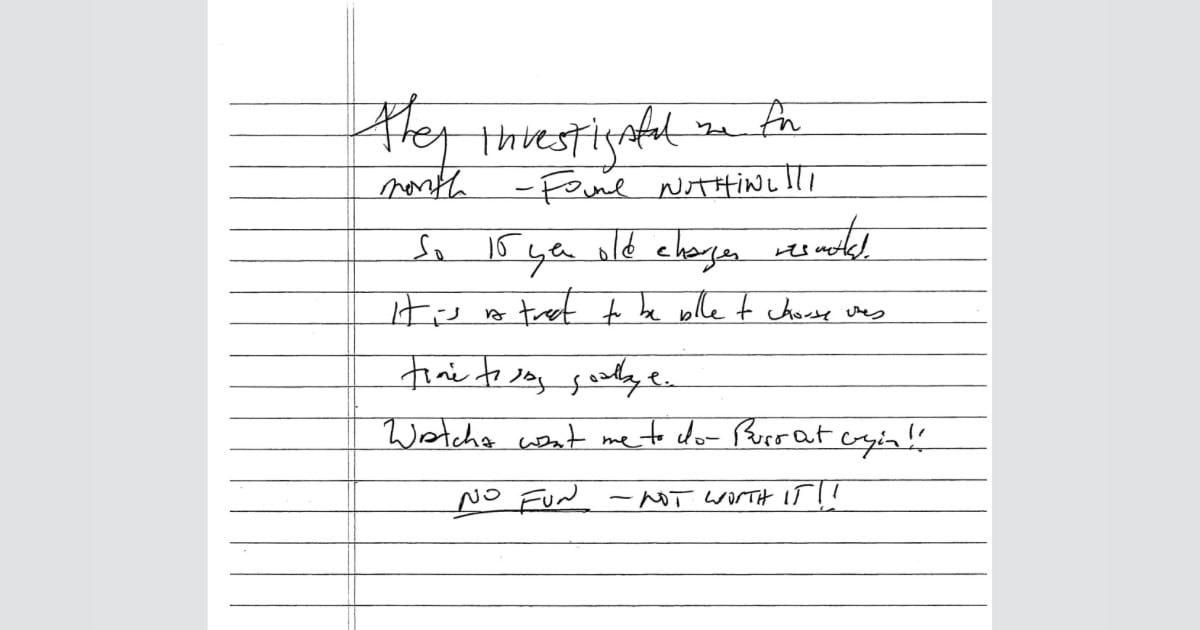

For nearly seven years, a handwritten “suicide” note attributed to Jeffrey Epstein sat under seal in a federal court file in White Plains, New York. The Justice Department, which has released millions of pages of Epstein-related material in the years since his 2019 death, never had it.
Federal investigators never reviewed it. The public never saw it. On Wednesday, that changed.
U.S. District Judge Kenneth M. Karas, a George W. Bush appointee, ordered the document unsealed after The New York Times petitioned for its release and federal prosecutors agreed there was no longer a compelling reason to keep it hidden.
The Epstein “suicide” note — short, jagged, hard to read in places — surfaces a long-buried piece of one of the most consequential federal custody failures in modern American history.
What the Epstein “Suicide” Note Says
The handwriting is rough. The message is bitter. According to images released in the court file, Epstein allegedly wrote:
“They investigated me for month — Found NOTHING!!! So 15 year old charges resulted.”
“It is a treat to be able to choose one’s time to say goodbye. Watcha want me to do — Bust out cryin!! NO FUN — NOT WORTH IT!!”
The note is undated and unsigned. No court or investigative body has authenticated it. Lawyers for Nicholas Tartaglione — Epstein’s former cellmate, who said he found the note tucked inside a book in their shared cell — claim handwriting experts verified it. The Justice Department has not weighed in on its authenticity.
How a Document This Significant Stayed Hidden
The path the note took out of public view is the part of this story that should sit uncomfortably with anyone who cares about institutional accountability.
Tartaglione, a former New York City police officer later convicted of four murders and sentenced to four consecutive life terms in 2024, said he found Epstein semiconscious in their cell at the Metropolitan Correctional Center on July 23, 2019, and revived him with CPR.
The note, by Tartaglione’s account, was already written and stashed inside a book. Epstein was moved to a different cell after the incident. Less than three weeks later, on August 10, 2019, he was found dead. A medical examiner ruled the death a suicide.
The note made its way to Tartaglione’s defense lawyers, who filed it under seal as part of a Curcio hearing — a routine federal proceeding to assess potential conflicts of interest among defense counsel. And there it stayed.
What is a Curcio hearing?

It was not turned over to the federal investigators who probed Epstein’s death. It was not included in the trove of documents released under the bipartisan Epstein Files Transparency Act, which President Donald Trump initially opposed but signed into law in November after Congress passed it.
In other words: a document potentially relevant to the death of one of the most high-profile federal detainees in U.S. history was technically a court record the entire time — accessible, in theory, to anyone with the will to ask for it. No one in a position of federal authority asked.
The Accountability Question
That gap is what congressional Democrats are now pressing on. Representative Raja Krishnamoorthi (D-Ill.) wrote to Acting Attorney General Todd Blanche on Monday, demanding answers by May 18.

“It is critical that the Department avoid the appearance of covering up for criminals simply because of a person’s status and resources,” Krishnamoorthi wrote. “If a suicide note exists and was not reviewed, obtained, or disclosed, the Department must explain why.”
Federal prosecutors in the Southern District of New York, to their credit, joined the Times’ unsealing request rather than fighting it.
Karas, in his ruling, leaned on the First Amendment and a common-law presumption of public access to judicial records, calling that access “firmly rooted in our nation’s history” and necessary to maintain “a measure of accountability” and public “confidence in the administration of justice.”
Those are the right words. They also describe a standard the federal system did not meet for almost seven years.
What this Changes — and What it Doesn’t
It would be a mistake to treat the unsealed note as a revelation about Epstein’s state of mind. Even if authentic, the writing is the embittered shorthand of a man who had spent decades evading accountability and had just lost the ability to do so.
It tells us little about his crimes, his network, or the people whose names continue to surface in the wider Epstein files — including Andrew Mountbatten Windsor, the former British prince arrested in February on suspicion of misconduct in public office, who has denied any wrongdoing.
What the note does illuminate is the machinery. The Bureau of Prisons failures at the Metropolitan Correctional Center — the cascade of “misconduct, negligence and errors” that the Justice Department’s inspector general identified in 2023 — produced the conditions for Epstein’s death.



The years-long sealing of a document found in his cell, in a separate federal proceeding, kept the public from a fuller picture of those conditions.
Survivors of Epstein’s trafficking network, who have spent years asking for transparency, learned of the note’s existence not from the agency that prosecuted him but from a Times investigation.
This is what institutional opacity looks like in practice. It isn’t always a conspiracy. Sometimes it’s a piece of paper filed under seal in an unrelated case, forgotten until a newspaper and a backbench congressman push hard enough to pry it loose. The result is the same: information the public was entitled to evaluate, kept out of public hands.
The note is now in the record. The harder question — why it took a federal lawsuit and a years-late congressional letter to get it there — remains open.
If you or someone you know may be experiencing a mental-health crisis or contemplating suicide, you can call or text 988 to reach the 988 Suicide & Crisis Lifeline.