

A USPS whistleblower inside the U.S. Postal Service has gone to Congress with a warning: the Federal Ballot Mail Portal system the agency is building to screen your mail-in ballot was thrown together in weeks, has barely been tested, and is designed so rigidly that a single misread barcode can send an entire batch of ballots — potentially tens of thousands of them — right back to the state instead of into voters' mailboxes.
Sen. Richard Blumenthal (D-Conn.) released the disclosure Tuesday morning, along with a letter demanding answers from Postmaster General David Steiner.
The whistleblower, who remains anonymous and is represented by the nonprofit legal group Whistleblower Aid, describes the project as secretive, rushed, chaotic, and fundamentally flawed.
In the final days before launch, according to the disclosure, USPS officials were calling the project something clear: "a shit show."
What the Postal Service is building
For as long as Americans have voted by mail, the Postal Service's job has been simple. Election officials print the ballots, decide who gets one, and mail them. USPS delivers.
President Trump's March 31 executive order blew that up. Under a final rule published August 26, USPS becomes a gatekeeper for the first time in its history — with the power to refuse to mail ballots that state election officials have already approved.
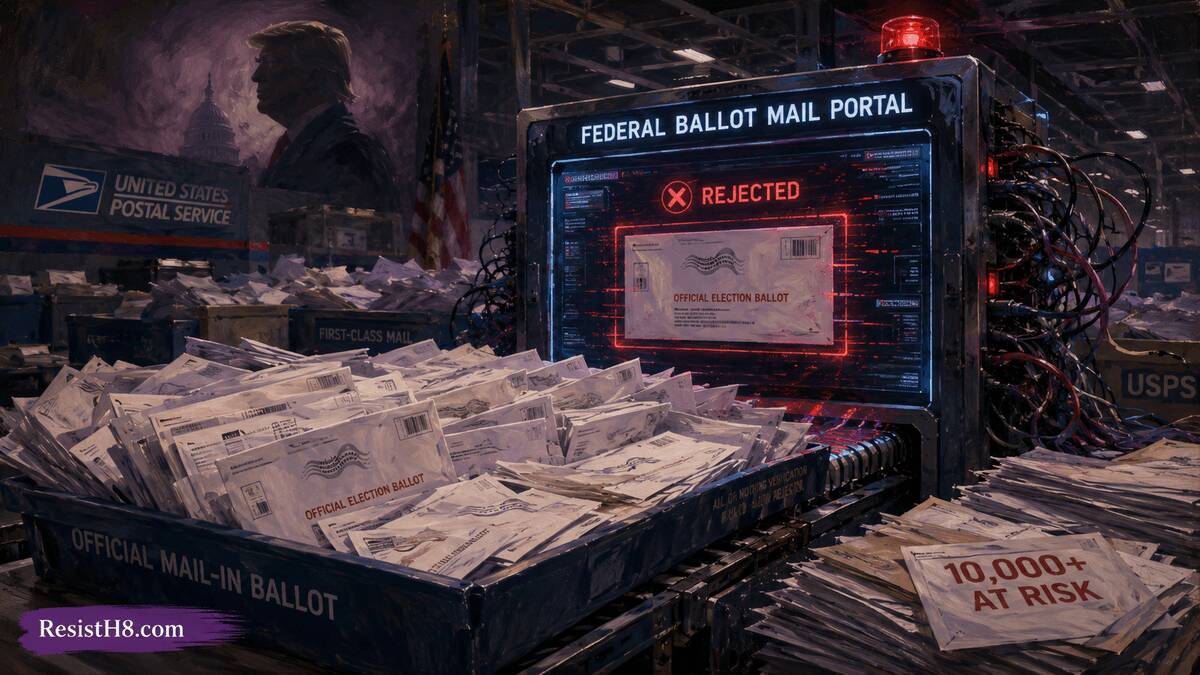
Here's how it would work. Every state would have to upload the name and ballot barcode of every single voter getting a mail ballot into a brand-new online system called the Federal Ballot Mail Portal.
Then, when the state brings a batch of ballots to the post office, two checks happen:
- A digital match. The state's batch list is compared against the portal. Every barcode has to match.
- A physical scan. Postal clerks hand-scan a sample of the envelopes — 15 for a batch under 1,000, 350 for a batch up to 10,000, and 400 for anything larger — to confirm the barcodes are in the portal.
And here’s the terrifying part of the plan: the failure rate USPS built in is zero percent. That means if just one barcode out of 10,000 doesn't scan, the Postal Service stops, refuses the batch, and sends all 9,999 other ballots back to the state.
Why "one bad scan" isn’t a rare event
Blumenthal's letter provides examples of ordinary human reasons a single ballot might not match: a voter got married and changed her name or a voter moved.
With American workers growing increasingly concerned about AI or robots taking their jobs, why not let a human handle the scanning, eh?
Democratic candidates should start attacking the Trump administration and Republicans in Congress (even though they have nothing to do with this — they deserve it). Claim they’re “replacing human postal workers with machines.”
Maybe the America First MAGA influencers and Republican voters can successfully put a stop to the entire “catastrophic” plan to use the Federal Ballot Mail Portal system before November.
Just a thought.
Barcode scanners also fail sometimes. A 2017 USPS Inspector General audit found scanning problems in roughly 5% of the scans it reviewed.
The USPS whistleblower said internal information also points to connectivity limits on the scanners that would be used at mail acceptance facilities.
When a batch bounces, the state has to physically haul the ballots back, find the one problem, fix it, re-upload a new manifest, and start over.
There’s no clear appeals process — the rule only says officials "will be informed of the escalation procedures" if they want to challenge a rejection.
Voters caught in a rejected batch may never learn their ballot was held up until it is too late to vote another way.
The Postal Service also declined to publish an estimate of how many ballots this system would reject.
In the 2022 midterms, states mailed more than 61 million ballots to voters. Blumenthal explained the risks to reporters: roughly a third of Americans vote by mail, and this puts all of their votes at risk.
The Federal Ballot Mail Portal: Built in weeks, tested for a couple days
A project this complex normally takes USPS nine months to a year, the whistleblower says — and a member of the Postal Regulatory Commission told NOTUS the same thing.



Instead, work started around June 15 for a September 1 launch. The disclosure describes what happened next as a slow-motion collapse: no written requirements at all, so developers had to guess at the job from vague comments in meetings; flowcharts that looked different every day; teams siloed so badly that two separate groups each built their own on/off switch for the system, and the deadline was too close to fix it, so both stayed in.
As late as August 21, engineers were still being given new requirements.
The complete system wasn't assembled until the week of August 24 — leaving about four working days of customer testing. Another USPS software project the whistleblower knew of was tested for 47 days.
When one worker raised the alarm about the lack of testing, a senior official reportedly answered: "We cannot fail." When workers pressed again on the missing written requirements, another senior official brushed them off, asking what the problem was, since ‘nobody was trying to stop anyone from getting their ballots.’
You sure about that? *cough*trump*cough *
The court orders USPS has allegedly ignored
The whistleblower also alleges USPS kept building while federal judges had ordered it to stop.
A federal judge in Massachusetts blocked the order on June 25, and USPS did pause — for about a month. Then, around July 29, work quietly resumed with no explanation of what authority allowed it.
The First Circuit had affirmed the block on July 25. A second, nationwide injunction was handed down on August 11. The Supreme Court didn't lift the first injunction until August 24, and the second wasn't lifted until August 26.
Meanwhile, USPS leadership was telling Democratic senators in writing that it was complying with the courts.
A new temporary restraining order issued August 27 halted the work again for 14 days. The whistleblower says development continued anyway.
Where this goes next
Blumenthal has asked USPS to answer his questions by September 4 and turn over records by September 8, and he copied the Postal Service Inspector General. House Oversight ranking member Robert Garcia (D-Calif.) called it an unconstitutional power grab that must be permanently blocked.
The White House disputes the whole premise. Spokesperson Lauren Bis told reporters the software work is neither complex nor unusual for USPS, which handles bulk mail barcodes routinely, and said the administration is working toward “safe and honest elections.” (Quotes added by the Editor)
The clock doesn’t care who’s right. North Carolina is required to mail its ballots by September 4, and officials there say they've gotten virtually no information about how any of this is supposed to work.
Libby Liu, who runs Whistleblower Aid, summed it up in seven words: we are crossing the Rubicon of American elections.