
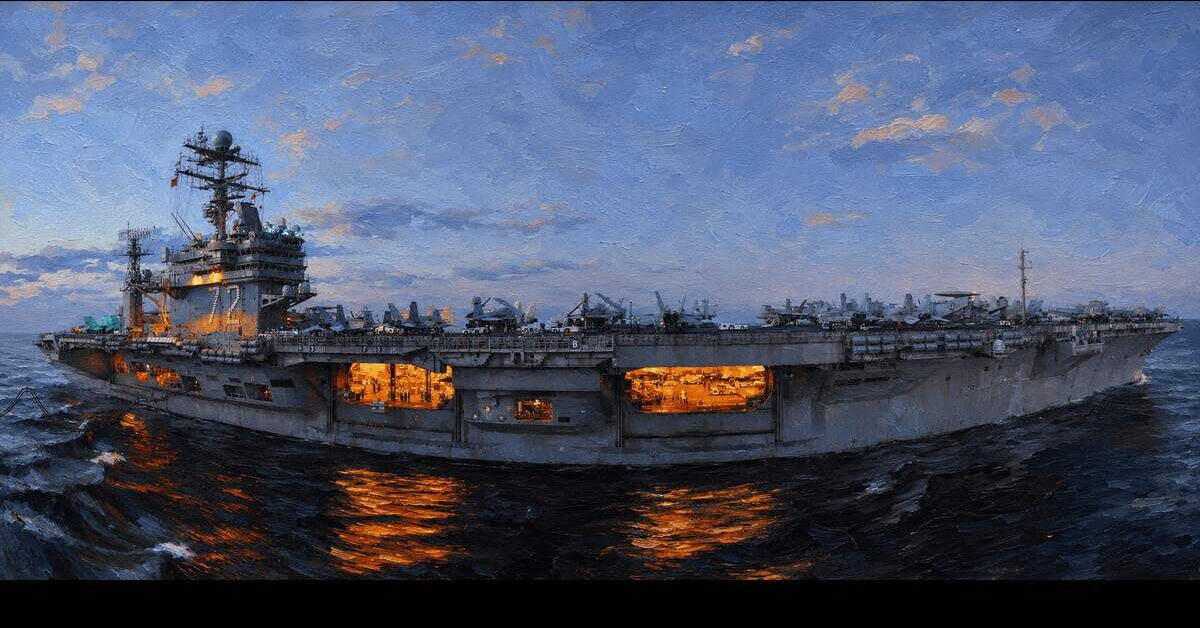

In April, families with service members aboard the USS Abraham Lincoln who sent them photo half-empty meal trays and sent them to reporters.
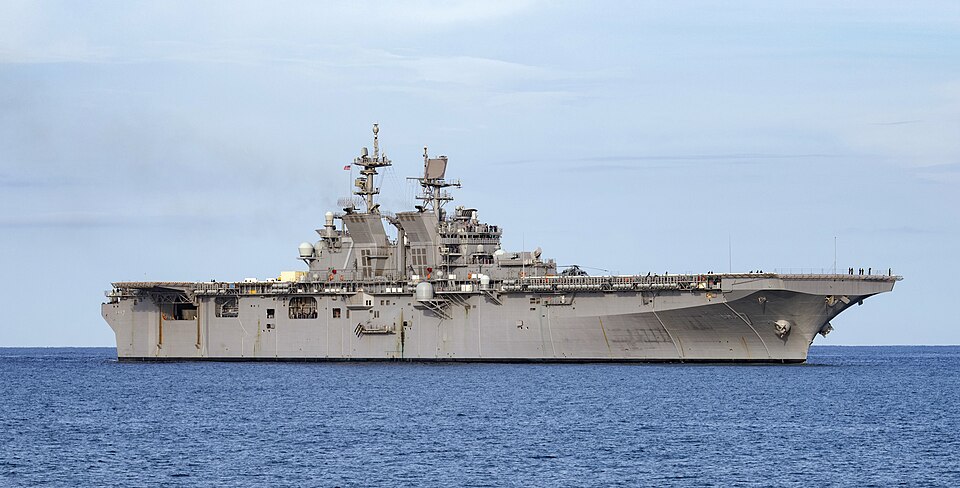
The Office of the Chief of Naval Operations posted a denial on X on April 17 insisting both the USS Abraham Lincoln and the USS Tripoli had "sufficient food onboard to serve their crews with healthy options."
Secretary of Defense Pete Hegseth said the ships each carried more than 30 days of food. He called the story “fake news” and it was waved off as an exaggeration.
Four months later, families of the roughly 5,000 sailors and Marines aboard the USS Abraham Lincoln are telling reporters that the conditions are so bad their loved ones are desperate enough to try to jump overboard.
What the Families Are Saying
On August 11, Military Times reported about the crew aboard the USS Abraham Lincoln: there were sailors trying to jump overboard the current deployment.
Annabelle Loma, the wife of a sailor in San Diego, said her husband tried to jump from the carrier after being repeatedly overextended. He is now on medical hold, and she has spoken with him only a handful of times since.
What he's most afraid of, she said, isn't what happened to him — it's what the Navy will do about it.
"He's scared," Loma told the outlet, describing a fear that his thirteen-year career could end in a dishonorable discharge because he burned out.
Another spouse, Maria Rodriguez, described her husband spotting a shipmate preparing to go over the side while he was standing watch. He called out, ran, and grabbed the sailor's arms, pulling them back onto the deck.
Three others came running when they heard the commotion. He told his wife about it days later. She never found out what happened to the sailor he saved.
Stars and Stripes reported a parallel account of watchstanders stopping a crew member from jumping, an incident the crew learned about through a shipwide announcement.
At a town hall with Navy leadership, one spouse told officials she had received a message from her husband that same day saying "he hopes he doesn't wake up tomorrow."

Asked how many sailors have attempted to go overboard or harmed themselves during this deployment, the Navy has not provided a number.
Nine Months at Sea With No Date to Come Home

The Lincoln left San Diego on November 21 for what was supposed to be a routine seven-month Pacific deployment.
It was rerouted to the Middle East, and when the Trump administration launched Operation Epic Fury in Iran on February 28, the carrier became part of sustained combat operations.
The deployment was supposed to end in May. It has been extended twice, with no publicly announced return date.
Navy officials say the crew has logged 250 consecutive days at sea and supported 40 straight days of combat operations. The Maritime Executive puts the figure above 260 days — longer than any American carrier in the modern era.
There has been roughly one port visit in all that time.
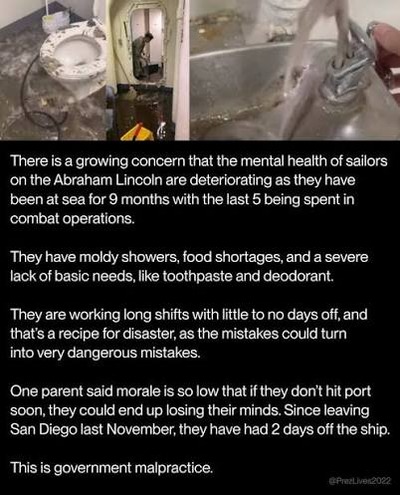
MS NOW first reported on August 5 what a year like that looks like on the inside: mold growing in showers, toilets stopped working, laundry machines out of service, and sailors running out of soap, toothpaste and deodorant.
Task & Purpose confirmed the account with additional family sources.
The April Warning That Was Ignored
The current crisis is not a surprise. It is the predictable end of a story that was reported, denied, and dropped.
USA Today published the first tray photos on April 16 — a lunch tray two-thirds empty with a scoop of shredded meat and one folded tortilla, and another with boiled carrots, a dry patty and a gray slab of processed meat.



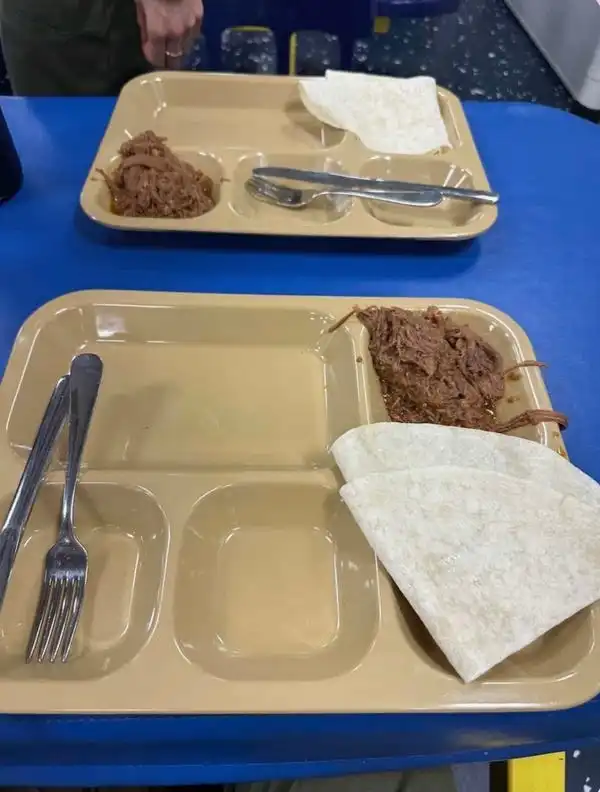
There is only one recognizable food item on the tray below: carrots.
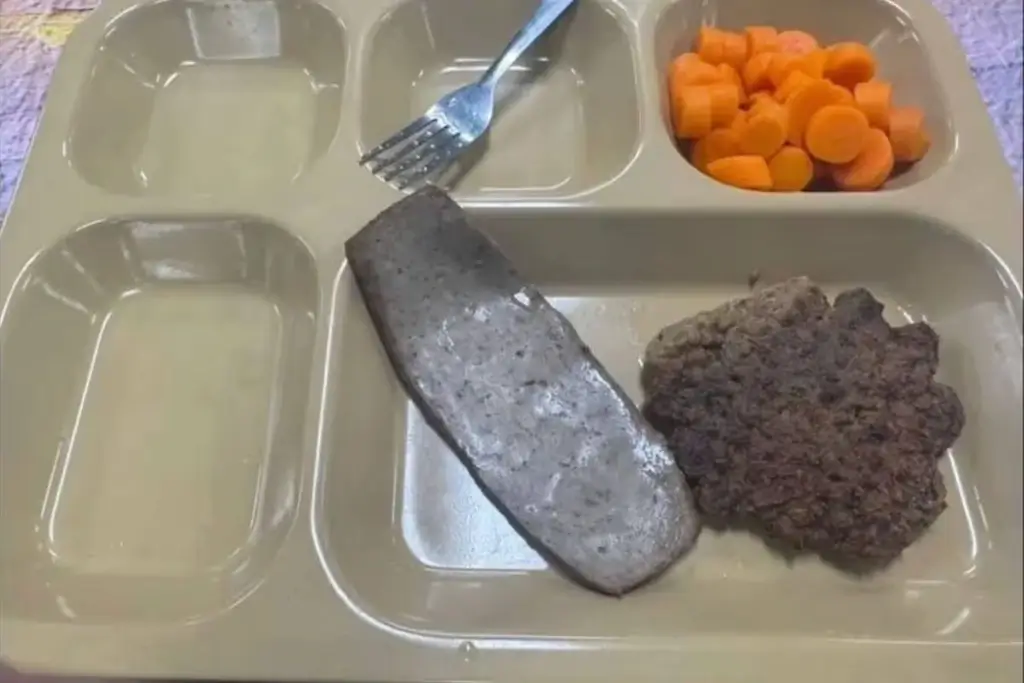
Newsweek obtained a second batch a week later, including trays holding two eggs and a scoop of porridge. Mothers reported sons losing 17 and 20 pounds.
Mail to 27 military ZIP codes in the region had been suspended, so the care packages families were spending thousands of dollars on never arrived.
Rep. Mike Levin (D-Calif.) called for an investigation, writing that the world's most powerful military was "failing to adequately feed its own troops."
Chief of Naval Operations Adm. Daryl Caudle told Navy Times that ships in the strike group had at least ten days of food and that the reporting mischaracterized the situation.
No investigation followed. The deployment was extended again.
What the Navy is Offering Now
More than 200 family members attended an in-person meeting in San Diego last week with acting Navy Secretary Hung Cao, followed by a virtual session the same evening.
Families leaked recordings of that meeting to MS NOW.
Vice Adm. Joseph Cahill, commander of Naval Surface Forces, acknowledged the strain on sailors and families and pointed to the resources already aboard: deployment-resilience counselors, chaplains, medical staff, and Human Factors Councils that review risks to crew well-being.
Cao told families the USS Theodore Roosevelt strike group is being prepared to relieve the Lincoln. Citing operational security, he gave no timeline.
That’s it. Counselors on a ship that has been at combat tempo for eight months, and a date when relief will arrive that they can’t share.
A Separate, but Related Story
Since Operation Epic Fury began, the Center on Conscience & War has reported a roughly 1,000% increase in service members seeking help filing as conscientious objectors.
Executive director Mike Prysner, an Iraq War veteran, told NPR the organization went from a handful of calls a week to three or four a day.
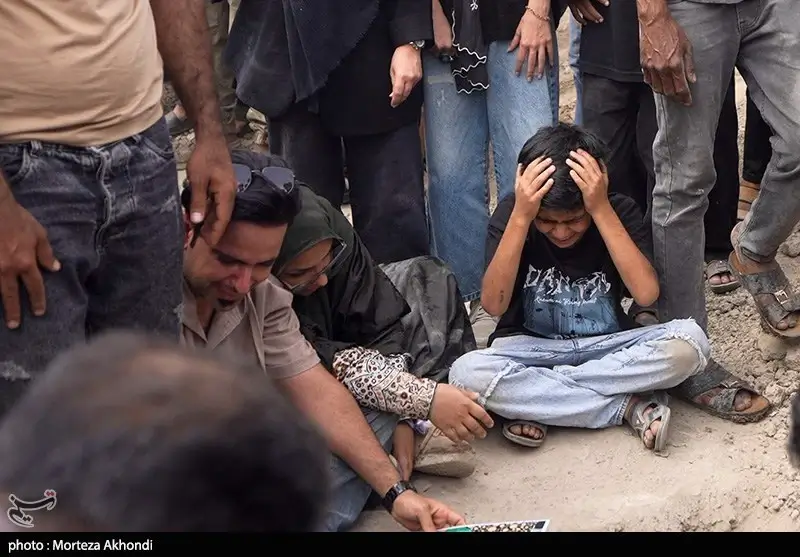
A lot of callers cite the same “breaking point,” he told Democracy Now, which was the strike on a girls' elementary school in Minab, Iran, that killed 168 people, including at least 110 children.
That is real, documented, and damning. But it’s not the same story as the sailors trying to jump Lincoln.
Snopes looked into the claim that troops were openly refusing deployment orders and found it unsupported — rising objector inquiries showed growing dissent, not mass refusal.
And no reporting connects the moral objections to the sailors overboard the Lincoln.
Both things can be true. A war can be illegitimate enough that a thousand percent more troops want out of it, and a deployment can be run badly enough that sailors are trying to it break down. The second doesn't need the first to be an outrage.
Who Decided This
Sailors didn’t extend their own deployment. They didn’t cancel their own port calls or suspend their own mail.
The decision to keep 5,000 people ready for combat in the North Arabian Sea for nine months — past every promised end date — was made by people who slept in their own beds every night.
When those people were shown photographs of the food trays in April, they called them “fake news.”
Families of sailors on the USS Abraham Lincoln sailors are asking for something this administration doesn't have: competence and concern for others.
Veterans/Military Crisis Line
If you or a service member you love is struggling, the Veterans/Military Crisis Line is available 24/7 by dialing 988 and pressing 1, or texting 838255.