



Rich Logis was a true believer. For seven years he wrote MAGA op-eds, hosted a MAGA podcast, contributed to call scripts for the Trump campaign, and attended a fundraiser at Mar-a-Lago. He once wrote that the Democratic Party was the most dangerous group in the history of the republic — more dangerous, in his telling, than Islamic supremacists. He was, by any honest measure, all the way in.
Then he wasn’t.
Logis left MAGA on August 30, 2022. He calls it his “leaving MAGAversary.” The botched federal COVID response shook him. January 6 shook him harder. But the breaking point was the Republican response to the Uvalde school shooting — nineteen children and two teachers murdered in a Texas classroom, and the answer from the party he had defended was more guns, more grievance, thoughts and prayers.
Months later he published what he called a mea culpa, apologizing for amplifying conspiracy theories that he said had produced unnecessary death, trauma and suffering.
Most political defectors stop there. Logis didn’t. In 2024 he founded Leaving MAGA, a 501(c)(3) and 501(c)(4) nonprofit built around a single premise: no one leaves a political community without somewhere to land.
A landing place, not a lecture
The organization runs on principles that, in 2026, sound almost radical. Leaving MAGA doesn’t push a partisan platform. It doesn’t demand that converts vote Democratic. Its members are described as conservative, moderate and progressive.
The point is not conversion. The point is exit — making the door easier to walk through.
The site features dozens of first-person testimonials from former MAGA supporters in Illinois, Texas, North Carolina, Michigan, Alabama, Idaho, New Mexico, Oklahoma, Arizona, Florida, Ohio, Indiana, Virginia, Missouri, Pennsylvania, Oregon, Georgia and New Jersey.
Each one names a person and a state. The stories aren’t anonymous case studies. They’re our neighbors.
Logis’s pitch to those still inside the movement is unusually generous. “MAGA is a politically traumatic, exploitative mythology,” he told Salon. “I will engage with MAGA voters — not by impugning them, but by showing them that realizing we were wrong, and acknowledging our errors, are traits of strength, not weakness. Castigating MAGA voters only strengthens their already rabid support of Trump.”
It’s a hard sell to a Left exhausted by cruelty. It’s also, by his account, working.
Billboards in red places
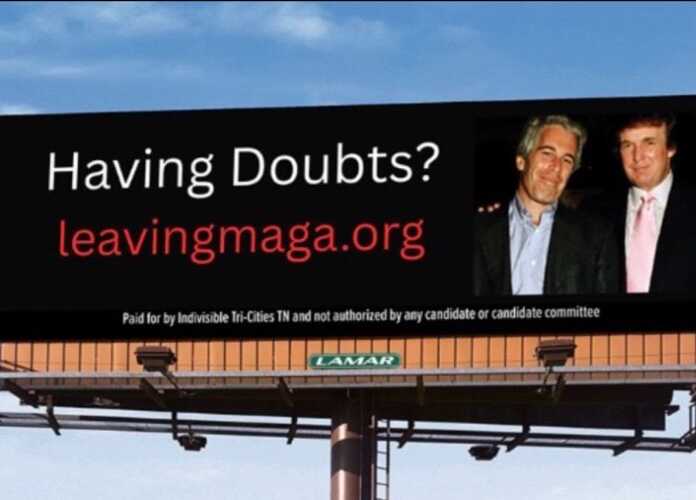
In April 2026, Leaving MAGA launched a roughly $20,000 billboard campaign. The first sign went up in Austin on April 15. More followed in Lancaster, Pennsylvania, Des Moines, Iowa, and Florida.
The messages are deliberately simple: Having doubts? You are not alone. Welcome home. Find your new community. The signs point to leavingmaga.org. They do not attack Trump. They do not name him.
That restraint is the strategy. A driver passing a billboard on the way to work isn’t going to have her mind changed by a slogan. But she might remember that someone left a door open.
The campaign has drawn more attention than its modest budget would predict. Billboards have generated coverage on MS NOW, the New York Post, and local news in Pennsylvania.

Former White House press secretary Jen Psaki promoted the organization on her show. In York County, Pennsylvania, an anonymous donor named Andrew Miller paid for four billboards on his own — Logis says he has never met the man and still cannot reach him. As of mid-May, the organization counts billboards in eleven states with a stated goal of reaching all fifty before November.
Leaving MAGA raised roughly $34,000 in its first year as a tax-exempt nonprofit. About $110,000 the next year. By the spring of 2026, $100,000 already in the door for the current year. The trajectory points in one direction.
What the defectors are saying

Logis ticks off the grievances he hears from people reaching out to the organization: the Epstein files. Tariffs that have pushed up grocery and gas prices. Deaths in ICE custody. The federal jobs gutted by the second-term cuts. The U.S. war of choice against Iran after years of promises to end “endless wars,” and Trump’s image of himself as Jesus Christ, posted on April 12 and deleted the next day after even evangelical leaders objected.
But the most consequential driver may be something more intimate. Salon’s Chauncey DeVega calls it moral injury — the gap between supporting Trump and continuing to believe oneself a good person, a gap that widens every time federal agents drag a neighbor’s family member out of a workplace or a hospital.
The Atlanta Journal-Constitution profiled Martín Verdi and Débora Rey, two Argentine-Americans in North Carolina who voted for Trump because of his immigration rhetoric. Then ICE detained their son, a legal green card holder, over a misdemeanor probation.
“This was a massive deception,” they told the paper. “We went from having a completely open door to closing it shut with 10 bolts.” They drove nine hours each way to visit him in a south Georgia detention center.
A 67-year-old white small business owner posted on Reddit about watching ICE terrorize his immigrant workers. “They are not employees to me. They are family. It breaks my heart to see these fine families getting separated and having to live in fear, when all they want is to make an honest living.”



Emily Anderson of Duluth, Minnesota, told the Wall Street Journal she voted for Trump after Robert F. Kennedy Jr. dropped out and endorsed him. She now calls her vote “the biggest mistake of my life.”
These are the people Logis is trying to reach. Not the committed. The wavering. The ones already saying it out loud to a Reddit forum or a reporter, who haven’t yet found a community willing to receive them.
The line of demarcation
“There’s still a lot of fealty to Trump within the MAGA community,” Logis told Raw Story, “but I think most people in MAGA have a red line, and when that line of demarcation is reached — when there’s one lie too many, when there’s one betrayal too many — it makes them start to wonder: if Trump is lying about one issue, is he lying about other issues?”
His own book is titled One Betrayal Too Many: Why I Left MAGA. The foreword was written by former Republican Representative Adam Kinzinger, who endorsed Kamala Harris at the 2024 Democratic National Convention. Logis spoke at the same convention. From the stage he told the country what he now tells anyone who will listen: Trump’s toxic superpower is lying.
A recent CNN poll found that seventeen percent of 2024 Trump voters either declined to express confidence in their vote or reported mixed feelings — a nine-point increase over the past year.
Five percent admitted regret outright. Trump’s approval has fallen to roughly 33 percent in the AP-NORC poll. Hispanic voters and young men, two groups that helped deliver the 2024 election, are pulling back. Even Tucker Carlson, Megyn Kelly and Marjorie Taylor Greene have publicly broken with the President on specific fights.
None of this means MAGA is collapsing. It means the wall has cracks, and Rich Logis is one of the people pointing at them and telling whoever is on the other side that there’s a way through.
Why it matters
The instinct on the Left is to refuse this work. To say, correctly, that MAGA voters chose this. That the families separated, the people killed in ICE custody, the institutions gutted, the democracy degraded — none of it was an accident. People voted for the cruelty. Twice. Some of them three times.
All of that is true. And it will still be true if America ever pieces itself back together.
What Leaving MAGA is modeling is something harder than absolution or punishment. It’s a structure that lets people who were wrong become people who can be useful. It separates the act of leaving a movement from the demand that someone perform the right politics afterward.
It treats the question of how a democracy heals as a logistical problem — where do the leavers go? — rather than a moral one to be litigated forever.
Logis is not asking anyone to forgive what MAGA has done. He’s asking what happens to the people who finally see it for what it is, and whether anyone is going to be there when they turn around.
For an organization with a couple hundred thousand dollars and some highway signs, that’s not nothing.