
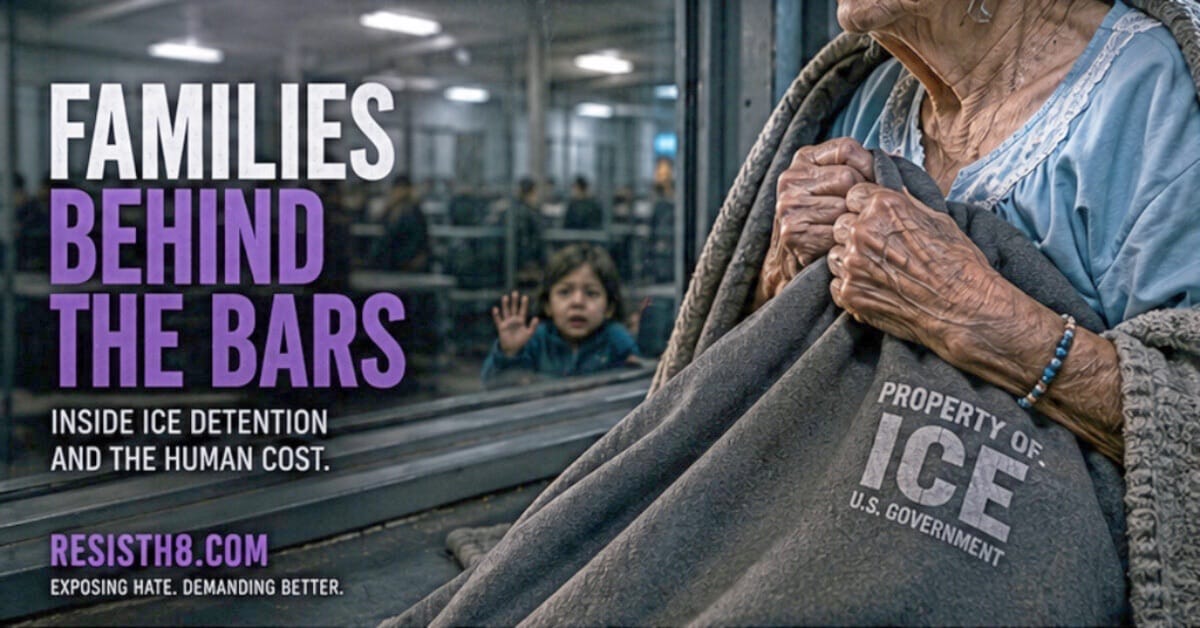

An 85-year-old widow from France, married to a decorated American veteran, spent 16 days locked in a Louisiana immigration detention facility this spring. She slept in a dormitory with 58 other women, most of them mothers. At night, when the shouting from guards finally died down, she could hear the children. And the babies.
“There’s babies in this jail,” Marie-Thérèse Ross told the Associated Press from her family’s home in Orvault, France, where she is now recovering. The women she was held with called her “Grandma.”
One of them, whose face she never saw in the dark, would silently reach over and pull her blanket back up when it slipped off her bed at night.
This is what immigration enforcement looks like under the second Trump administration: an octogenarian widow in pajamas and slippers, handcuffed at her own front door, hauled across state lines, and held for more than two weeks in a facility where babies cried through the night.
How a Love Story Ended in Federal Detention
Marie-Thérèse first met William B. Ross in the 1950s. He was an American soldier stationed in France. She was a young secretary working at NATO. He eventually returned home, married, and built a life in Anniston, Alabama. She built her own life in France. For six decades, they stayed loosely in touch through William’s wife, who became a friend.

Then both of them lost their spouses. They started spending holidays together. The old feelings came back. Last year, in their eighties, they got married. Marie-Thérèse crossed the Atlantic to spend whatever years remained with the man she had quietly carried in her memory for most of her life.
William died of natural causes in January. According to court records and her own account, his sons turned on her almost immediately. A dispute over the estate followed. His sons rerouted her mail away from the Anniston home, and as a result, she missed an immigration-related appointment.
An Alabama judge later wrote in a court order that one of those sons — a former state trooper who now works as a federal employee — appears to have used his position to engineer his elderly stepmother’s arrest. The judge called for a federal investigation. The stepson denies it.
What’s not in dispute is what happened next.
A Knock at 8AM
On April 1, five men identifying themselves as immigration officers banged on the door and windows of the Alabama home where she had been living with her late husband. It was early morning. Marie-Thérèse was still in her pajamas, slippers, and bathrobe. They handcuffed her and put her in a vehicle. Two days later, she was inside the immigration detention facility in Basile, Louisiana.
The French Foreign Minister called for her release, saying U.S. immigration enforcement methods are “not in line” with French standards.
They’re not in line with anyone's standards. (Editor)
She was 85 years old. She was the widow of a U.S. military veteran. She was, by every reasonable measure, no threat to anyone.
Her arrest sparked an international incident. French Foreign Minister Jean-Noël Barrot publicly demanded her release and said bluntly that ICE methods were “not in line” with French standards. After 16 days, they let her go. She flew home to France.

The Department of Homeland Security responded this week by saying she had overstayed a 90-day visa and insisting that ICE facilities are “regularly audited” and that detainees receive “proper meals, quality water, blankets, and medical treatment.” The agency added that ICE has “higher detention standards than most U.S. prisons that hold actual U.S. citizens.”
That is the official line.
Pardon me while I laugh hysterically. RH published a report last month on the inhumane treatment, human rights violations, and deaths in ICE detention facilities. Alligator Alcatraz was recently shut down by a judge following reports of terrible conditions and the routine denial of medical treatment for sick or injured detainees.
Here is what the 85-year-old grandmother who lived inside one of those facilities actually said.
What She Saw
The room held 59 women. Most were mothers. Some did not know where their children were. “I think it’s terrible for a woman not to know where her children are,” she told the AP.
The guards, she said, could not speak without yelling. Everyone in the dorm talked over each other just to be heard, which meant the only time the room ever went quiet was at night. And in those moments of quiet, the sound that filled the space was the crying of children and babies.
Most of the women she was held with came from South America. She watched them, and she came to a conclusion she could not unsee. “Their only fault was to be South American,” she said.
She kept a friendship bracelet one of the women wove for her out of strips of colored plastic. She wears it now in France. Her family says she is dealing with memory gaps and emotional distress, and that she is seeking medical follow-up for symptoms consistent with post-traumatic stress. Imagine the trauma these children are experiencing that will affect them for the rest of their lives.
A Trump Voter’s Wife, Changed
Here is the part of the story the administration can’t spin.
Marie-Thérèse Ross is not a progressive activist. Her late husband was a Trump supporter. They used to watch Fox News together in the living room of their Alabama home. She came to the United States believing it was a “country of freedom, where people are not arrested based on how they look, and where those who are detained are treated fairly and with respect.”



Then she lived inside it. And the country she had imagined for sixty years did not match the one she found.
“When I left this jail in Louisiana,” she said, “I told them that if I ever had the chance to speak about them, I would do it, to help them.”
She is keeping that promise. The question is whether anyone with the power to act on it is willing to listen.
What This Story Actually Says
The defenders of the current immigration crackdown have a script ready for almost every case. Criminals. Gang members. National security threats. That script does not work here. Marie-Thérèse Ross is an 85-year-old widow of an American veteran. She came to this country to grow old with the man she loved. She missed a paperwork appointment because someone in her own family — by her account and a judge’s — appears to have made sure she would miss it.
What ICE produced out of that situation is a grandmother in handcuffs, sixteen days in a Louisiana dorm full of separated mothers, and a diplomatic crisis with France.
And running underneath all of it, the detail she cannot let go of, the one she came home with and keeps telling reporters: in the silence, when the guards stopped shouting, she could hear the babies crying.
“There’s babies in this jail,” she said.