
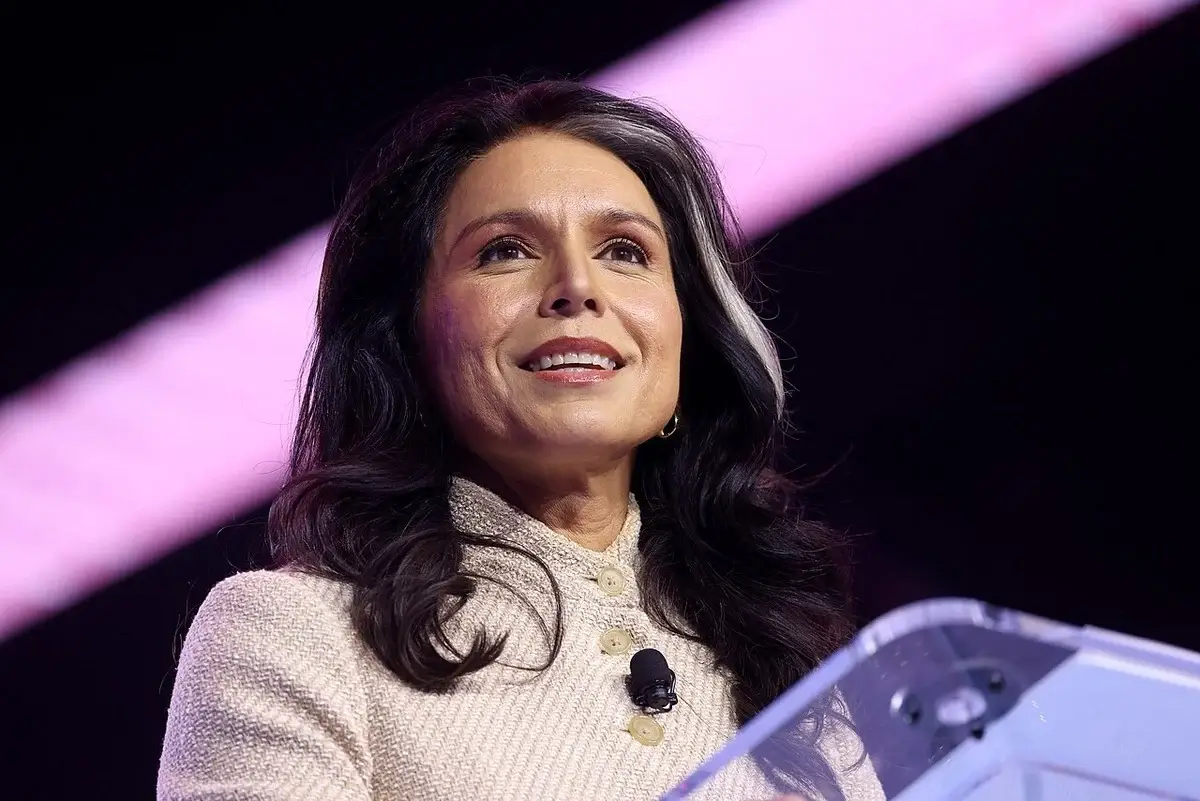

For much of her career, a cult leader controlled Tulsi Gabbard. She was told what to think, what to say on television, and which bills to introduce in Congress.
For a year and a half, until she stepped down at the end of June, Tulsi Gabbard sat at the very top of the U.S. intelligence world. As Donald Trump's Director of National Intelligence, she oversaw all 18 federal spy agencies — including the CIA, the FBI, and the NSA — and helped decide what secrets landed on the president's desk each morning.
Now a sweeping Washington Post investigation has revealed deeply unsettling information about the woman who held that job.
According to the Post, that “cult” leader was Chris Butler — a reclusive 78-year-old Hawaii guru who leads the Science of Identity Foundation (SIF), a breakaway Hare Krishna group that splintered off in the 1970s and that numerous former members have described as a cult.
Gabbard grew up inside the group. Her parents held senior positions in it, and she has publicly called Butler her guru.
SIF denies it is a cult, and Butler's associates deny he authored anything.
What the Documents Show
Reporter Jon Swaine and his colleague Aaron Schaffer spent roughly a year reviewing more than 25,000 pages of emails, memos, and messages spanning 2011 to 2017 — most of it covering Gabbard's first two terms in the House.
The trove came from Rebecca Saltzburg, a former SIF member who worked on digital strategy for several of Gabbard's campaigns.
She told Swaine she handed it over because she felt Gabbard had misled voters about how much Butler shaped her decisions.
What's in those pages is, frankly, jaw-dropping. Dozens of memos read like marching orders — telling Gabbard which legislation to propose, which policy positions to take, and even how to carry herself on TV.
A 173-page 2014 dossier titled "TG Issues" coached her on everything from taxes to the disappearance of Malaysia Airlines Flight 370, peppered with blunt commands like "Stop being weak."
Then comes the part that turns the memos from strange to damning. When the Post lined up Gabbard's actual public record against the instructions, the parallels were unmistakable.

In 32 television interviews between 2014 and 2016, she used language from the prepared talking points almost word-for-word on 24 occasions.
A memo labeled with Wolf Blitzer's name scripted a specific line for a CNN hit — and she delivered nearly that exact line on air that day.
A 2014 memo pushed her to introduce a bill punishing countries whose citizens fought for ISIS; she put out a statement the next day and filed the bill within a week.
On at least one occasion, an aide sent her a pre-written tweet, and she posted it without changing a word.
Control, not Coaching

These weren't gentle suggestions. Some memos were openly contemptuous of Gabbard herself.
One from January 2015 dismissed her reaction to President Obama's State of the Union as "intellectually lazy." Another called her "chickenshit" and "mealymouthed."
One even fussed over her facial expressions during media appearances, with the writer complaining, "She's still doing the eye thing." This is the language of a handler managing a subordinate — not a mentor offering advice.
So how did the Post pin the memos on Butler, who reportedly doesn't even use a computer and relies on secretaries to transcribe his spoken instructions?
Two ways.
First, the messages were routed through an email domain that Swaine traced to Butler's office.



Second, the Post ran a word-fingerprint analysis — comparing the memos against 7,000 pages of Butler's recorded lectures and the writing of two other men, including Gabbard's father.
The memos matched Butler far more closely, right down to oddball coinages like "duplistic" instead of "duplicitous."
Former followers say Butler wanted, in one ex-member's words, "to rule the world," and spent years trying to push his reach into American politics.
The reporting also describes a coordinated online operation: dozens of fake social media accounts, complete with phony names and stolen profile photos, used to defend and boost Gabbard.
The documents suggest she knew about it.
A National Security Alarm Bell
Strip away how bizarre it sounds, and what's left is a serious accountability story.
This is the person who, until weeks ago, oversaw America's most sensitive secrets.
Butler himself has reportedly described U.S. intelligence agencies as institutions run by "madmen" — even as his lifelong disciple was placed in charge of them.
Senators asked Gabbard about her ties to Butler during her 2025 confirmation hearings, and she downplayed them.
Back in 2019, when a Post reporter asked whether Butler had mentored her politically, she answered flatly: "No, no, not at all."
Gabbard did not respond to Swaine's detailed questions.
Her chief of staff called the story false and "a blatant example of anti-Hindu bigotry." (Similar to the “call anyone who criticizes the Netanyahu government an ‘antisemite‘” deflection tactic.)
Let’s be clear about that defense: the allegations are not about the Hindu faith, which deserves respect like any other.
They are about whether one specific man and his organization secretly steered a sitting member of Congress — and later, the nation's top spy.
There's one more detail that's hard to ignore. After two months of silence from Gabbard's office, Swaine notified her he was running the story.
Two days later, her resignation became public.
Officially, she stepped down to care for her husband, Abraham, who was diagnosed with a rare bone cancer — a real and painful reason no one should minimize.
But the timing has raised eyebrows, and questions about who was pulling the strings are not going away.