

What is a Planetary Parliament? What are the rights of nature? Who are the Planetary Democrats? You’re about to find out. But first, humor me.
Picture a legislature. You stand up to introduce a global carbon tax — good policy, the kind of thing that gets you a nice write-up. The human delegate across the aisle nods along.
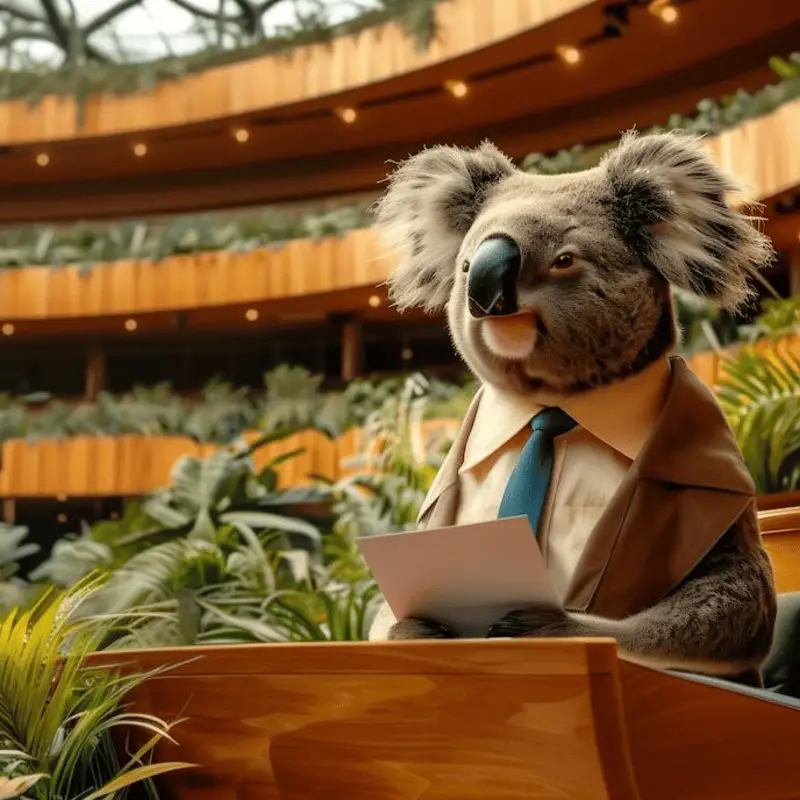
Then a koala raises an objection.
Turns out your carbon tax pencils out a solar buildout in Australia, and that buildout means bulldozing the eucalyptus grove where she lives.
Beside her sits a frangipani tree.
Beside the tree, a bend of the Murrumbidgee River, which has thoughts about water allocation.
None of them work for you. All of them get a vote.
That scene comes from a 2024 Grist piece by Joseph Winters, and it was written as a deliberate absurdity.
Koalas are not going to file into a chamber and press a voting button. But the proposal underneath it was real, and two years later it's stopped looking quite so whimsical.
The Proposal
Planetary Democrats, a legal association founded in Hamburg in 2023, wants a 400-seat legislative body — ideally housed inside the United Nations — that represents the nonhuman world.
The math is the interesting part.
Half the seats, 200 of them, would go to ordinary people drawn at random from the global population.
Not politicians. Not donors.
A lottery, like jury duty for the species.
The other 200 seats would go to experts nominated by environmental organizations, each assigned to speak for a slice of the living and nonliving world: animals, fungi, plants, microorganisms, the atmosphere, the ice, the water, the rock.

Built inside the U.N., such a body could propose legislation and make decisions binding under international law.
Anton Rüpke, the group's first chairperson, put it this way: these entities are affected by our laws, so they belong in the process that makes them. Not because they're useful to us. Because they exist.
Rights Are Not the Same Thing as Representation
Here's the distinction that makes this more than a philosophy seminar.
The rights of nature movement has racked up real wins.
Ecuador wrote nature's rights into its constitution in 2008.
New Zealand granted personhood to the Whanganui River in 2017.
Colombia's high courts recognized the Atrato River and later the Colombian Amazon as subjects of rights.

Panama, Spain, Bolivia, Uganda, Mexico, India — roughly 30 countries now have some version on the books.
But a right you can't exercise is just a decoration. Rivers don't hire lawyers. Forests don't file briefs.
Every one of these frameworks depends on humans showing up as surrogates, usually after the damage is already underway.
Rüpke's objection is that this leaves nature permanently on defense — reacting to each new pipeline, each new mine, each new rollback, always a step behind.
His argument is that nature needs a seat in the branches that write the laws, not just standing in the branch that reviews them after the fact.
Bolivia is the cautionary tale. It passed a Law of the Rights of Mother Earth in 2010, and critics say large-scale mining and deforestation rolled on anyway, often with the government itself behind the projects.
Rights on paper, bulldozers in the field.
What's Happened With the Planetary Democrats Since 2024
This is where the story gets less hypothetical.
On May 19, 2026, the European Commission formally registered a European Citizens' Initiative called "Rights for Nature: Empower Citizens to Represent and Protect Ecosystems."
It asks the Commission to recognize rights of nature in EU law through an actual directive or regulation — moving ecosystems out of the property column and into the rights-holder column, with rights to exist, regenerate, and be restored.
Registration isn't victory. It's a starting point.
The organizers — a coalition that includes lawyers who've argued river-rights cases in court and campaigners behind Spain's Mar Menor lagoon win — need one million signatures across EU member states, and collection opens in autumn 2026.
The Commission has explicitly said it hasn't weighed in on the merits.
The Commission also registered a companion initiative on building European biodiversity corridors to reconnect fragmented habitat.
And the smaller experiments Grist described as "green shoots in the garden of experimentation" — the phrase belongs to bioethicist Melanie Challenger — have kept sprouting.
In February 2026, a bill on legal personality for the Seine was tabled in the French Senate.
In April 2026, Maidstone Borough Council became the first UK council to adopt a rights of nature framework.
Ecuador's Constitutional Court extended its framework to marine environments, opening a door to challenges against overfishing and offshore drilling.
Petitions are pending for the River Clyde in Scotland and for England's rivers and rias.
Meanwhile, in America
While Europe debates giving ecosystems a voice, the United States spent this month taking one away.
On July 14, 2026, the Fish and Wildlife Service and NOAA Fisheries finalized a rule rescinding the regulatory definition of "harm" under the Endangered Species Act — a definition that had stood for fifty years and that the Supreme Court upheld in 1995.
Under the old reading, destroying the habitat an endangered species needs to breed, feed, and shelter counted as harming it.
Under the new one, it may not.
The agencies say this cuts red tape.
Earthjustice and more than half a dozen groups say it hands industry a license to level the places grizzlies, salmon, and marbled murrelets live in, and they sued in federal court in Seattle.
At least four federal suits are now pending.
The rule takes effect September 14.
So: two continents, two directions. One arguing over whether a river should be able to speak. The other quietly redefining a word so that flattening a forest no longer counts as hurting the animals inside it.
Rights of Nature: The Hard Parts
A planetary parliament that represents the rights of nature raises problems nobody has solved.
Representatives can't poll their constituents — you cannot ask a wetland what it wants.
They'd be acting on scientific inference and their own judgment, which means the accountability question is enormous.
Who checks whether a "representative of the atmosphere" is doing right by the atmosphere?
What happens when the interests of one ecosystem collide with another's?
Pablo Magaña, an animal ethics researcher in Barcelona, argues the whole thing collapses without deep consultation and broad inclusion.
Rüpke has floated the idea that members take regular trips to the ecosystems they represent, on the theory that it's harder to abstract away a place you've stood in.
None of that is a reason to dismiss it.
Every extension of political voice in history was called impossible first, then dangerous, then obvious.
Letting women vote was once denounced as a reckless social experiment.
The koala isn't coming to Brussels.
But the question the koala represents — who counts as an interested party when we write the rules — is now sitting in the European Commission's inbox, waiting on a million signatures.