

According to a new report, sweeping reductions at the U.S. Environmental Protection Agency (EPA) have hampered state regulators' capacity to fight pollution. And as the Trump administration now pushes for even steeper EPA cuts in 2026, additional states could soon find themselves in an impossible position.
“If EPA’s capacity to do its job is further diminished, how prepared are our states to shoulder more responsibility for protecting us from these threats? Unfortunately, not well,” Jen Duggan, executive director of the Environmental Integrity Project (EIP), the nonprofit behind the report, said in a press conference announcing the report’s findings.
EPA cuts at the state level
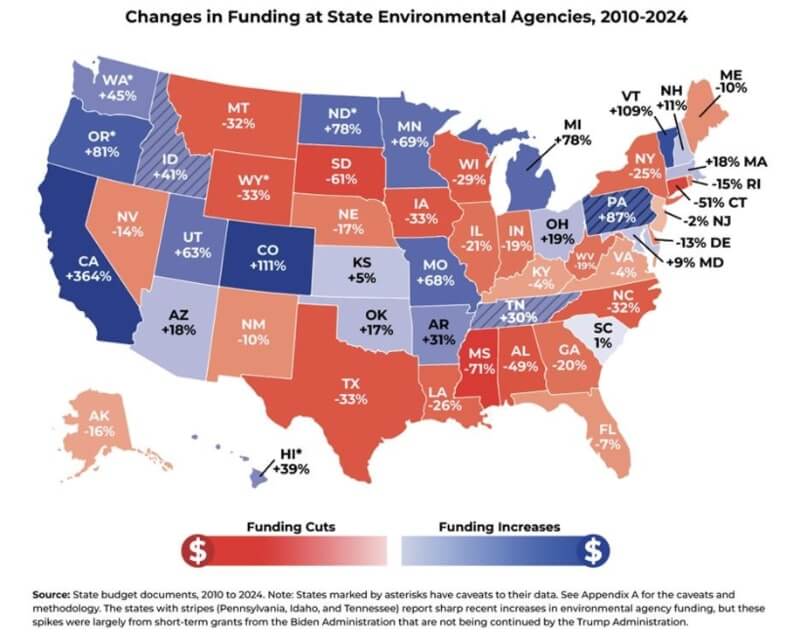
The report found that 27 state governments have cut environmental agency funding over the past 15 years, including seven states — Texas, Wyoming, Iowa, Alabama, Connecticut, South Dakota, and Mississippi — that have cut budgets by a third or more.
And 31 states cut the number of staff at their environmental agencies. Together, they eliminated 3,725 jobs that same period.
That leaves state agencies vulnerable to Trump administration changes at the EPA, which has already had its budget cut 40% between 2010 and 2025.
In 2025 alone, EPA employees left in droves, thanks to mass firings, layoffs, and resignations — as much as 33% of its total staff, according to some estimates.
Meanwhile, the White House has proposed cutting the agency’s budget by 55% in 2026 to $4.2 billion, its lowest funding level in four decades.
EPA Administrator Lee Zeldin has suggested that states will be able to pick up the slack, describing a vision for the agency that involves giving “power back to states to make their own decisions.”
In a March press conference announcing a major deregulation initiative — what he called “the greatest day of deregulation our nation has seen” — Zeldin fundamentally recast EPA’s mission, announcing a new mandate to “unleash American energy” and “revitalize the American auto industry.”
Advocates warn shifting responsibility to states would be devastating
Protecting Americans from the impacts of industry pollution, he suggested, would be shifted to state agencies, which are “best positioned to work with unique communities and implement laws.”
“In too many instances and across too many administrations, EPA has retained control of implementing many laws from its perch in the nation’s capital,” he said, in an address to the Environmental Council of the States, a national nonprofit organization representing environmental agency leaders, later that month. “It’s this kind of common sense reform I want to partner with states to achieve.”
In its report, EIP argues that this perspective ignores EPA’s defined mission to protect the health and well-being of Americans, while downplaying the vital role it plays in creating national standards and coordinating efforts related to complex, multi-state issues. Even more troubling, though, according to the report, is how many states simply aren’t equipped to address these issues without a strong partner in Washington.
“This kind of handoff — from federal to state — can only work if the teammate receiving the baton has not been hobbled, as many state environmental agencies have been, by budget cuts,” the report’s authors wrote.
Twenty three states have in fact worked to increase environmental funding since 2010 — with California (364% increase), Colorado (111% increase), and Vermont (109% increase) leading the way.
This means future cuts to the EPA would likely have a disproportionate impact on states like Mississippi and South Dakota, which have cut agency funding by 71% and 61%, respectively.

State-level regulatory dysfunction
In Wednesday’s EIP press conference, environmental advocates painted a picture of state-level regulatory dysfunction that would only be worsened by further federal cuts.
The proposed cuts are “a recipe for disaster in states like ours, where the state agency is already stretched thin,” Drew Ball, southeast campaigns director for the National Resources Defense Council of North Carolina, where environmental agency funding had already declined 32% since 2010, said at EIP’s news conference.
“It’s like dismantling the fire department while the house is already burning.”
States depend on EPA grants to help fund their compliance efforts, ensuring that standards under the Clean Air Act, the Clean Water Act, and other laws are met.
The Trump administration has proposed cutting EPA “categorical grants” by approximately $1 billion, eliminating nearly all federal funding for a range of issues, from air quality management and pollution control to lead removal.
That recommendation would “devastate economic development, critical infrastructure, and environmental protections across the nation,” representatives from the Environmental Council of the States wrote in an open letter to Zeldin in May.
At Wednesday’s press conference, Kathryn Guerra of Public Citizen, a nonprofit consumer advocacy group, said her state of Texas already suffers from widespread regulatory noncompliance.



According to its own enforcement reports, she said, the Texas Commission on Environmental Quality (TCEQ) never investigates many of the environmental complaints it receives, while its backlog of unresolved enforcement cases has grown to over 1,400.
“The funding cuts to TCEQ described in this report render the agency largely ineffective, and cuts to the EPA will worsen that ineffectiveness,” she said.
Meanwhile, both houses of Congress are recommending much less severe EPA cuts.
The House Appropriations Committee has recommended cutting the agency’s budget by 23% in 2026, while its counterpart in the Senate has voted for just a 5% reduction. But the advocates convened by EIP argued that current levels of funding are already critically low.
“This report is a warning,” said Jennifer Walling, chief executive officer for the Illinois Environmental Council. “If both lines of defense, our state agencies and the U.S. EPA are weakened at the same time, pollution enforcement will falter, emergencies will happen, and public health will suffer.
We cannot pretend that states are prepared to shoulder this burden alone.”