

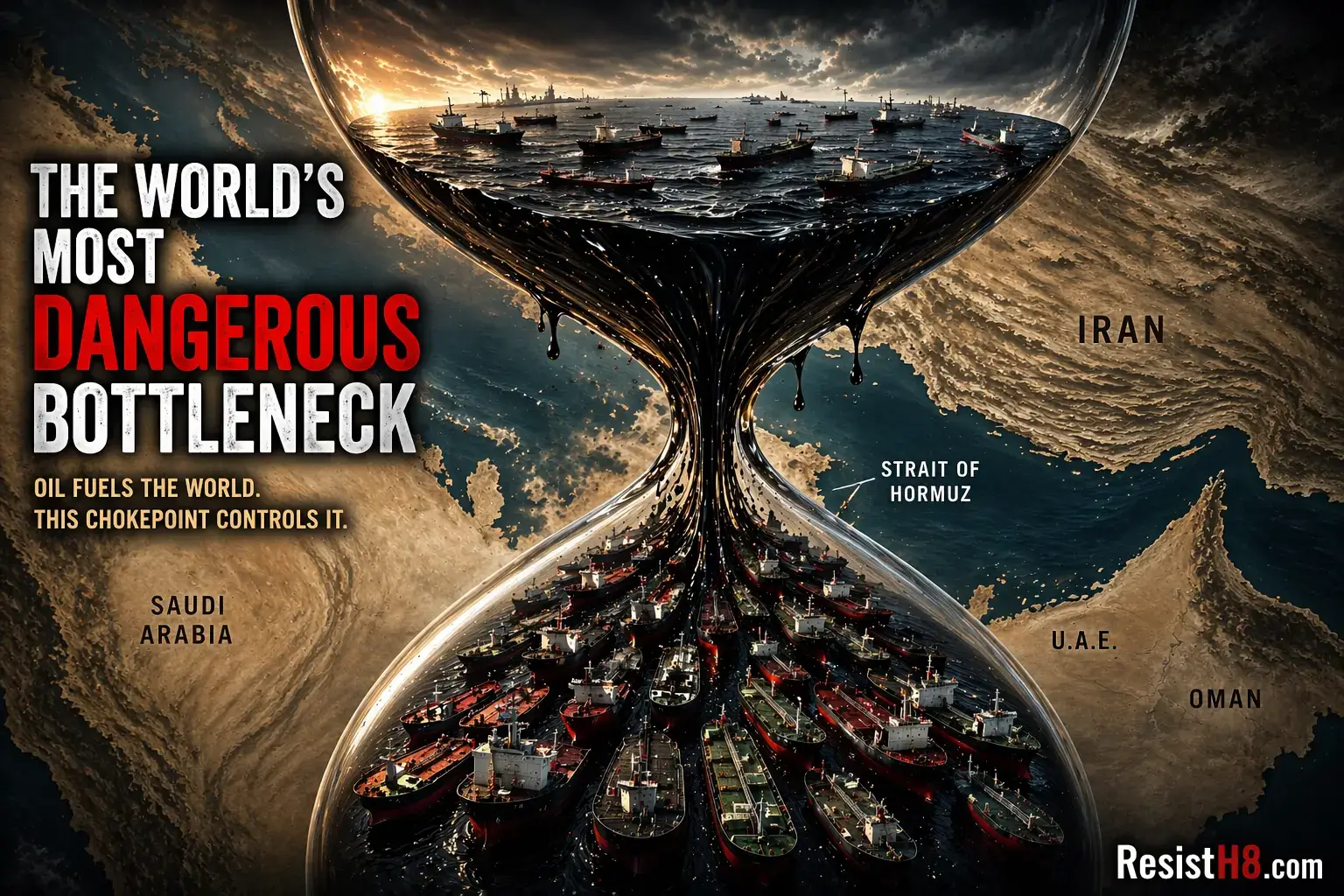

Iran declared the Strait of Hormuz, the world’s most critical oil shipping lane, open to all commercial vessels on Friday. Trump confirmed it, then immediately said the U.S. naval blockade on Iran would continue anyway. Welcome to the current state of diplomacy.
Here’s a sentence you don’t see every day: the Strait of Hormuz is technically open, and simultaneously not fully open.
On Friday, April 17, Iranian Foreign Minister Abbas Araghchi announced that passage through the Strait of Hormuz — the narrow waterway that handles roughly a quarter of the world’s seaborne oil — is “completely open” for all commercial vessels for the duration of the ceasefire in Lebanon.
Oil markets responded immediately and dramatically. Brent crude plunged around 9%, and U.S. West Texas Intermediate dropped more than 11% — one of the biggest single-day oil price collapses since the war began.
Trump posted his own all-caps confirmation on Truth Social: “THE STRAIT OF HORMUZ IS COMPLETELY OPEN AND READY FOR BUSINESS AND FULL PASSAGE.”
Then, in the very next sentence, he added that the U.S. naval blockade would remain “in full force and effect as it pertains to Iran, only, until such time as our transaction with Iran is 100% complete.”
So: open, but the blockade stays. Iran says the blockade violates the ceasefire terms. Trump says the deal isn’t done yet. And 20 ships were spotted moving toward the strait’s exit as analysts immediately began questioning whether any of this provides enough certainty for commercial shipping to actually resume.
This is where we are.
How We Got Here: A Very Compressed Timeline
The Strait of Hormuz has been at the center of the U.S.-Iran war since the beginning. When the United States and Israel launched Operation Epic Fury on February 28, 2026 — a coordinated campaign of airstrikes on Iranian military targets, including the assassination of Supreme Leader Ali Khamenei — Iran’s response was swift and economically devastating: it closed the strait.
The Islamic Revolutionary Guard Corps (IRGC) broadcast warnings over VHF radio that no ships were permitted to pass. The British Royal Navy acknowledged the closure wasn’t legally binding but admitted safety couldn’t be guaranteed, and ships began turning back.
By March 4, Iran claimed complete naval control of the waterway. The world’s energy markets went haywire.
Over the following weeks, Iran issued selective permissions — China, Russia, India, Pakistan, Iraq, and eventually several other countries were allowed passage for their vessels, mostly petroleum tankers. Iran also threatened to set fire to any unauthorized ships.
At least three tankers were struck near the strait. Meanwhile, the U.S. launched an aerial campaign in mid-March specifically targeting Iranian naval assets to pressure a reopening, and Israel assassinated the Iranian naval officer overseeing the blockade.

A temporary ceasefire on April 7 was supposed to include the reopening of the strait. Instead, Iran began charging tolls — reportedly over $1 million per ship — which Western nations rejected outright.
When U.S.-Iran talks in Islamabad collapsed on April 12 (JD Vance made the announcement), Trump responded by declaring a U.S. naval blockade of Iranian ports, deploying more than 10,000 sailors, Marines, and special operations forces to enforce it.
Today: Open-ish, For Now, Conditionally
Friday’s announcement came tied directly to the Israel-Lebanon ceasefire, which took effect Thursday evening. Iran’s position is clear: the strait’s reopening to all commercial traffic is part of the ceasefire package, and it is coordinated through Iran’s Ports and Maritime Organisation.
That last part matters. Ships aren’t simply free to sail through as they were before February. They still need to transit on “the coordinated route as already announced” by Iranian authorities.
Analysts quickly noted that shipping logistics through the Strait of Hormuz are complicated even in peacetime — in the middle of a war with an active U.S. naval presence and unresolved nuclear negotiations, the uncertainty is enormous.
Iran’s parliament speaker then posted a warning on X: if the U.S. blockade of Iranian ports continues, the strait will close again. “If the blockade continues, the Strait of Hormuz will not remain open,” he wrote.
Iran’s Foreign Ministry called Trump’s simultaneous confirmation-and-blockade announcement “contradictory positions,” and warned that Iran would take “necessary measures” if the U.S. doesn’t lift the naval blockade.
Trump’s response: the blockade lifts when a full deal is signed. Nothing before.
Meanwhile, world leaders were meeting in Paris on Friday for emergency discussions about how the strait will actually be administered going forward, with French President Emmanuel Macron and British Prime Minister Keir Starmer among those in attendance.


A small sign of normalcy: a cruise ship — the Celestyal Discovery, which had been stranded in Dubai for 47 days — reportedly crossed the strait on Friday. It was carrying no passengers, but it was the first passenger vessel to transit since the war began.
Why This Matters Beyond the Price of Gas
The Strait of Hormuz is 21 miles wide at its narrowest point, with shipping lanes just two miles wide in each direction. Through those lanes flows roughly 20–25% of the world’s oil and about 30% of its liquefied natural gas.
There is no adequate alternative route for most of it — while Saudi Arabia and the UAE have pipeline bypasses, Iraq and Kuwait have almost none, and those alternatives have their own vulnerabilities.
Every day the strait operates below capacity translates directly into elevated energy costs globally — at the pump, in home heating, in freight and manufacturing costs, in airline ticket prices. The months-long disruption has already hit the global economy hard.
War risk insurance premiums on tankers surged from roughly 0.05% of vessel value before the war to over 5% at the peak of the blockade — a 100-fold increase that effectively priced many shippers out of the route entirely.
The oil price drop on Friday — roughly $12 per barrel for Brent crude — reflects how much of a risk premium has been baked into global energy markets since February. The market is betting the worst is behind us.
Whether that’s accurate depends entirely on whether negotiations between the U.S. and Iran produce a signed agreement before the ceasefire expires and before either side decides they’ve had enough.
The Bottom Line
The Strait of Hormuz is open — in the sense that Iran has declared it open, ships are beginning to move, and oil prices have responded as if the crisis is easing.
It is not fully open — in the sense that the U.S. naval blockade of Iranian ports remains in force, Iran has warned it will close the strait again if the blockade continues, ships must still coordinate transit with Iranian authorities, and the entire arrangement is explicitly tied to a ceasefire that is ten days old and fragile.
The situation is, in the diplomatic equivalent of a sandwich: open on the outside, complicated in the middle, and likely to change again before you finish eating it.
Negotiations between the U.S. and Iran over a broader agreement — covering Iran’s nuclear program, sanctions, and the formal end of the war — are ongoing. Until something is signed, the strait’s status should be considered provisional.
The 10,000+ U.S. military personnel maintaining the blockade aren’t going anywhere yet, and Iran has made crystal clear that it views a continued blockade as a ceasefire violation.
Watch this space.