
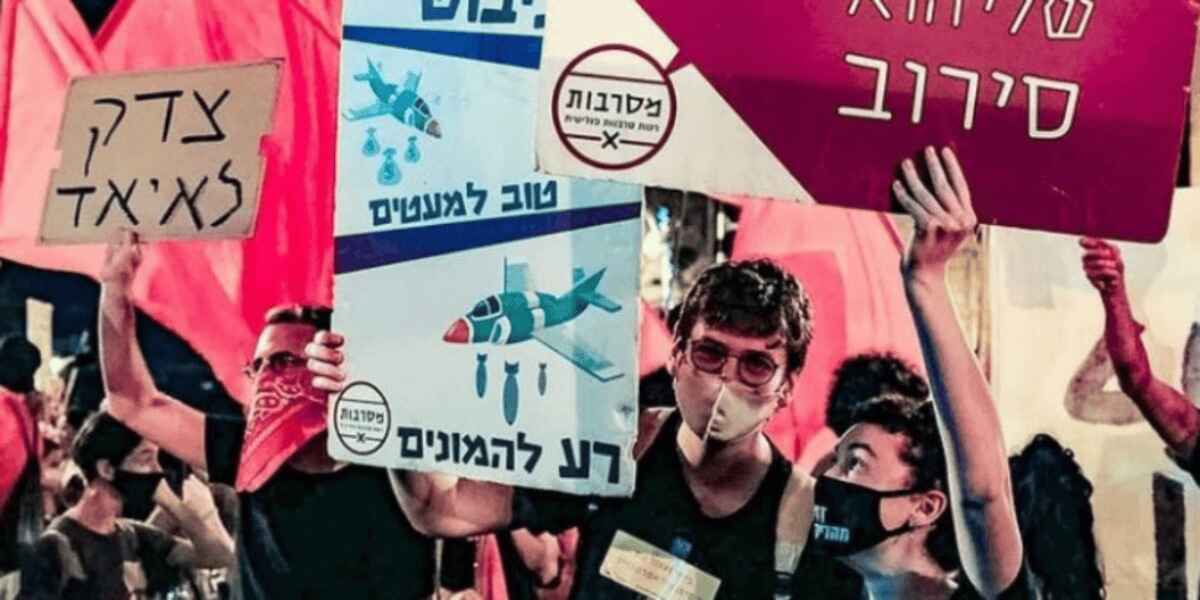

The refuseniks stand on Tel Aviv pavement holding a paper that orders them to put on a uniform, and they set it on fire. They know what comes next. A van. A military prison. Solitary, if they’re trans. A sentence that gets extended every time they refuse again — and they keep refusing again.
This is the part of Israel that doesn’t make it into most American newsrooms. While U.S. politicians repeat the line that Israel speaks with one voice on Gaza, a small but growing group of young Jewish Israelis are standing in front of cameras, lighting their conscription notices, and announcing they would rather sit in a military prison than fire a single round in their name.
The viral clip circulating this week — young people marching, signs demanding an end to the genocide, one young man speaking about the “circle of blood” caused by his country — is real.
It is also not new. It is part of a refusal movement that has been growing, quietly and at enormous personal cost, since the bombs started falling on Gaza in October 2023.

“I will not enlist in an army committing genocide”
Meet the refusers (refuseniks). The organization at the center of this movement is called Mesarvot — Hebrew for “refusers.” Founded in 2015, it provides legal support, media training, community, and a public platform for the Israeli teenagers who don’t want to serve in the IDF on political grounds. Military service is compulsory in Israel for most Jewish citizens at 18. What the refuseniks are doing is not just unusual. It is socially radioactive.
It is also, increasingly, a felony with teeth.
Before October 7, conscientious objectors typically served around three weeks in military prison. Since the war began, those sentences have ballooned. Tal Mitnick, the first refuser jailed after October 7, served 185 days. Itamar Greenberg served nearly 200 — the longest sentence for a conscientious objector in over a decade.
According to Mesarvot, the military has abandoned its prior policy of releasing refusers after 120 days. Extended prison terms are now the norm. The army repeatedly sends refuseniks back behind bars by treating each renewed refusal as a “new” offense.
Yuval Peleg, one of the refusers, has now served four separate stints in military prison, the most recent one 100 days long. He is expected to return for a fifth.
Yona Roseman, a 19-year-old trans woman who burned her draft papers in Tel Aviv in July 2025, was sentenced to 30 days that she knew from the start would be extended. As a trans prisoner, she spends most of her hours in solitary confinement — taken out for short, last-in-line breaks under army policy.
She refused anyway. “I am refusing because my country is committing genocide and I will not enlist into an army that’s committing genocide,” she told The Independent before going in. “I have no doubts in my mind that this is the right thing to do.”
“It’s important for me to point out, especially after being treated in a humiliating way following my arrest at protests, that the state’s attitude toward queer people is liberal and progressive only under specific conditions,” she said. “The moment you don’t meet the national standard, your rights are stripped away.”
“The circle of blood”
The phrasing from the viral video — a young man speaking about a circle of blood caused by Israel attacking its neighbors in his name — is the moral vocabulary the refuseniks have been building for two years.
Tal Mitnick, in his own refusal statement, wrote that “violence cannot solve the situation, neither by Hamas, nor by Israel. There is no military solution to a political problem.” He called the assault on Gaza a “revenge war” and said he refused to take part.
These are not vague pacifists. They are specific. They name the genocide. They name the occupation. They name the apartheid system the IDF enforces in the West Bank.
They name what is being done in Lebanon, where the U.S.-brokered April 2026 ceasefire has largely unraveled, with Israeli strikes continuing to kill Lebanese civilians, including women and children, on a near-daily basis.
They name what is being done in Gaza, where Israeli ceasefire violations have killed more than 800 Palestinians since the supposed ceasefire began.
And they say: not in my name. Not with my hands.
The wave the army is trying to drown
The numbers are still small. Around 20 Israeli teens have been publicly jailed for refusing the draft on political grounds since October 2023. A draft cohort is tens of thousands. The refuseniks themselves are the first to say so. “We’re talking about a few dozen refusers out of a draft cohort of tens of thousands. It’s not enough,”
Daniel Schultz, an 18-year-old who grew up believing the IDF was “the most moral army in the world,” told +972 before imprisonment.
But the trajectory matters more than the snapshot. In August 2025, seven refusers were jailed simultaneously — the largest number Mesarvot had seen at once since the organization began operating in 2016.
Beyond the public refusers, more than 300 reservists have sought support from the older refusal movement Yesh Gvul (“There is a limit”), most of them called up specifically for Gaza service.

Israeli media has reported that during the last major Gaza offensive, as many as 100,000 reservists declined to show up — a number the IDF disputes but cannot make disappear.
The army knows what a public refusal wave would mean. “The army doesn’t want refusal to become a political issue,” Ishai Menuchin of Yesh Gvul has said, “so when a wave starts they will try to repress it, to make the punishments more severe.” That is what extended sentences and solitary confinement are designed to do. Make the cost unbearable. Make the example terrifying.
It is not working as fast as the army would like.
What this footage is and what it isn’t
The video circulating on X this week is not proof that Israeli society has turned against the war. Polling inside Israel still shows broad support for the campaign, particularly among Jewish Israelis. Protestors at refuser demonstrations have been physically attacked in the street, including by a soldier in uniform.
Right-wing accounts circulate the names and faces of refusers to encourage harassment. The refuseniks are dissidents in the truest sense — a minority paying real prices for an unpopular conscience.
But the footage is also not nothing. It is the visible edge of a deeper crack. It is teenagers who grew up on the IDF mythology looking at what their country has done in Gaza and deciding their soul is worth more than their freedom.
It is a generation refusing to inherit the killing.
The “circle of blood” line lands because it is true. Hamas attacks Israelis. Israel responds by killing tens of thousands of Palestinians, the majority of them women and children. Hezbollah fires rockets. Israel levels southern Lebanon. Iran is drawn in.
The U.S. arms the cycle and calls it stability. The blood goes in a circle, and the people pulled into the middle of it are almost always the ones who never made the decision in the first place — the conscript, the civilian, the child.
The young Israelis lighting their draft papers are saying: I see the circle. I refuse to add to it. Lock me up.
That refusal is worth honoring. It is also worth remembering, when the next “Israel stands united” headline runs in an American paper, that this is what unity actually looks like — a state so frightened of dissent that it puts teenagers in solitary confinement for saying no.