
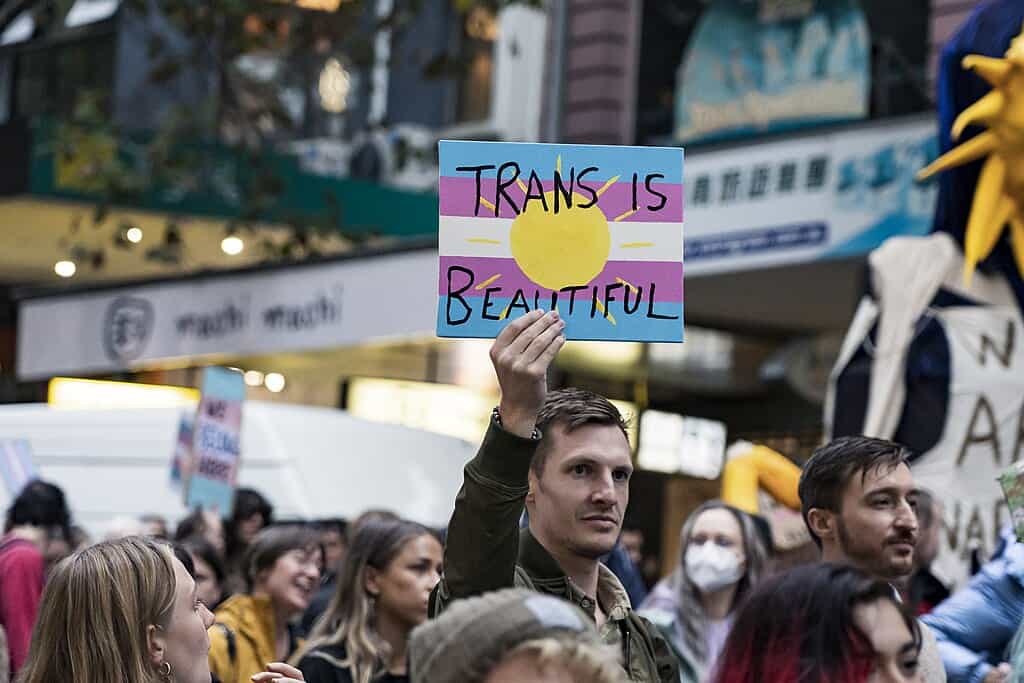

The war on the transgender community has resulted in a drop in the number of community health centers that offer gender-affirming care across the country. West Virginia is down to just two.
A year and a half ago, Danté Vega stopped taking testosterone. The 33-year-old West Virginian had begun hormone therapy after coming out as a transgender man at 29.
Then he left his job, lost his health insurance, and went on Medicaid — only to find that even with Medicaid, the medication cost more than he could afford. So he stopped.
He has since made peace with where he is in his transition.
But he also watches what is happening around him, and what he sees worries him.
Vega's situation is becoming the norm in West Virginia, where West Virginia Watch reporter Gabriella Souza found that an increasingly hostile political climate has made gender-affirming care harder and harder to reach.
The state is now down to just two community health centers that openly provide it: the Women's Health Center of West Virginia in Charleston and a Planned Parenthood in Vienna.
Transgender residents are leaving the state or going without care entirely — a choice that medical research ties to real harm to both physical and mental health.
For many patients, the providers say, this care is lifesaving. Danielle Maness, the medical director at the Charleston clinic, told the outlet that nearly every appointment now includes the same anxious questions: What happens if I can't get my medication anymore? How long do I have before I need to leave West Virginia?
Since the start of 2025, her clinic has written prescriptions or made referrals for 318 patients, and the wait for an appointment now runs about three months.
Staff say providers who once offered this care are relocating to other states, and that a growing number of insurers are refusing to cover it.
The pressure is coming from several directions at once. West Virginia has banned gender-affirming care for nearly all minors since 2023, and a 2025 law removed the last narrow exception that had allowed it for severe cases of gender dysphoria.

This past March, a federal appeals court upheld the state's refusal to cover gender-affirming surgery for adults on Medicaid, and the plaintiffs' request for another hearing was denied.
State lawmakers also pushed bills that would have treated a transgender person using a locker room as a sex offender and banned drag performances in public spaces.
Both failed in the House of Delegates, but the message they sent landed all the same.
None of this is unique to West Virginia. In June 2025, the U.S. Supreme Court upheld Tennessee's ban on gender-affirming care for transgender youth in United States v. Skrmetti, making it far harder to challenge similar laws — which now exist in more than two dozen states.
Since early 2025, the Trump administration has leaned on hospitals with funding threats, federal investigations, and subpoenas seeking the medical records of transgender minors.
At least 20 hospitals, in both red and blue states, have dropped gender-affirming care for young people rather than risk the consequences.
Every major American medical association treats this care as evidence-based and medically necessary, yet that consensus has done little to slow the legal and political campaign against it.
Billy Wolfe of the ACLU of West Virginia — which is helping build a fund to cover care for transgender residents — argues the fear is manufactured on purpose.
The politicians stoking it, he says, don't have answers for what people actually struggle with, like the cost of living or clean drinking water, so they hand people someone to blame instead.
One season it's immigrants; the next it's transgender people in bathrooms.



Del. Kayla Young, a Democrat from Kanawha County, noted that the 2025 restriction on care for minors was pushed through on the final day of the legislative session, under a procedural move that blocked lawmakers from even speaking against it.
West Virginia is one of the least healthy states in the country, she said, and its leaders are spending their energy taking things away rather than helping anyone.
For the people living through it, the cost is measured in fear and distance — longer drives, fewer options, and the creeping sense that it is no longer safe to be visible.
Mariah Felty, the LGBTQIA+ Health Coordinator at a West Virginia clinic said, “Unfortunately, there’s a lot of folks who are listening to what they’re being told instead of getting to know folks in the community to make their own judgment about people,” she said.
“To see that villainization, particularly of trans folks, is bizarre, and unfortunately, I’ve seen a lot of rhetoric like, ‘I can’t get my medication covered by my insurance, I can’t get this medically necessary procedure covered by my insurance, so why should people receive gender-affirming care when that’s a choice?'”
Vega, who volunteers with Huntington Pride, hears it constantly from other transgender West Virginians.
“There's a lot of people that are too scared to be themselves right now," he said.
The fear is doing exactly what it was built to do.
The real question is how many people it drives out of the state, or out of care, before it is undone.
Know that you are not alone. ❤️ There are resources available if you need help.