



This article will cover Pierre Damas Bel — who he was and what happened to him — in just a moment.
First, there are a few things I need to say to the folks in Washington, D.C.

God forgive America.
There are concentration camps filled with innocent mothers, fathers, grandparents, and children in America. People who have lived and worked in this country for years, sometimes for decades.
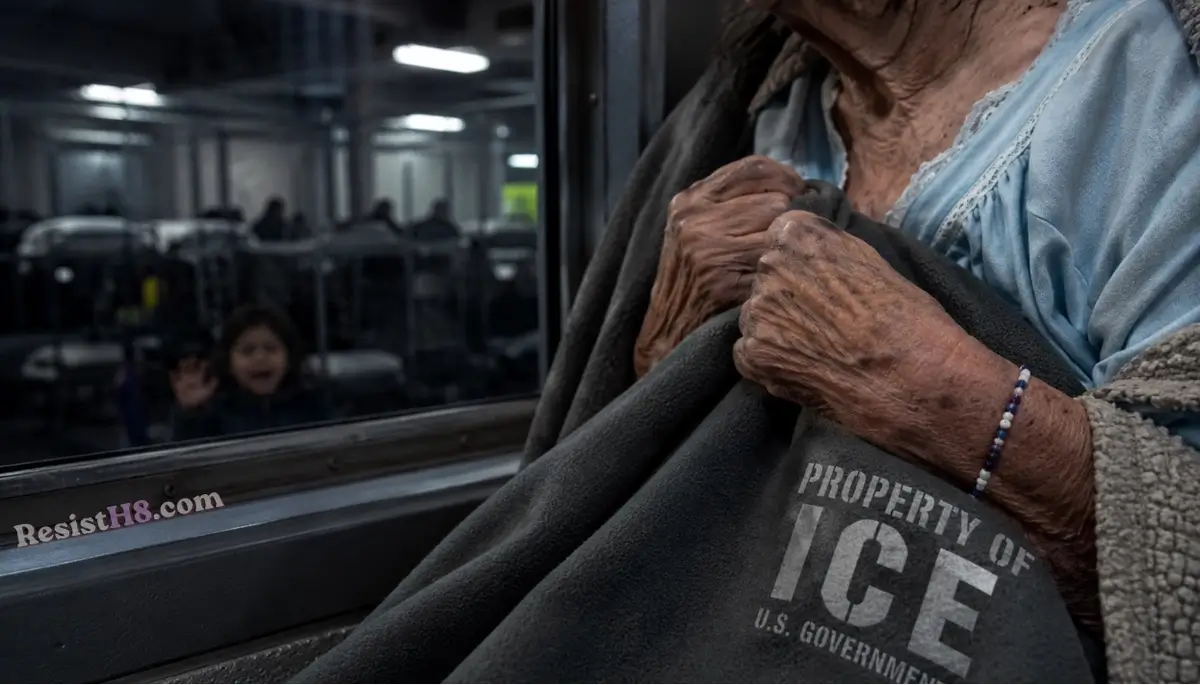
They built our homes, picked our food, and cared for our sick. They acted as guardian angels watching over our mothers, our fathers, and our children.
They paid taxes. They funded Medicaid and Medicare, knowing they would never have access to those programs themselves.
What do they receive in return?
A GPS monitor. Harassment. Violent assaults by men wearing masks. Each day there’s a chance they might be detained or shot.
Months locked in a cage inside a detention center called Alligator Alcatraz. Maggots in their food. Politicians joking and laughing at the idea of them being eaten by an alligator.
People inside detention camps aren’t getting enough food to eat or they aren't receiving proper medical care. Their child is sick because there’s a Measles outbreak.
They have no contact with family. No friends. They can't call or visit with a lawyer.
At some point they realize that once they’re deported to God-knows-where, they will never again be able to sit on the back porch of the home they built in Springfield and watch their kids play in the backyard.
They were ripped away from the small businesses they opened.
Who will tell the staff where they’ve gone? Will the doors simply be left unlocked for looters to take everything they worked for?
And then, after these people have already been disrespected, humiliated, and treated like animals, they’re given a one-way ticket back to the country they escaped from.
They fled war. Rape. Torture. Gang violence. Famine. U.S. troops bombing their homes.
They fled their home and ran toward the promise of asylum, safety, and a shot at “the American dream.”
For some, that one-way ticket lands them in a war-torn country they’ve never even been to before. They don’t know anyone there, they can’t speak the language, they dont have money for food or shelter. It’s as though America dropped them onto a different planet.
The U.S. State Department warns American citizens not to travel to that country because it’s not safe. The country’s government has a long history of human rights violations.
Yet this is where that woman, the one who held your mother’s hand and prayed with her as she passed away last month, is being dumped. Dropped in the middle of a strange country like a bag of trash.
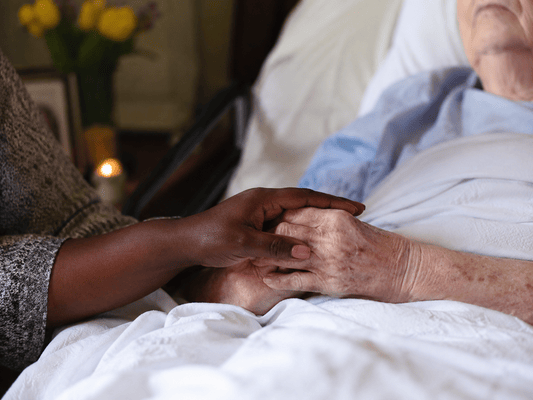
She has no money.
No family.
No friends.
No clothes.
No way out.
She was there. For your Mother.
All of you in the federal government should be deeply ashamed of yourselves.
God forgive America under this fascist regime.
If you or someone you know is struggling, call or text 988 to reach the Suicide and Crisis Lifeline. Press 2 for Spanish, and Haitian Creole support is available through the Lifeline's interpretation service.
Pierre Damas Bel had been a college student for exactly one week.
He was 20 years old. He graduated with honors from Springfield High School in May, played forward and midfield for the Springfield Wildcats, and wore a Junior ROTC uniform he was proud of. He came to Ohio from Haiti in 2024 to reunite with his parents.
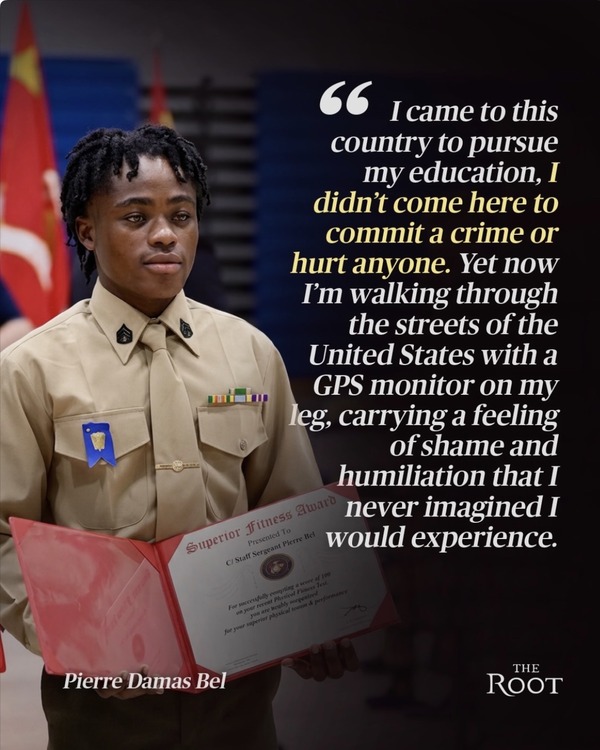
He started classes at Wright State University on August 24, studying neuroscience because he wanted to be a doctor. He was the oldest of three brothers.
On Monday morning, August 31, he pulled his car onto the shoulder of Interstate 70 in Clark County, walked into the westbound lanes, and was struck and killed by a tractor-trailer. His family says he died by suicide.
Three hours before it happened, he called his father on video.
"I'm not feeling okay mentally because of the bullying," his father, Pierre Ronal Bel, remembers him saying.
His father told him to come home so they could talk. Around 11 a.m., police knocked on the door instead.
The device on his leg
Pierre was one of roughly 350,000 Haitians who lost Temporary Protected Status after the Supreme Court cleared the way in June for the Trump administration to terminate Haiti's designation.
TPS exists precisely for countries too dangerous to return to. Haiti — where gangs control most of the capital and hundreds of thousands are displaced — is the textbook case.
The administration ended it anyway.
What followed in Springfield, home to an estimated 12,000 to 15,000 Haitian residents, was mass tagging.
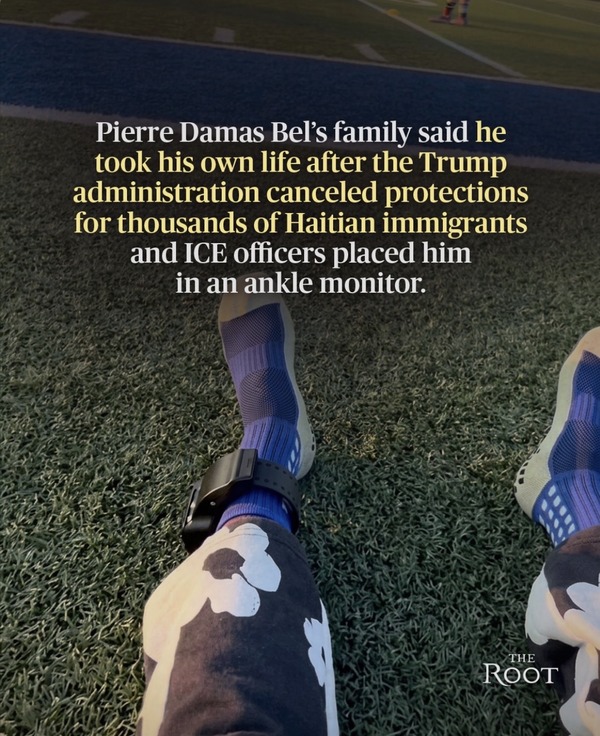
A senior DHS official has said ankle monitors are being issued partly because there is nowhere to put 300,000-plus people.
So hundreds of Springfield Haitians were called into ICE offices and fitted with GPS trackers, then sent back to their jobs, their churches, and in Pierre's case, his freshman year of college.
His father says the device changed his son. He couldn't comfortably play soccer anymore. He was no longer able to play for the Wittenberg University men's team after losing status, and he was not issued an ROTC uniform at Wright State.
His father made two trips to ICE offices trying to get the monitor taken off.
And at school, classmates saw the box on his ankle and made fun of him.
He was called a criminal. He was mocked.
His father said the ankle monitor left Pierre feeling like he was "treated like an animal," according to a statement read by Springfield pastor Carl Ruby.
That’s what an ankle monitor does. It broadcasts. It tells every stranger in a lecture hall that this person is dangerous, before he even opens his mouth.
"When you're dehumanizing people, you're putting chains on people who have not ever committed a crime," said Yola Lamarre, Pierre's friend, at a Tuesday gathering.
What the powerful said

Ruby, who sat with the family, went public immediately. "I wish President Trump could hear the mom's wails," he wrote, adding that the family wants the public to know this was a suicide and to know whose policies they hold responsible.
Ohio Gov. Mike DeWine, a Republican, called it a "horrible, horrible tragedy" and said the administration's mass deportation policy is misguided and wrong.
He asked out loud whether this is really what Americans want done in their name. He reached out to the family personally.
Wright State President Sue Edwards said the university was heartbroken by the loss, describing Pierre as an honors student already engaged in campus life.
DHS offered something else. A spokesperson responded to a young man's death with a lecture about decisions: "Remaining in the country illegally, while fighting removal, is a choice," the agency said, pitching a plane ticket and $2,600 as the alternative.
ICE separately said it does not comment on a cause of death during an open investigation
That statement completely ignored the grieving father
What we don't know, and what we do
The Ohio State Highway Patrol investigation is still open. And Pierre's father has said he is not fully convinced: he told The Haitian Times he wants to see video, that he needs proof, that he cannot picture his son doing this.
Both things can be true at once — a family wants the world to view this as a suicide caused by dehumanizing policy, and a father who can’t yet believe that it happened. Grief does not resolve neatly.
Suicide is also rarely traceable to one cause. Experts consistently caution that it emerges from layers of pressure, not a single trigger, and honest coverage should make that clear.

Policy is one of the layers though, and it’s the one we choose. The federal government pretends Haiti is safe when it clearly isn’t. DHS decided to tag a teenager who had never been accused of a crime.
It decided to make his status visible to every classmate he passed.
Those were choices, made by people in power, and they chose a kid who wanted to be a doctor.
Pierre’s family, his two younger brothers, and 12,000 neighbors in Springfield are still wearing a GPS tracker.
If you or someone you know is struggling, call or text 988. If you are an immigrant afraid to seek help, the Lifeline does not ask about immigration status.
We’ll just leave this here for the Republicans