

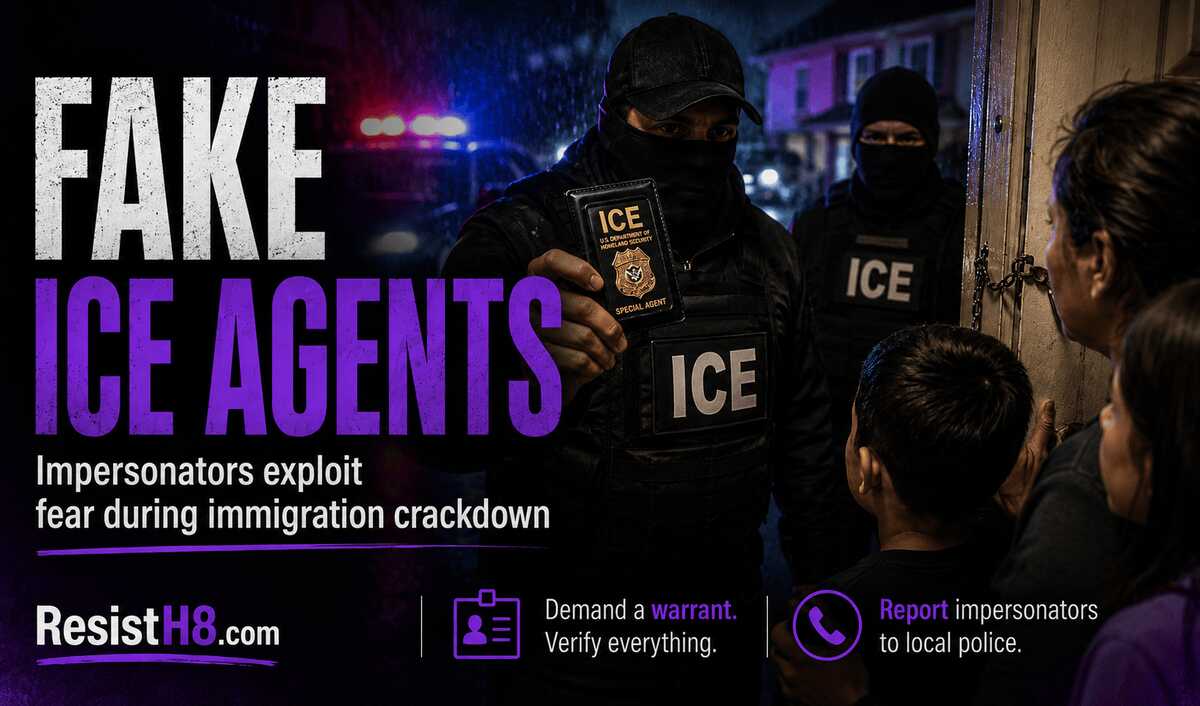

A hooded man kicked down a bedroom door in Greensboro, North Carolina, shouting “ICE! ICE!” The Mexican immigrant inside raised his hands. Then the man asked where the money was, and the immigrant understood. It was not ICE. They were fake ICE agents. It was a robbery.
By the time the four assailants left, one resident’s forehead had been split open with the butt of a gun — ten stitches, four staples — and a gun had been pointed at a baby while the assailants demanded money from the infant’s parents.
That assault happened on January 20, 2025 — the same day Donald Trump returned to the White House promising the largest mass deportation operation in American history. More than a year later, no one has been arrested.
A Noticias Telemundo investigation, reviewed and reported out by NBC News, documented at least 31 cases of fake ICE agents preying on immigrants in 2025 alone. The previous decade averaged 5.3 incidents per year. That is roughly a six-fold spike in a single year. And the violence has escalated alongside the volume: between 2014 and 2024, about 23 percent of documented incidents involved violent acts. In 2025, that number jumped to 38 percent.
The crimes catalogued read like a war zone. A Dominican woman dragged into a basement, beaten, and raped after leaving a medical appointment in New York. A Venezuelan immigrant raped at her workplace in North Carolina by a man claiming to be a federal agent.
A Dominican cashier in Philadelphia zip-tied and robbed of $1,000 by an armed man wearing a vest marked “Security Enforcement Agent.” A driver in California flashing police lights and sirens hitting a person while shouting “ICE raid!”
An armed man in Florida cycling through an apartment complex hunting for “illegal Mexicans.” An attempted rape of a woman in broad daylight in Brooklyn Heights.
Eighty-four percent of the 2025 cases involved someone claiming to be ICE specifically. The rest impersonated Border Patrol or the Department of Homeland Security.
The mask makes it possible
The crime exists because the federal government has made it possible. ICE agents now routinely conduct operations in masks, plainclothes, and unmarked vehicles. The agency defends this practice by pointing to doxxing risks and an 8,000 percent increase in death threats against officers.
ICE says its officers carry badges and credentials and will identify themselves “when required for public safety or legal necessity” — language vague enough to mean almost anything.
The result is a country where any man in a hood, vest, and tactical gear can credibly claim to be a federal agent. The victims interviewed by Telemundo said they could not tell the difference between real ICE agents and impostors “because now they all come hooded.”
John Tobon, a retired deputy director of Homeland Security Investigations who spent 31 years in ICE’s investigative arm, said flatly that no law enforcement agent should cover their face or refuse to identify themselves. “If that opens the door for people to act and retaliate against agents, that’s something we already know. It’s a risk we accept when we take the job.”
Naureen Shah, who directs government affairs for the ACLU’s equality division, was clear. “We are in uncharted territory. We’ve never in this country experienced masked agents on this kind of scale. And so, we’ve never experienced this problem before of people being able to credibly impersonate federal law enforcement agents.”
She noted that masked figures carry a specific legacy in American history — the Ku Klux Klan — and that masks are designed to terrorize.

The FBI knew
This is not a secret the government stumbled into. An internal FBI bulletin obtained by Telemundo, dated October 2025, warned that criminals were “taking advantage of ICE’s higher public profile and media coverage to target vulnerable communities and commit criminal activity.”
The bulletin flagged at least five separate incidents between January and August 2025, including a previously unreported New York case where three men in black clothing robbed an ATM, tied up two people, and put a trash bag over one victim’s head.
The FBI’s own assessment was that these incidents make it “difficult for the community to distinguish” legitimate officers from impostors — destroying the trust law enforcement claims to need.
Despite this, DHS and ICE did not respond to Telemundo’s requests for official statistics or comment.
Only two suspects in the entire country were charged federally with impersonating an ICE agent in 2025.
Why most of it never gets reported
Telemundo reached out to at least a dozen immigrants who had been victims or witnesses. Seven did not respond or declined to talk. That included two women who, according to court records, had been raped by fake agents. They cited fear of their attackers and fear of being identified by immigration authorities.
Rep. Laura Friedman is a California Democrat who led 30 other members of the House Democratic Women’s Caucus in an August letter to then-DHS Secretary Kristi Noem demanding ICE agents identify themselves visibly.
Friedman said the obvious: “If someone is robbed or assaulted and is undocumented, in this environment, they’re probably not going to come forward and complain to the police. It’s very possible that this is happening a lot more than we even know.”


The mechanism that keeps these crimes invisible is the same mechanism that produces them. ICE’s cooperation agreements with local police mean immigrant victims often cannot tell whether the officer taking their report will end up calling immigration.
Nina Cano, an immigration attorney who represented one of the survivors, said immigrants fear “the very officer they go to report a crime will be the one who calls immigration.”
In September, a Honduran immigrant in Iowa survived being shot during an attempted robbery and went to police to retrieve his vehicle. They arrested him on an old traffic warrant and turned him over to ICE.
This is the system working as designed. Victims who cannot report are victims who do not exist on paper. Crimes that do not exist on paper are crimes that do not require federal action.
State and local pushback
California passed a law banning agents from wearing masks or refusing to identify themselves. A federal judge blocked enforcement after the Trump administration sued.
Philadelphia’s City Council passed legislation prohibiting ICE agents from wearing masks or using unmarked vehicles and requiring them to display badges. Kendra Brooks, the Philadelphia City Council’s minority leader, made the parallel that shouldn'tneed to be made: the gas company and the water department have to identify themselves when they come to your door.
The question of why federal agents are exempt from a standard the utility company has to meet does not really have an answer that makes sense.
Philadelphia District Attorney Larry Krasner, who said he had never encountered cases like this in the city before 2025, told Telemundo that people committing serious crimes while pretending to be ICE agents “absolutely should be locked up.”
Federal impersonation is punishable by up to three years in prison. Two charges in a year is not the response of a government that considers this a priority.
The aftermath
The young Mexican immigrant who was harassed by a fake ICE agent while landscaping on Sullivan’s Island, South Carolina, was the only worker in his crew who reported the crime. His co-workers were too afraid.
He has since had his first panic attack. He has insomnia and dread in places he used to enjoy. The man who threatened him — Sean-Michael Emmrich Johnson — pleaded guilty and was sentenced to three years’ probation and 200 hours of community service.
In Greensboro, one of the men attacked in the January 2025 home invasion barely leaves his house. He has installed extra locks. A Christ figurine watches the door. Archangels and holy cards line the walls.
“I know they’re just pieces of wood or little locks,” he said, “but they help me because I feel a little safer.” More than a year after the assault, no one has been arrested.
He said what most victims will not say out loud. “What if he had killed me?”
The administration that promised the largest mass deportation in American history has produced exactly the conditions that allow predators to operate with impunity inside immigrant communities — masked federal agents indistinguishable from masked criminals, victims too frightened to report, and a federal apparatus that has charged two people in a year.
The cruelty is the policy. The collateral damage is the point of the policy. And the people paying for it are, as always, the ones with the least power to refuse.