
New York City Mayor Zohran Mamdani publicly condemned a real estate event held Tuesday at a Manhattan synagogue that promoted property sales in Israeli settlements built on occupied Palestinian land — settlements that the United Nations, the International Court of Justice, and most of the international community have repeatedly declared illegal under international law.
The event, called the Great Israeli Real Estate Event, took place at Park East Synagogue on the Upper East Side. It is part of a roving expo that markets land in Israel and the occupied West Bank to buyers in the United States, Canada, and the United Kingdom.
Sponsored by a group called Home in Israel, the showcase advertises help with taxes, schools, and other logistics for Americans looking to relocate.
Through a spokesperson, Mamdani made his position unambiguous. “Mayor Mamdani is deeply opposed to the real estate expo this evening that includes the promotion of the sale of land in settlements in the Occupied West Bank,” said Sam Raskin. “These settlements are illegal under international law and deeply tied to the ongoing displacement of Palestinians.”
What’s Actually Being Sold
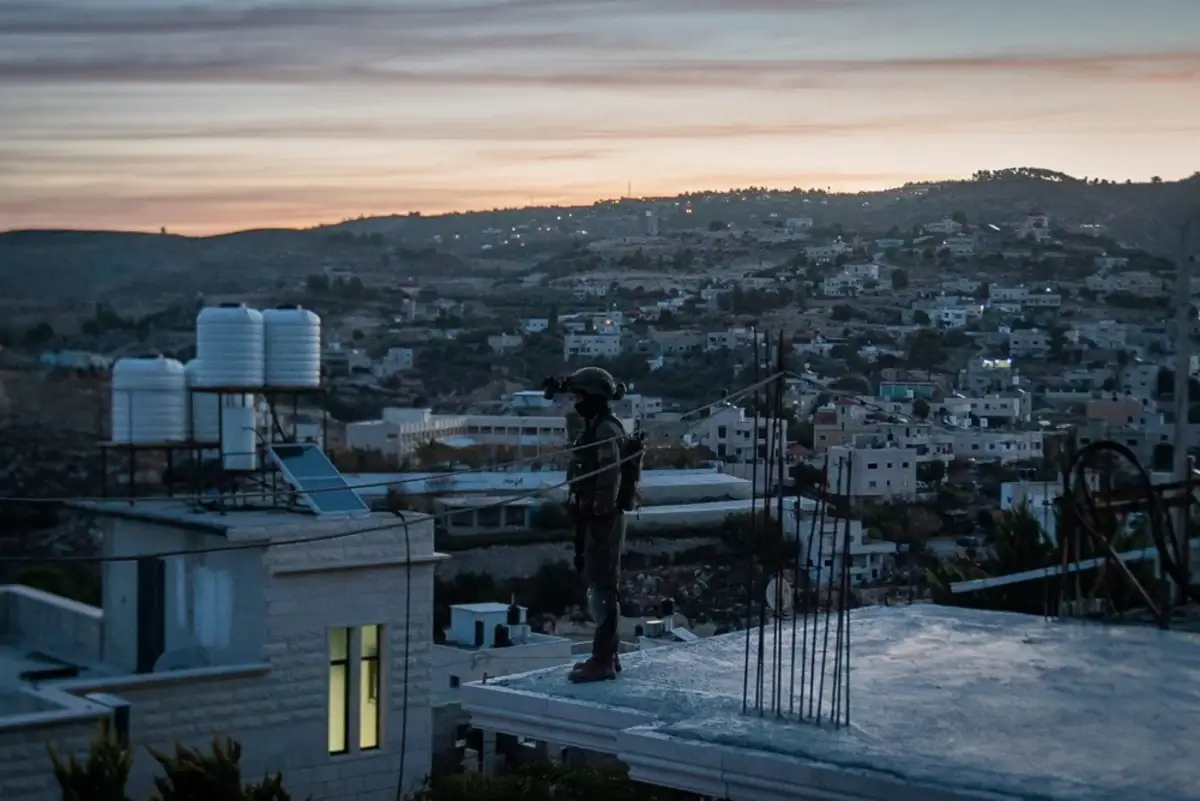
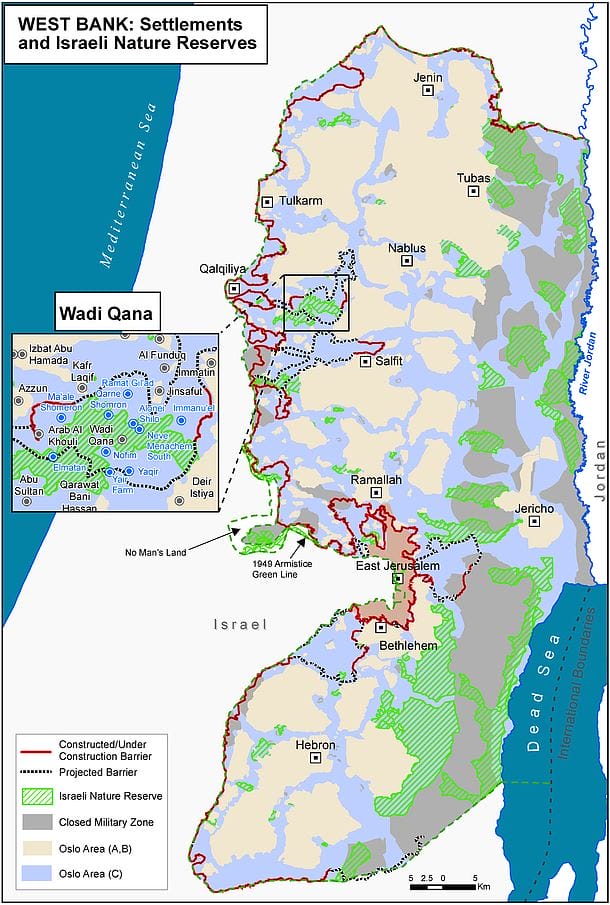
This is not a vague concern. Reporters from The Intercept who attended the expo documented at least one company, Harey Zahav, displaying a map and brochures of properties in Kfar Eldad, Karnei Shomron, and other West Bank settlements.
The expo’s own website references Gush Etzion, a cluster of roughly 20 settlements south of Jerusalem.
Lara Friedman, president of the Foundation for Middle East Peace, explained why that matters. “Gush Etzion is the Israeli term for an area of the West Bank located south of Jerusalem on which, under international law, all Israeli construction, all Israeli communities are considered illegal under international law,” she said.
The settlement movement, she added, treats the entire territory as a single religious birthright — erasing any distinction between Israel and the lands it occupies.
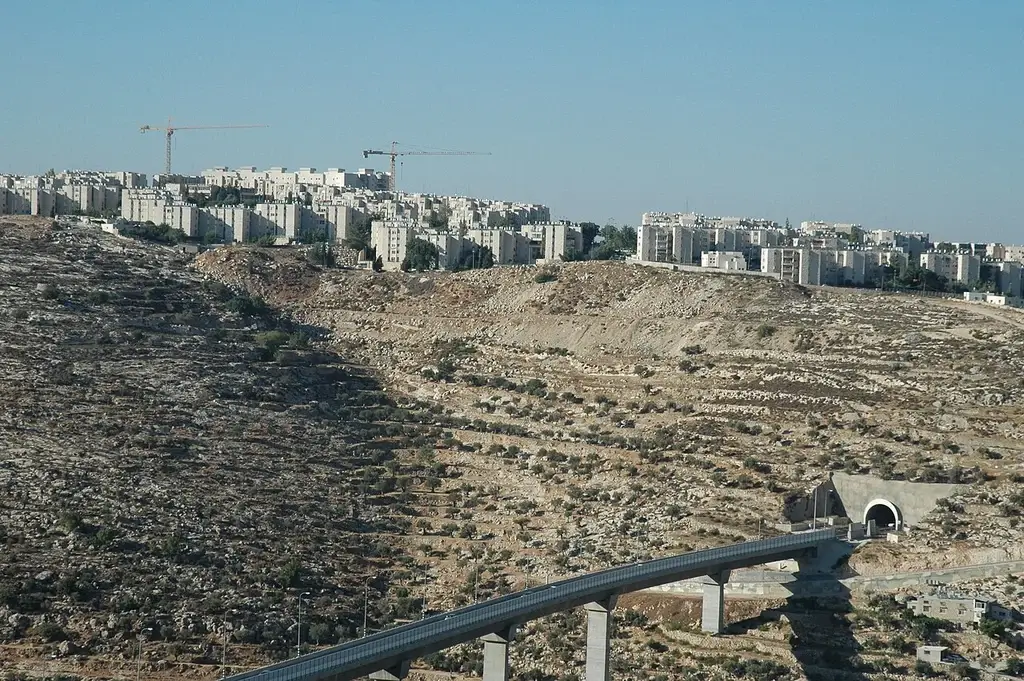
Bridge connecting Israel with the West Bank/Palestine.
This is a tunnel and bridge leading from the Jerusalem suburb of Gilo to the West Bank settlements of the Gush Etzion bloc. (Justin McIntosh CC BY 2.0)
In plain terms: Americans were being invited inside a New York synagogue to buy houses built on land taken from Palestinians, in communities that the world’s highest legal bodies have ruled cannot lawfully exist.
A Pattern of Discrimination
Israeli settlements in the West Bank are widely understood to be open only to Jewish residents. That has surfaced legal problems for similar expos held on U.S. soil.
At a 2024 real estate event in suburban New Jersey, protesters reported being explicitly asked about their religious affiliation when they tried to register, raising serious questions under American anti-discrimination laws. The New Jersey Civil Rights Division questioned realtors about their practices in response.
Similar fairs have been held in Baltimore, Montreal, and other North American cities, often hosted at synagogues.
The pattern is the same: a foreign government’s expansionist project finding a marketing pipeline through houses of worship in liberal democracies.
Protests and the Free Speech Question
The pro-Palestine group Pal-Awda announced a protest outside Park East Synagogue, writing on social media, “We will not be silent as ethnic cleansing is being actively promoted in our neighborhoods.” A counter-protest flyer also began circulating, though it did not appear to come from the synagogue itself, which declined to comment.
This sets up the kind of confrontation Mamdani has tried to navigate carefully. Past expo events have produced violent clashes between demonstrators and counter-demonstrators.

Raskin’s statement on behalf of the mayor explicitly defended both sides of the equation: “Our administration has also been clear that we are committed to ensuring safe entry and exit from any house of worship, and that such access never be in question while all protesters are able to exercise their First Amendment rights.”
That balance is consistent with Mamdani’s record so far. In April, he vetoed a City Council bill that would have created buffer zones around universities and other educational institutions, calling it overbroad and a threat to free speech.
A narrower companion bill, which requires the NYPD to develop a protection plan for houses of worship but drops the buffer zone language, became law on April 25 after Mamdani declined to either sign or veto it.
The Bigger Picture
What happened in Manhattan on Tuesday is not an isolated curiosity. It’s a routine, organized commercial channel that funnels American money into the physical expansion of an occupation. Every house sold in Kfar Eldad or Karnei Shomron is a fact on the ground that makes a future Palestinian state harder to imagine and a Palestinian family is forced out of their home (killed in some cases).
For Mamdani — the first Muslim mayor of New York and a politician who built his coalition partly on opposition to U.S. complicity in the war on Gaza — this was a low-cost, high-clarity moment.
He didn’t try to police the event out of existence or summon the NYPD to break it up. He named what was being sold, said it was illegal, and connected it to Palestinian displacement. That is the kind of plain speaking elected officials in the U.S. have spent decades avoiding on this issue.
The expo will move on to its next city. The settlements will keep growing. But for once, the mayor of America’s largest city declined to pretend that buying a house built on stolen land is just real estate.