


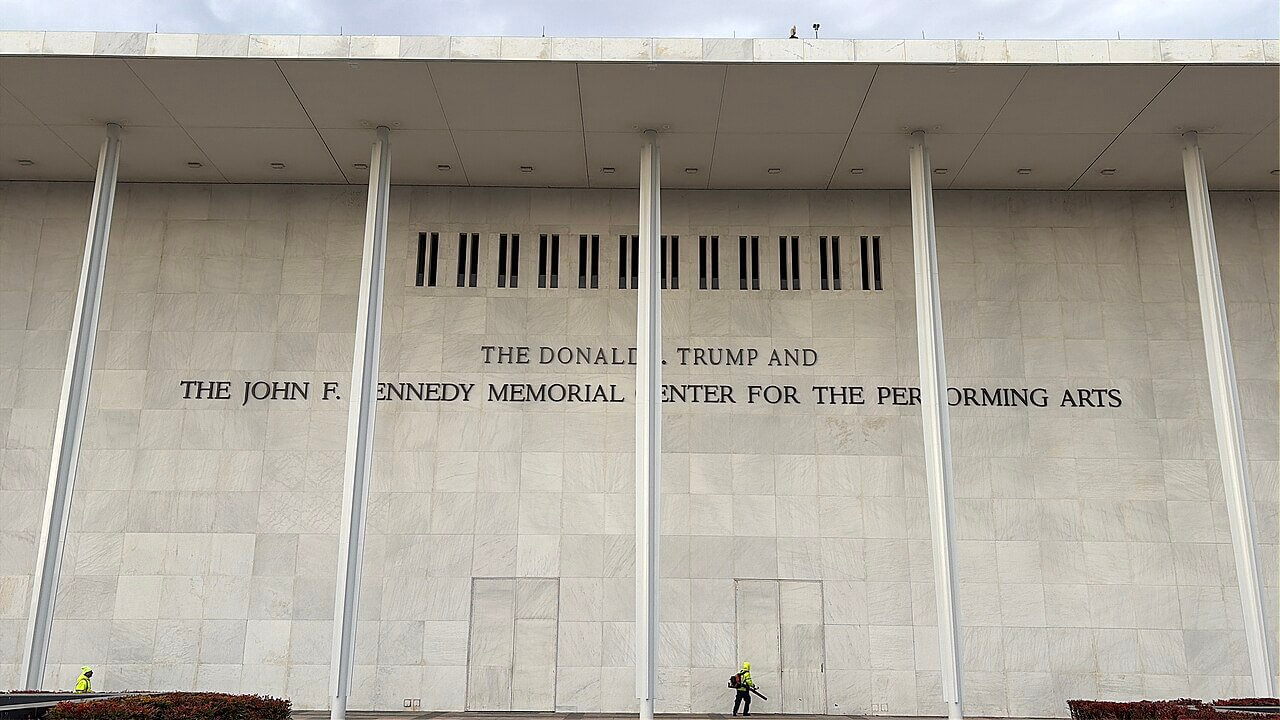

A federal judge told President Donald Trump on Friday that he does not get to put his own name on the Kennedy Center.
By Saturday, Trump was on Truth Social ranting about the Kennedy Center ruling, calling the judge “an anti-Trump Hater,” blaming the judge’s wife for the ruling, floating the idea that the judge should face charges, and predicting the nation’s premier performing arts center would “soon be closed, probably never to open again.”
It was a lot of fury over a building Trump now says he wants nothing to do with.
What the judge actually ruled
U.S. District Judge Christopher Cooper issued a 94-page decision on Friday — Kennedy’s birthday — finding that Trump’s handpicked board broke the law when it renamed the institution the “Trump Kennedy Center” in December.
The reasoning was straightforward: Congress created the Kennedy Center and gave it its name, so only Congress can change it.

Cooper ordered Trump’s name stripped from the building’s facade, its signage, and its website within two weeks.
The judge also temporarily blocked the board’s plan to shut the center down for a roughly two-year renovation set to begin in July.
He described the board’s March vote to close it as “ill-informed and seemingly preordained,” saying the trustees had rubber-stamped the decision without weighing their legal obligations or the consequences for the center’s programming.
That board is not a neutral body. Shortly after returning to office in January 2025, Trump ousted the Kennedy Center’s existing leadership, installed his own slate of trustees, and had them name him chairman.
The lawsuit that succeeded was brought by Rep. Joyce Beatty, an Ohio Democrat who sits on the board through her role in Congress.
“The Kennedy Center is an institution that belongs to the American people, not to Donald Trump,” Beatty said.
The response
Rather than engage with the legal reasoning, Trump went after the people behind the ruling.
He singled out Cooper’s wife, attorney Amy Jeffress, suggesting without evidence that her work created a conflict of interest.
He noted that her law firm represents former President Joe Biden in a separate case and once represented E. Jean Carroll, the writer a jury found Trump had sexually abused. Cooper himself was nominated to the bench by Barack Obama — the detail Trump leaned on to cast the ruling as partisan rather than legal.
Trump tied the loss to other recent defeats, including the Supreme Court’s rejection of his sweeping tariffs in February, and complained that it was “impossible for me to be treated fairly.”
He claimed the center was “rusted, rotted, and rat and bug infested,” and said that if he couldn’t run the renovation, the institution could simply close.
In a separate post about musicians pulling out of a planned 250th-anniversary celebration, he wrote, “Cancel it.”
He also tried to distance himself from the renaming he had presided over, insisting it was the board’s idea, not his.
Why it matters
The Kennedy Center fight is small next to tariffs or immigration. But the pattern in Trump’s response is not.
When a court rules against him, the reaction is not an appeal on the merits — it’s a personal attack on the judge, an insinuation about the judge’s family, and a suggestion that ruling against the president should carry consequences.
That is the language of a leader who treats an independent judiciary as an obstacle rather than a check.
The legal principle Cooper applied is about as nonpartisan as it gets: a board appointed by the president cannot unilaterally rewrite an act of Congress, even when that board is stacked with the president’s loyalists.


Stripping a sitting president’s name off a public memorial he placed there himself is not “anti-Trump.” It’s the statute working as written.
A spokesperson for the Kennedy Center said the board expects to win on appeal and to see Trump’s “historic contributions” recognized.
The Justice Department, which is defending him, said it would keep fighting for the renovation.
For now, the names come down, the doors stay open, and a president who wanted a monument to himself is instead reminded that some institutions still belong to the public.
You can follow how this fits the state of our country in our Life in Trump’s America series.