
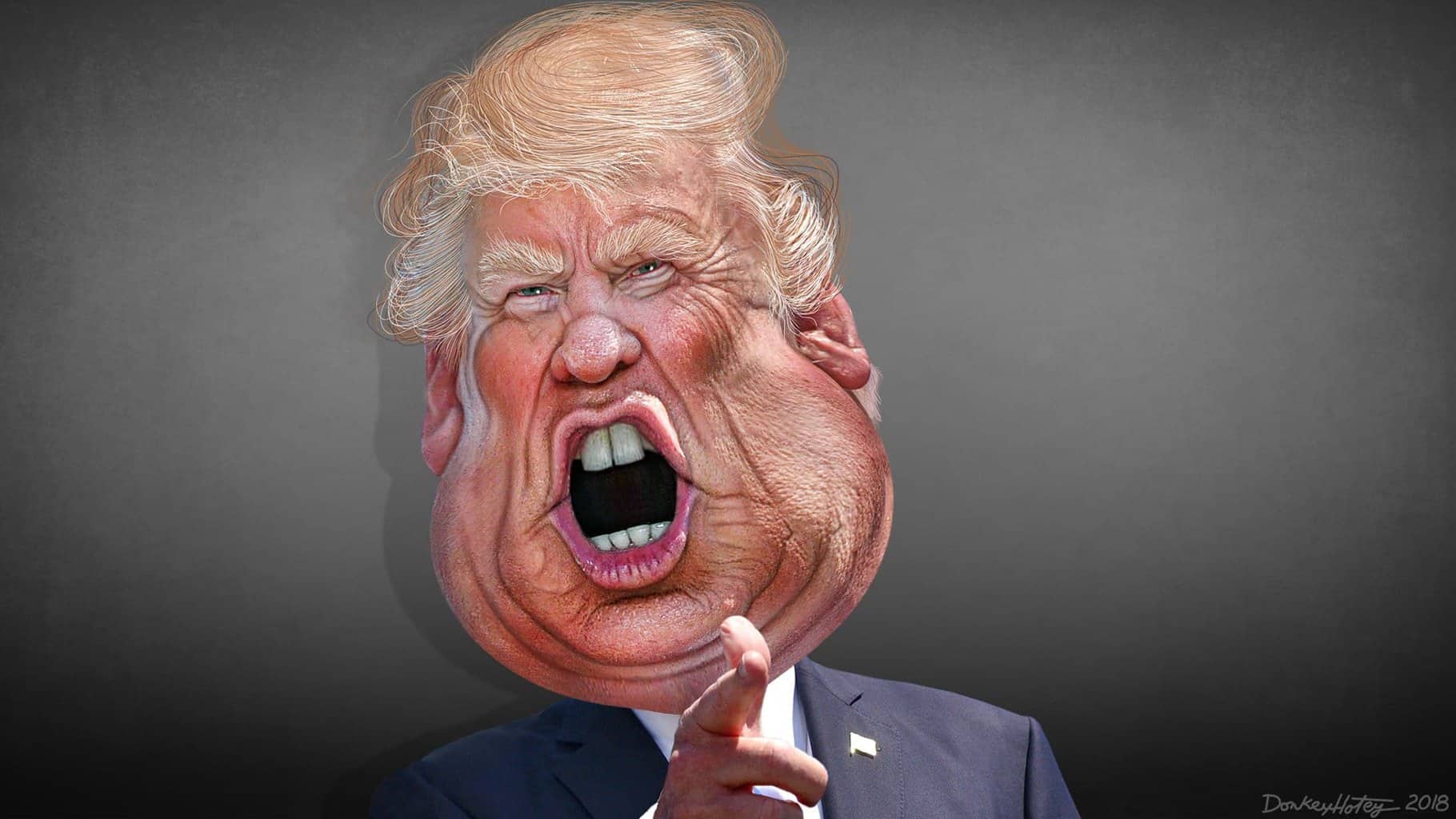

American democracy was already in rough shape before the 2024 election. Now the man who tried to overturn the last election is headed back to the White House, and his allies at the Heritage Foundation have spent two years writing him an instruction manual. Are our Constitutional guardrails strong enough to stop an authoritarian with an instruction manual?
That manual is Project 2025. Its centerpiece, the Mandate for Leadership, is a 920-page plan that the Center for American Progress warns would hand a president near-total control of the federal government. Heritage president Kevin Roberts has called the effort a "second American Revolution" and said it would stay bloodless "if the left allows it to be."
The Constitution was built with guardrails meant to stop exactly this kind of power grab. So the question keeping a lot of us up at night is simple: will they hold?
Below, we walk through the guardrails one at a time. For each one, we'll look at what it's supposed to do, how an authoritarian could get around it, and where the cracks already show.
A quick note: We name Donald Trump where the examples are his, but most of this guide talks about "a president" on purpose. The guardrails don't care who's pushing on them, and this guide should stay useful no matter who's in office.
Guardrail 1: A professional civil service
Most people who work for the federal government aren't political appointees. They're career staff, like scientists, attorneys, inspectors, and analysts, hired for what they know, not who they voted for. They stay on when administrations change. That's by design.
It wasn't always this way. In the 1800s, government jobs went to political supporters, and the result was rampant corruption and incompetence. After a man who was angry he didn't get a government job assassinated President James Garfield in 1881, Congress passed the Pendleton Act and built a civil service based on merit.
Project 2025 wants to undo a big piece of that. It calls for reviving "Schedule F," an executive order Trump signed in October 2020 that President Biden later rescinded. James Sherk, one of the order's architects, has said it was designed to strip job protections from about 50,000 career employees, making them nearly as easy to fire as political appointees.
Why does that matter? Career staff are often the people who say, "You can't do that. It's illegal." Schedule F specifically covers the government attorneys who supervise that kind of legal review. Replace them with loyalists, and the "no" disappears.
Now picture the agencies in charge of environmental protection, public health, and national security run by people chosen for loyalty instead of expertise. Decisions are made for the president's political benefit, and the rest of us pay the price.
Guardrail 2: A free press
A free press is supposed to be the public's watchdog. (Emphasis on supposed to.) When it works, reporters tell you what the people in power are doing so you can hold them accountable.
Authoritarians know this, which is why controlling the press is usually near the top of their to-do list. Hungary's Viktor Orbán and Russia's Vladimir Putin both turned their countries' media into megaphones for the government. When citizens only hear the state's version of events, dissent has nowhere to grow.
Project 2025 has plans here, too. According to CAP's analysis, it would let a president use the Federal Communications Commission, which licenses broadcast stations, to lean on networks that criticize him. It questions whether reporters should keep their workspace at the White House, and it would cut federal funding for the Corporation for Public Broadcasting, which supports NPR and PBS.
It's also worth looking at who Trump keeps company with. In March 2024, Orbán flew to the U.S. and skipped the White House entirely. He spoke at a closed-door Heritage Foundation event with Kevin Roberts, the man behind Project 2025, then visited Trump at Mar-a-Lago the next day.
Orbán has already hollowed out democracy in his own country. We can only guess what advice he brought with him.

Then there's Putin. In his book War, Bob Woodward reports that Trump has had as many as seven private phone calls with Putin since leaving office in 2021. Trump's campaign dismissed the reporting as made up.
When trust in the news collapses
Here's the bigger problem: Americans already don't trust the news. A Gallup poll released in October 2024 found that only 31% of adults trust the mass media a great deal or a fair amount. That's a record low, and more people (36%) said they don't trust it at all.
When people stop trusting the news, they retreat into bubbles where they only hear what they already believe. Corporate media has its own biases, usually toward whatever keeps its owners and advertisers happy. Right-wing media goes further. It builds a whole alternate reality, then skips any story that doesn't fit. There's a reason people joke that conservatives live on "Earth 2."

Here's a real example. On February 10, 2021, during Trump's second impeachment trial, House managers laid out their case that he incited January 6th. Fox News carried the trial live for hours, along with ABC, CBS, NBC, CNN, and MSNBC.
Then, just after 5 p.m., Rep. Eric Swalwell started playing never-before-seen security footage of rioters closing in on lawmakers. That's when Fox cut away to its panel show The Five, where co-host Greg Gutfeld dismissed the trial as "political theater." Juan Williams, the lone dissenting voice at the table, pleaded with his co-hosts to pay attention to the news.
Think about what that footage would have meant to viewers who'd spent weeks hearing January 6th was overblown. It would have shown them what really happened. It also would have shown them that their trusted network had been misleading them. Fox News picked its narrative over its audience.
Guardrail 3: Independent agencies
Congress set up certain agencies to operate at arm's length from the White House. The Federal Trade Commission, the Federal Communications Commission, the Federal Election Commission, the Equal Employment Opportunity Commission, and the National Labor Relations Board are run by bipartisan commissions. Their members generally can't be fired just for disagreeing with the president. The Supreme Court upheld that setup back in 1935 in Humphrey's Executor v. United States.

The idea is to let experts make decisions on things like elections, workplace rights, and consumer protection without a president breathing down their necks.
Project 2025 refers to them as "so-called independent agencies." According to CAP, it wants Humphrey's Executor overturned so a president can fire commissioners at will, and it wants the White House to review these agencies' rules before they take effect.
Put those together and "independent" becomes a label with nothing behind it. An FCC that answers to the president can threaten the licenses of stations that air unflattering coverage. An election commission that answers to the president... you can see where this goes. Oversight weakens, corruption grows, and the powerful find it even easier to get their way.
Guardrail 4: Keeping the military out of domestic politics
The U.S. has a long tradition of keeping soldiers out of civilian law enforcement. The big exception is the Insurrection Act, which lets a president deploy troops at home to put down an insurrection or domestic violence.
Presidents have used it in genuine emergencies. Dwight Eisenhower sent troops to Little Rock in 1957 to enforce school desegregation, and George H.W. Bush invoked it during the 1992 Los Angeles riots.
The danger is how much the law leaves up to the president. He gets wide latitude to decide what counts as an insurrection, and Congress, the courts, and governors have very few ways to stop him once he does.
That's what makes the planning in Trump's orbit so alarming. In February 2024, Politico reported that documents drafted by Russ Vought's Center for Renewing America included invoking the Insurrection Act on day one to put down protests. The group disputed the report. The New York Times has also reported on how Trump would use soldiers against riots, crime, and migrants in a second term.
In the wrong hands, peaceful protesters get relabeled as "insurrectionists," and people exercising their First Amendment rights are met with troops instead of protection.
Turning dissent into the enemy
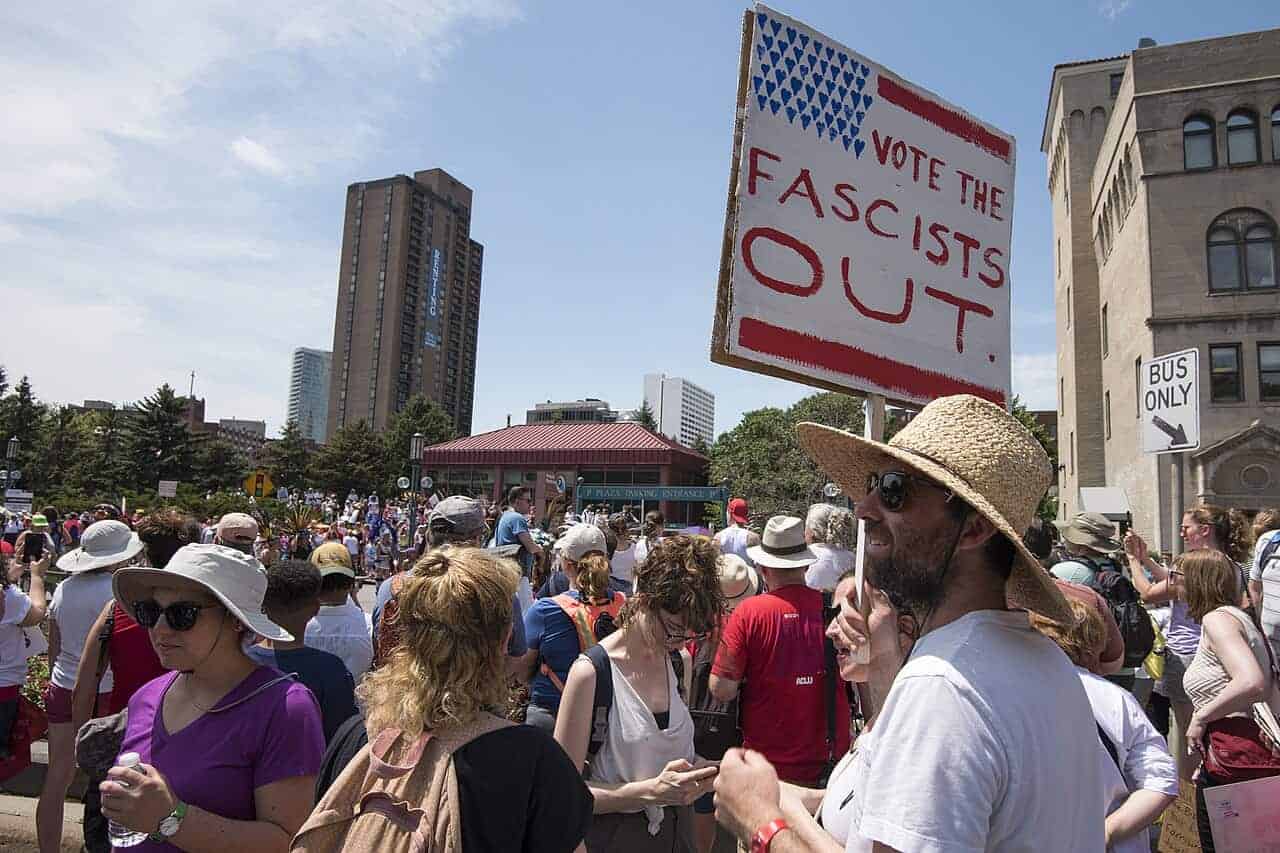
This part of the playbook usually starts with words. Critics get called traitors, enemies of the people, or worse. Once dissenters are painted as a threat, a crackdown starts to look reasonable to a lot of people. Everyone else learns to keep their heads down.
The framers knew better. The entire system of checks and balances assumes people will loudly disagree with whoever is in charge. When enough of us refuse to stay quiet, that collective voice becomes a guardrail of its own.
Guardrail 5: The courts
Courts are supposed to be the referee. When a president oversteps, judges can rule that he's gone too far, and the Supreme Court gets the final word on what the Constitution allows.
That referee has been quietly switching teams for years. Conservative legal activist Leonard Leo spent decades building a pipeline of right-wing judges, and Trump's three Supreme Court picks, Neil Gorsuch, Brett Kavanaugh, and Amy Coney Barrett, came from a list Leo helped shape.
The payoff came fast. In July 2024, the court ruled in Trump v. United States that presidents have broad immunity from prosecution for official acts. The majority also wrote that the executive branch has exclusive authority over which crimes the Justice Department investigates. That leaves very little standing between a president and a DOJ aimed at his enemies.
Meanwhile, Trump spent years attacking the judges and prosecutors on his cases and calling it all "lawfare." That's textbook projection: accuse your opponents of weaponizing the Justice Department, and you've got cover when you do it yourself. A DOJ that goes after a leader's political enemies is Fascism 101.
Could a president pack the court? Not on his own. Adding seats takes an act of Congress. But with a friendly Congress and a steady supply of loyal judges, he may not need to.
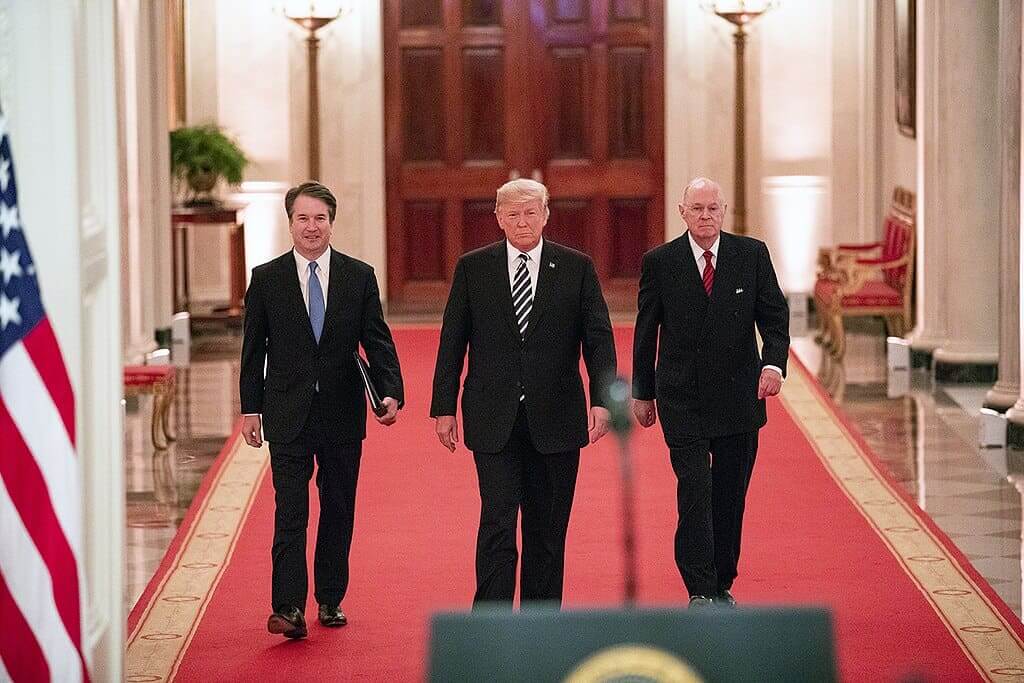
If you're reading this thinking, "That already happened," you're mostly right. The court isn't fully captured, though. Justices Sonia Sotomayor, Elena Kagan, and Ketanji Brown Jackson are outnumbered, but their dissents and their questions from the bench still put the stakes on the record where everyone can see them.
Guardrail 6: Congress controls the money
The Constitution gives Congress, not the president, the power of the purse. Congress decides how federal money gets spent. After Richard Nixon refused to spend money for programs he didn't like, Congress passed the Impoundment Control Act of 1974 to stop presidents from sitting on funds it had approved.
Project 2025's authors want that power back. Vought, Trump's former budget director, has called the law "unworkable" and wants presidents to be able to impound money again. A president with that power could starve an agency he dislikes until it withers, without a single vote in Congress.
We've already seen a preview. In 2019, after Congress refused to give Trump the $5.7 billion he wanted for a border wall, he declared a national emergency to go around lawmakers. His administration then shifted $3.6 billion away from military construction projects to pay for it. Congress passed a resolution opposing the emergency. Trump vetoed it.
Guardrail 7: The Senate's confirmation power
Presidents don't get to install whoever they want in top jobs. The Senate has to confirm Cabinet secretaries and other senior officials, which is supposed to screen out the unqualified and the dangerous.
Project 2025 suggests working around that by placing nominees in "acting" roles on day one. And just five days after Election Day, Trump demanded that the next Senate Republican leader agree to recess appointments. That's a way to install officials while the Senate is out of session and skip the confirmation vote entirely. All three senators running for the job quickly signaled they'd go along.
This guardrail has already held once. Trump's first pick for attorney general, Matt Gaetz, withdrew on November 21 after it became clear he didn't have the votes. That's exactly what the Senate is for. Whether it keeps doing that job under pressure is another question.
Guardrail 8: Elections
Elections are the most basic check of all. If a leader starts acting like a dictator, voters can fire him.
The problem is history. Plenty of authoritarians came to power through elections, then made sure they never had to face a fair one again. People often ask how a fascist could get elected in the first place. The 2024 election answered that. Trump told us exactly what he planned to do, over and over, and he won anyway.
He also spent the final stretch of the campaign laying the groundwork to reject the results if he lost. In late October, he claimed Democrats had been "caught" in Lancaster County, Pennsylvania, with 2,600 fake ballots. There were no fake ballots. County officials were reviewing about 2,500 suspicious voter registration applications, and those people were never registered. Trump and his allies ran with the story anyway.
Republicans also spent the year pushing the conspiracy theory that Democrats opened the border so immigrants could vote. In July, the House passed the SAVE Act 221-198 to require proof of citizenship to register. But it's already illegal for noncitizens to vote in federal elections. When several states audited their rolls, they each found fewer than 50 noncitizens who had voted, out of millions of ballots.
Then Trump won, and the fraud talk vanished overnight. What happened to all those illegal voters? Nobody asked. If he had lost, we'd be watching a rerun of 2020. When he wins, the election was fair. When he loses, it was rigged. Funny how that works.
So, are the guardrails strong enough?
On paper, the system is solid. Congress can impeach and remove a president. Courts can strike down illegal orders. The press can expose abuses. Career staff can refuse unlawful commands. Voters get their say every two years.
But every one of those guardrails depends on people choosing to use it. Removing a president takes a two-thirds vote in the Senate, which has never happened. Courts only check power when judges are willing to. The civil service only protects the law if its members can't be fired for following it. The people who wrote Project 2025 understand this, which is why their plan goes after the people as much as the rules.
The American people can push back, and we should. But we can't do it alone. It's up to Congress, the courts, and the institutions we've trusted for generations to hold the line. Let's hope those guardrails were built with the strongest materials available, because over the next four years, they're going to take some serious hits.