
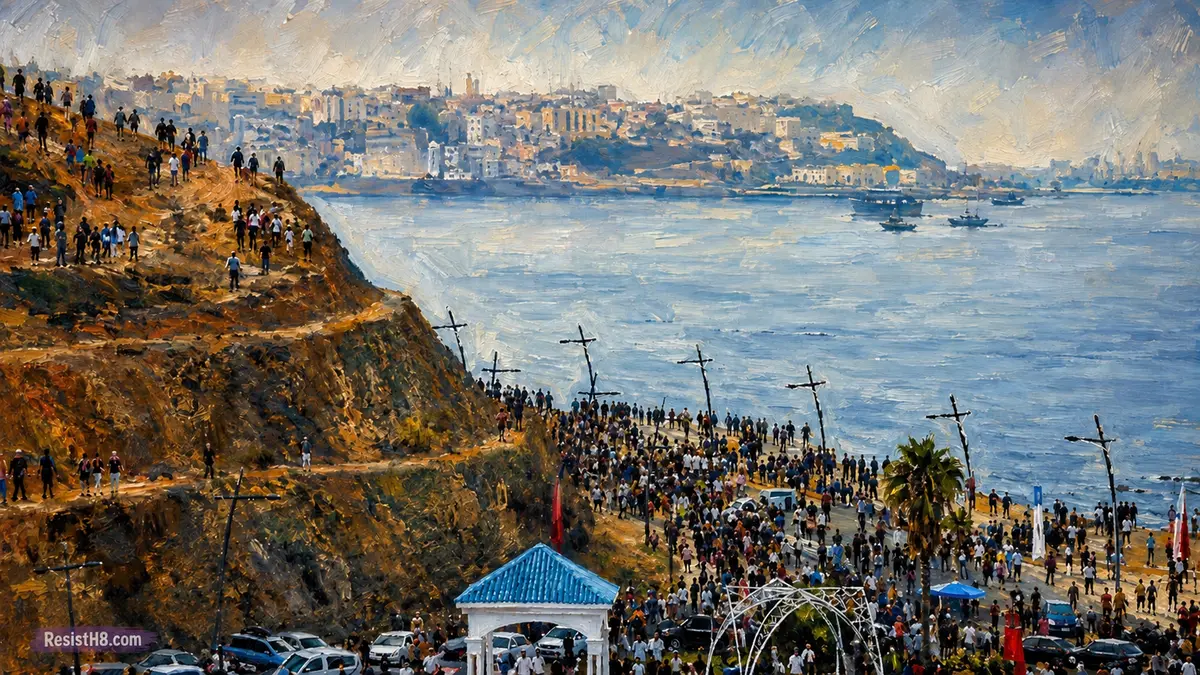

Sixty-seven people are dead after migrating to Ceuta. Most of them drowned. Others were trampled trying to climb over a concrete breakwater into the sea.
Nearly all of them were young Moroccans who had been told, by strangers on the internet, that Spain had opened its border and would welcome them.
Within hours of their deaths, the President of the United States looked at the footage and saw a campaign ad.
What Actually Happened
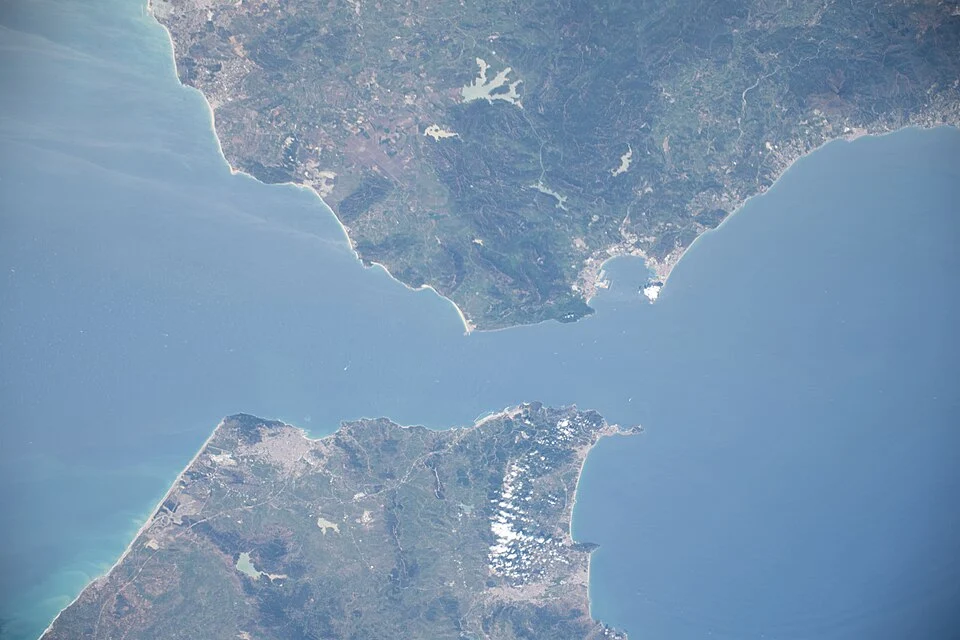
Ceuta is a Spanish city of about 80,000 people sitting on the North African coast, surrounded by Morocco. It covers roughly seven square miles. Along with Melilla, it is the European Union's only land border with Africa.
Beginning Thursday, July 30, people started crossing in numbers no one was prepared for. Ceuta's president, Juan Jesús Vivas, put the total at around 60,000 in about 24 hours.
Spanish police sources put it closer to 40,000–50,000.
Either way, a city the size of a mid-sized American suburb absorbed a population surge of more than half its own size in a single day.
Most swam. The route runs roughly three miles from the Moroccan town of Fnideq, around the Tarajal breakwater — a concrete spur where the border meets the water.
Others simply walked around it along the shoreline.
Video showed crowds of mostly young men, but also women and children, moving past the fence onto local roads.
Ceuta's shelters filled immediately. Thousands of people, including unaccompanied children, slept in parks and on sidewalks.
The Red Cross and Spanish soldiers pulled exhausted swimmers out of the water on the beach.
By Saturday, Spain's interior minister Fernando Grande-Marlaska said the situation had been almost entirely reversed.
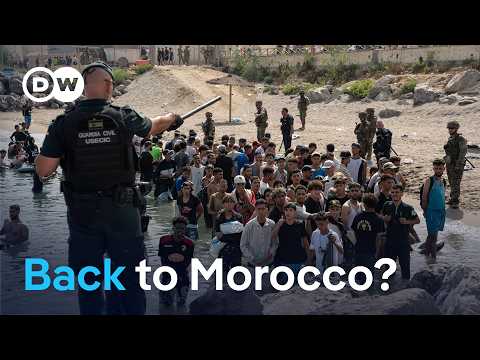
Roughly 48,300 people had gone back to Morocco by Friday afternoon alone, most of them voluntarily.
Reuters reporters watched people walk back through border posts and holes in the fence, telling them there was no food and nowhere to sleep.

A few refused. Mohamed Hatri, 23, told reporters that everything had been shut down around them specifically to starve them into going home — and said he wasn't going.
Why They Came
Two things converged.
The first was legal. In early July, Spain's Supreme Court ruled that migrants intercepted at sea trying to reach Ceuta or Melilla could not be summarily deported without due process.
The ruling applied only to sea arrivals, not to people climbing the land fence.
The second was a rumor built on top of it. For weeks, public Facebook groups, WhatsApp threads, and TikTok accounts had been planning and equipping the swim.
One group had more than 20,000 members by late July. Members traded Google Maps screenshots measuring the distance around the breakwater.
They posted photos of wetsuits and diving fins, asked about taxi routes to Fnideq, and pooled money for a kayak.



Fins were advertised for sale in Casablanca.
What spread alongside the logistics was false: that Spain was now granting automatic entry.
Migrants who made it across told NPR they expected to be welcomed and taken to mainland Spain.
They weren't. Sixty-seven of them didn't make it at all.
Was the Ceuta Migrant Crisis Engineered?
This is where the story gets harder, and where it deserves honesty rather than certainty.
Some people are reporting that the entire Ceuta migrant crisis was engineered by U.S. President Donald Trump and Israeli Prime Minister Benjamin Netanyahu to punish the leader of Spain.
Punishment for refusing to allow U.S. military forces to use military bases in Spain to attack Iran (and to create video Republicans can use to scare Americans into voting for them in the upcoming midterm elections) and for comments about the actions of Israel in the Gaza genocide.
Riccardo Fabiani, North Africa director at the International Crisis Group, told NPR that after two days he was confident this was a manufactured crisis.
He pointed to testimony from Moroccans who crossed and to videos circulating online showing trucks full of people being unloaded in front of Moroccan police who did nothing.
Spanish critics have said the same — that Moroccan border forces were absent, or complicit, during the critical hours Thursday.
Morocco's ambassador to Spain, Karima Benyaich, denied it, saying Rabat has always prioritized legal and orderly migration.
She did not explain what set the crossing off.
There is precedent.
In 2021, roughly 8,000–10,000 people crossed into Ceuta after Morocco visibly relaxed its border controls — widely read as retaliation for Spain hosting a Western Sahara independence leader for medical treatment.
Morocco does not recognize Ceuta and Melilla as Spanish, and is leverage it has used before.
There is also context: Sánchez visited Algeria, Morocco's regional rival, days before this happened.
What can be said accurately is this — the crossing was organized, the organizing is documented, and the question of whether a government looked the other way is a live allegation from credible analysts that Morocco denies.
Sánchez Refused the Easy Version
Spain's Prime Minister flew to Ceuta on Friday.
He deployed the army, ordered a 500-meter floating barrier installed at the breakwater, and called the crossing a violation of Spanish territorial sovereignty.
But he did not aim any of it at the people in the water.
He blamed the smuggling networks who, he said, deceive so many young people, and ultimately lead many of them to their deaths.
He then turned on his own continent, condemning what he called the selfish, polarising and unlawful reaction of EU states after Italy suspended Schengen travel from Spain and France tightened its border.
Sánchez has spent years arguing that Spain's economy has grown because of migrants, not despite them.
He is now one of the last European leaders still saying it out loud.
The Ad Campaign
Trump was asked about Ceuta Friday during a televised cabinet meeting at Camp David.

He said it looked like an invasion of a country by hundreds of thousands of people, said the same thing would happen here if Republicans lose in November, and said flatly that it would be a talking point for the midterms.
He told Fox News the same morning: that's going to be us in three years if the wrong side gets in.
Stephen Miller reposted footage of the crossing and blamed the Biden administration.
JD Vance called it a lesson about mass migration.
The comparison doesn't survive a map.
As Forbes laid out, Ceuta is a seven-square-mile European city physically embedded in Africa, reachable by a three-mile swim.
The United States has no equivalent geography and no equivalent legal circumstance.
Spain's overall irregular arrivals actually fell this year, from 17,990 in the first half of 2025 to 12,138 in the same period of 2026.
None of that matters to the ad. What matters is the picture — which is exactly what Trump told people to remember.
Here is the picture he's asking you to remember, described accurately: a 3-mile swim taken by unemployed young men who believed a lie they read on TikTok, ending with 67 bodies pulled from the water and off a breakwater, and tens of thousands of survivors walking home hungry.
That's not an invasion. That's a mass casualty event, and it's being converted into campaign material before the families have finished identifying the dead.