
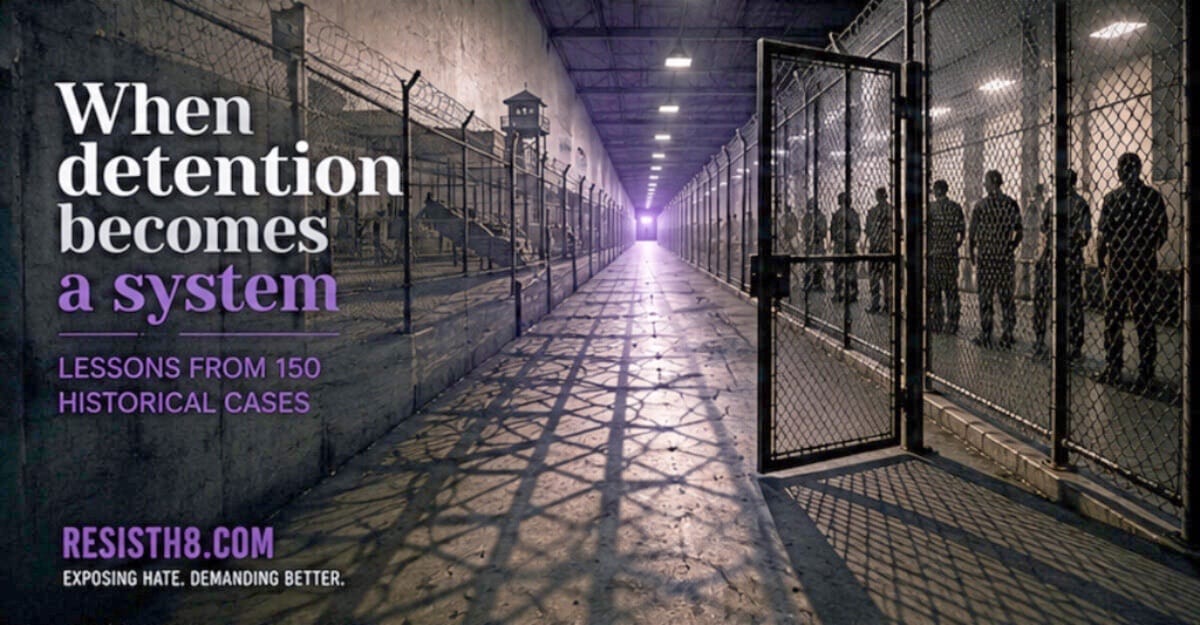

It is a sentence the federal government has spent years policing, scolding, and re-litigating: that the network of cages, contracts, and tents the United States runs for immigrants is a system of concentration camps.
Now two political scientists who have spent their careers studying camps as a tool of state repression have published the case in plain language, with the data behind it.
Writing in The Conversation this week, University of Arizona professor Alex Braithwaite and Louisiana State University assistant professor Rachel D. Van Nostrand laid out the findings of their peer-reviewed research, which catalogued 150 systems of camps used globally since 1896.
Their conclusion: as of April 2026, the U.S. ICE (Immigration and Customs Enforcement) detention network meets the criteria of a concentration camp system.
They write that they are not using the term to be provocative.
They are using it, in their words, to provide precise language rather than euphemisms, so the public can recognize the warning signs of past atrocities while there is still time to act on them.
The Four Criteria
Braithwaite and Van Nostrand define a concentration camp system using four features drawn from a century-plus of historical evidence:
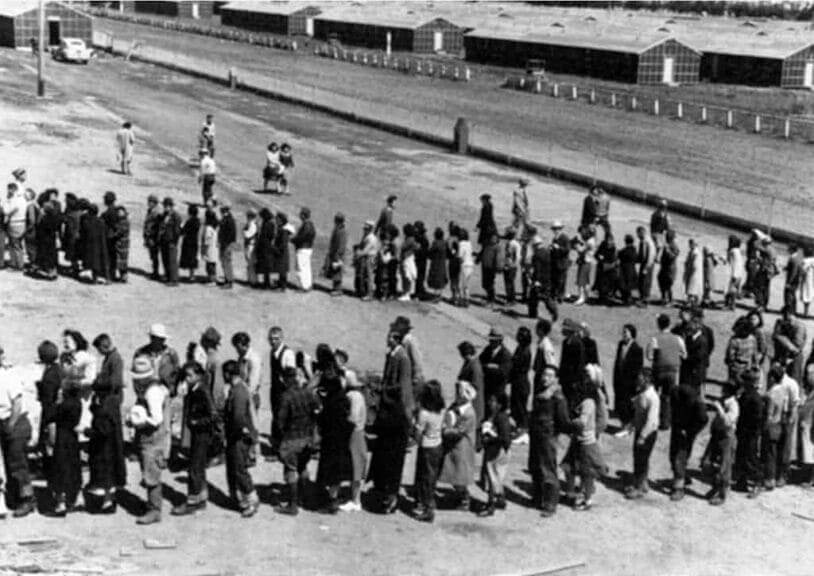
By those measures, their dataset includes the Spanish reconcentrados in Cuba in 1896, the British camps that killed roughly 27,000 Boers and 14,000 Black Africans during the second Boer War, the U.S. internment of more than 125,000 Japanese Americans and Japanese immigrants during World War II, the Argentine military junta’s camps of the mid-1970s, and the so-called filtration camps Russia has used in its war on Ukraine.
The authors make clear that listing these together is not a claim that every camp system is identical to the Nazi extermination camps of the Holocaust.
The historical category of “concentration camp” is older than the Holocaust and broader than any single regime’s use of it.
The point is to use the category as it has actually been used by historians and political scientists — a recognizable pattern of state behavior.
What ICE Looks Like by Those Criteria
The numbers Braithwaite and Van Nostrand cite are damning.
There are now more than 240 active ICE detention facilities operating across the United States. People held inside are not free to leave.
Many are presented with what the authors describe as a binary choice: agree to self-deport immediately, or remain in detention indefinitely.
Hundreds of U.S. citizens have been swept up and held without justification and against their will. By October 2025, the number of people being arrested in homes and communities — frequently without a judicial warrant — had climbed past 400 per day.

Conditions inside the facilities are deteriorating. The authors point to a 36% drop in mandated inspections by ICE’s own internal Office of Detention Oversight, alongside reports of cutoffs in payments to the third-party medical providers who actually treat detainees.
The result is exactly what those policy choices invite: unsanitary facilities, untreated illness, and rising body counts.
Twenty-three people died in ICE custody between October 2025 and March 2026, putting the current fiscal year on track to be the deadliest in more than two decades.
A network of more than 240 enclosed sites. A targeted civilian population. A detention regime that operates well outside ordinary criminal procedure, where people can disappear into the system for days, weeks, or months without seeing a judge.
Documented abuse, neglect, and a death toll trending upward. Four criteria. Four checkmarks.
“A Permanent Pillar of State Function”
The most haunting line in the piece is borrowed. Braithwaite and Van Nostrand quote journalist Andrea Pitzer, who has written extensively on the global history of concentration camps, on the logic of how these systems harden over time.
The longer camps exist, Pitzer has argued, the more they stop being framed as a transient emergency response and start becoming a permanent pillar of how the state functions.
That is the warning underneath the academic language. The Trump administration has spent its second term expanding detention capacity, contracting with new private operators, opening tent cities, building offshore facilities, and chipping away at the inspection routine that was already inadequate.
Each of those moves makes the system more durable. Each makes it harder to dismantle. Each shifts mass detention from something a future administration could unwind into something baked into the system.



The history these scholars studied is explicit on this point. Camp systems do not collapse on their own. They are ended by political will, public pressure, or military defeat — and ending them late always results in a greater loss of human lives than ending them early.
Why the Word Matters
There will be readers who reach this point ready to argue that the term is too loaded, too inflammatory, too easy to dismiss. That argument has been made for years, and it has functioned as a cover. Every title — “processing center,” “holding facility,” “temporary housing” — buys the camp system more time and more legitimacy. Every demand to soften the language is a demand to lower the volume of the alarm.
Braithwaite and Van Nostrand’s contribution is to take the question out of the realm of rhetoric and place it inside a defined method, applied evenly across 150 historical cases, and let the criteria speak. Their answer is that the United States is now operating a system that fits the definition. Not metaphorically. Not as an insult. As a matter of comparative analysis.
The people inside these facilities are mothers, fathers, asylum seekers, lawful residents, U.S. citizens swept up by mistake, children separated from their families. They are not statistics, and they are not abstractions. They are the human beings history keeps trying to warn us about.
If precise language is the requirement for action, that language now exists in peer-reviewed print. The question is whether the country chooses to hear it before the camps become, as Pitzer puts it, permanent.