



On Sept. 30, President Trump sat in the Oval Office and talked about Iran. A reporter asked how he could make a deal with leaders he calls crazy. His answer: "Maybe you blow them up." Then he added, "We blow them up, make a deal, but the time is coming."
That same day, independent journalist Ken Klippenstein published a story that makes those words much harder to shrug off. The Pentagon is quietly giving Trump more nuclear options. The Senate heard about it behind closed doors. The rest of us didn't.
Here's what Klippenstein found, what his documents show, and, just as important, what they don't show.
The document senators saw and you didn't
On Sept. 17, the Senate Armed Services Committee held a closed briefing with Elbridge Colby, the Pentagon's top policy official. There was no video and no public transcript.
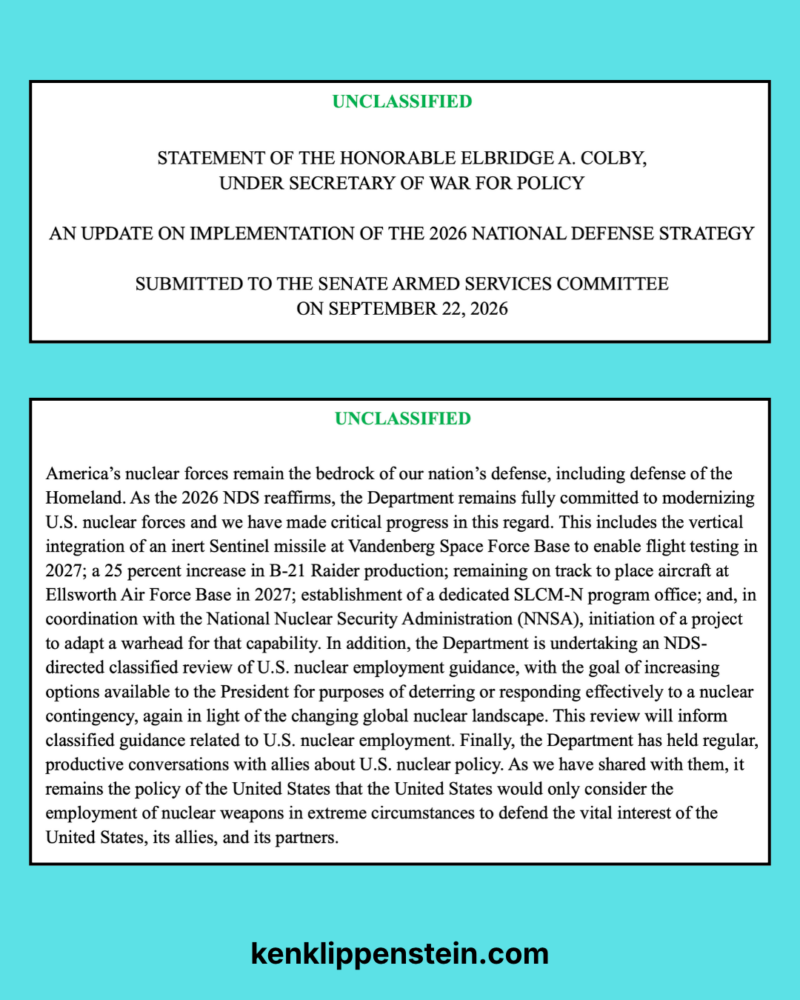
Klippenstein obtained Colby's testimony and posted it in full. In it, Colby says the Pentagon is "increasing [nuclear] options available to the President" to deter or respond to "a nuclear contingency."
In plain English: the people who plan for nuclear war are building the president a bigger menu.
Klippenstein says no one in Congress or the press has said a word about Colby's disclosure. He also notes that Sen. Jack Reed of Rhode Island, the top Democrat on the committee, was briefed on all of it and has stayed quiet.
Trump’s nuclear options: what's on the new menu
For most of the nuclear age, the big fear was all-out war. Thousands of warheads. Whole countries wiped out. That kind of war is so horrible that leaders treat it as unthinkable.
Colby sees that as a weakness. He has argued for years that a president needs smaller nuclear choices, something between doing nothing and ending the world. Back in 2011, he wrote that America's war plans should include limited nuclear strikes. Now he's in a position to make it happen.
Based on Klippenstein's reporting and the government's own records, here is what that looks like:
- Smaller, "lower-yield" nuclear bombs and missiles carried by planes. Klippenstein reports these are meant to give Trump more choices in Europe and on the Korean Peninsula.
- A nuclear cruise missile launched from the sea, called SLCM-N. In April, Robert Kadlec, the Pentagon's nuclear deterrence chief, told senators to speed it up. Sen. Deb Fischer praised his written testimony, which said the missile gives the president a regional nuclear presence "without dependence on host nations." In other words, the U.S. wouldn't need an ally's permission.
- "Credible, rational nuclear options." That's Colby's own phrase from an August speech at U.S. Strategic Command. He said the goal is to expand the president's options, including what he called "counterforce options."
In that same speech, Colby said the nuclear threat he fears most is a regional war that could see "local employment, God forbid, of nuclear weapons." The same day he spoke, NBC News reported that the Pentagon is drafting a new, classified nuclear strategy built around shorter-range "tactical" weapons. Colby has said that review won't be made public.
In May, Colby gave a speech to the National War College. He told officers that keeping political goals in mind doesn't only mean holding back. Sometimes, he said, it "may require aggressiveness and an acceptance of great risk."
The Arms Control Association, a nonpartisan group that tracks nuclear weapons, warned in August that by building more of these weapons without ruling out using them first, the administration is "signaling its intention to use them."
So where does Iran fit in?
The U.S. and Israel started bombing Iran on Feb. 28. One of the main stated goals was ending Iran's nuclear program. Seven months later, the war is still going.
Klippenstein points out that none of this is a classroom exercise for an administration already at war with Iran. "This is a question of national survival," he writes.
When Kadlec testified in April, he warned that the U.S. must deter China and Russia at the same time, plus "regional powers with growing capabilities." He didn't name those regional powers. Klippenstein's take: think of Iran.
There's also an older piece of the puzzle. In March 2025, almost a year before the current war began, Klippenstein published "The Nuclear War Plan for Iran." Using procurement documents, internal company communications, and a retired senior military officer who had been briefed on the planning, he reported:
- The Pentagon's Iran war plans include nuclear options, tucked into a section called Appendix 1 to Annex C.
- Nuclear use could start two ways. A military commander could ask for it, mostly to stop Iranian forces from winning on the battlefield. Or the president could order it from the top, as a show of force to send Iran a message.
- The low-yield warhead on Navy submarine missiles, called the W76-2, is an option in Trump's hands.
The retired officer told Klippenstein that people may be shocked nuclear weapons are even being considered, "but we have entered a new era."
Klippenstein's editor, William Arkin, reported in 2020 that a U.S. war game played just days before the 2016 election ended with America using a nuclear weapon on Iran.
Does this mean Trump plans to nuke Iran?
Here's where we have to be careful. No document Klippenstein has published shows a decision or an order to use a nuclear weapon on Iran. Klippenstein himself says nuclear war isn't imminent or even likely.
Trump's "blow them up" comment didn't mention nuclear weapons. And talks are still alive: the U.S. sent Iran a response to its seven-day proposal through Qatar on Sept. 30.
Some people are warning about more. In August, former Rep. Marjorie Taylor Greene posted that officials "are discussing using nuclear weapons on Iran in strategy meetings," and said she knows it's real. We haven't seen evidence that backs that up.
Annelle Sheline, a former State Department official now at the Quincy Institute, warned in September that Trump could launch a nuclear strike. She said her worry comes from rumors, not a confirmed plan.
Psychiatrist Dr. John Gartner, who has never been wrong about a Trump prediction, said on a podcast that he predicts Trump will use a nuclear weapon and become the largest mass murderer in history.
So the honest answer is this. The plans exist. Trump’s nuclear options are growing. And the man who can use them is publicly talking about blowing up a country he's already at war with.
What a "small" nuke would do to real people
"Low-yield" sounds mild. It isn't.
The W76-2's exact power is secret. Experts estimate it at about 5 kilotons, roughly a third of the bomb dropped on Hiroshima in 1945. That bomb killed tens of thousands of people.

Think about who lives under a target. Iranian families have already lived through seven months of airstrikes. Parents walking kids to school. Doctors and nurses working long shifts. Grandparents who survived the Iran-Iraq war in the 1980s and never expected to see bombs again.

They don't run Iran's government. They'd pay the price anyway.
Radiation doesn't stop at a border. And nobody can promise that a "limited" nuclear strike stays limited. Once one goes off, the next move belongs to someone else.
If you want to understand how deep the ties between Americans and Iranians once ran, our piece on the US-Iran friendship before 1953 is a good reminder that these are people, not targets.
One person makes the call
In the United States, the president alone has the authority to order a nuclear strike. He can ask advisers for input, but he doesn't need anyone's approval. And the U.S. has never promised not to use nuclear weapons first.
We've explained how that launch process works, step by step. Read it with Colby's plans in mind.
A bill in Congress, the Restricting First Use of Nuclear Weapons Act, would stop any president from launching a nuclear first strike unless Congress declares war and specifically allows it. It was reintroduced in early 2025. Ask your senators and representative where they stand.
The public deserves a say
Klippenstein's bigger point is simple. Nuclear policy affects every person on Earth, yet it's being decided in rooms we’re not allowed into. The Senate got a private briefing.
The public only saw Colby's words because an independent reporter posted them.
The public never got a say on whether a president should have more ways to start a nuclear war. Congress should hold public hearings on Colby's review.
And the senators who sat in that closed room on Sept. 17 owe the country an explanation of what they heard and what they plan to do about it.
Trump’s nuclear options should be “There are none.”