
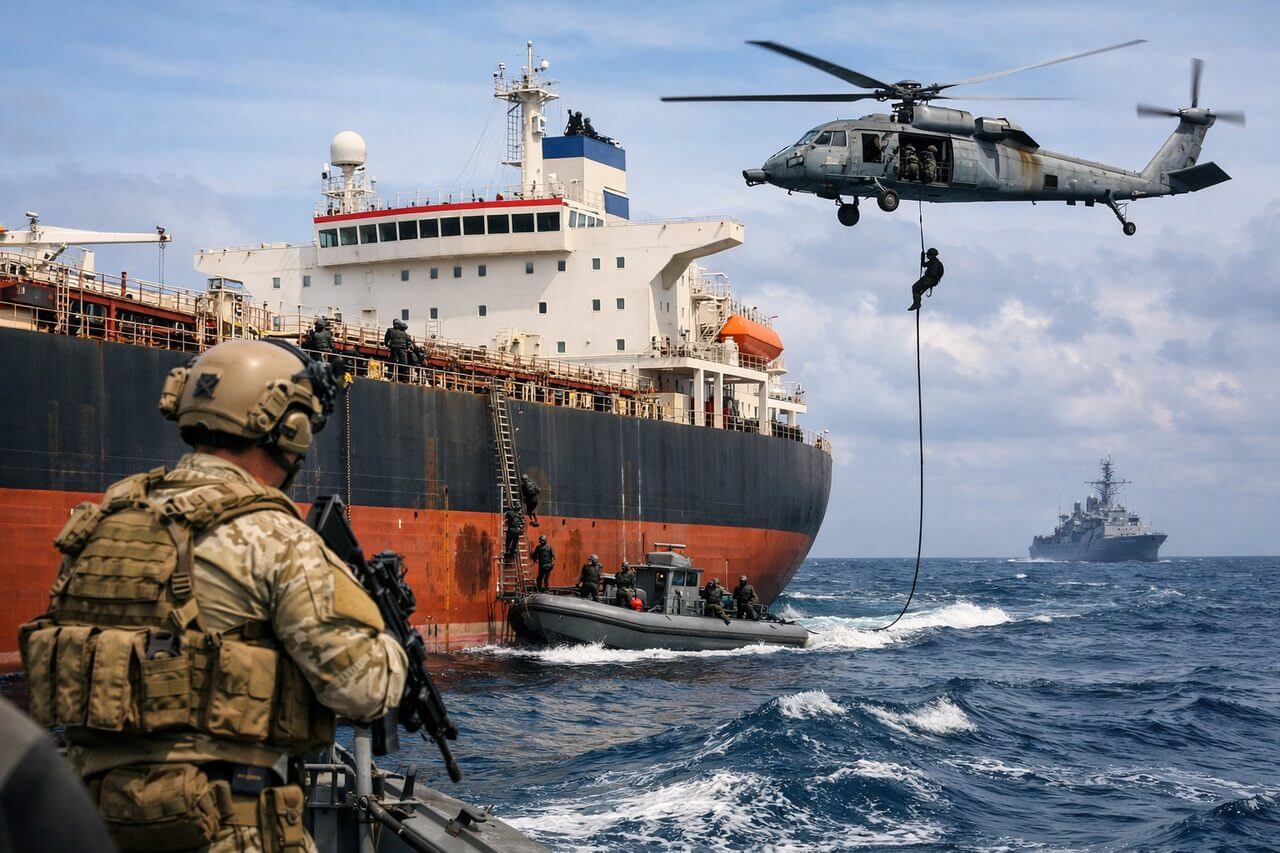

In a stark escalation of U.S.–Venezuela tensions, American military forces have seized a seventh oil tanker linked to Venezuela, signaling a deepening effort by the Trump administration to dominate the flow of Venezuelan crude.
U.S. Southern Command announced Tuesday that the Motor Vessel Sagitta, a Liberian-flagged tanker, was boarded “without incident” in the Caribbean Sea after allegedly defying a U.S. quarantine on sanctioned vessels.
The operation, part of a sweeping campaign to regulate Venezuelan oil exports and enforce U.S. sanctions, underscores the administration’s broader strategy: control the world’s most oil-rich nation’s lifeblood and funnel its economic value into what U.S. officials describe as “rebuilding Venezuela’s energy infrastructure and stabilizing its economy.”
What This Means for Global Oil Prices
The U.S. seizure of Venezuelan oil tankers adds another layer of uncertainty to an already fragile global oil market, even if it does not immediatelyThe U.S. seizure of Venezuelan oil tankers adds another layer of uncertainty to an already fragile global oil market, even if it does not immediately spike prices at the pump.
In the short term, global oil prices are unlikely to surge dramatically from these seizures alone. Venezuela’s oil production, while vast in potential, remains far below historic levels due to years of sanctions, infrastructure collapse, and mismanagement. As a result, Venezuelan crude currently represents a relatively small share of global supply compared with heavyweights like Saudi Arabia, Russia, or the United States.
However, the long-term implications are more complex.
First, the seizures reduce the availability of “gray market” oil. Venezuelan crude has often moved through opaque shipping networks to buyers in Asia, particularly China, at discounted prices. When tankers are intercepted or deterred, that discounted supply shrinks. Fewer barrels moving quietly through back channels can tighten supply in certain regional markets, especially for refiners that depend on heavy crude similar to Venezuela’s.
Second, the actions increase geopolitical risk premiums. Oil markets react not only to physical supply but to instability. Military involvement in oil transport, even without open conflict, makes traders nervous. If investors believe seizures could escalate into broader maritime confrontations or trigger retaliatory actions by other countries, futures prices tend to rise in anticipation rather than in response to actual shortages.
Third, U.S. control over Venezuelan oil introduces uncertainty about timing and intent. The Trump administration has said seized oil will be sold and proceeds used to rebuild Venezuela’s energy sector. If those barrels reach the market quickly and transparently, they could modestly ease supply pressures. If sales are delayed by legal disputes, corrupt activities, or international pushback, markets may price in tighter supply instead.
Finally, there is a precedent concern. If major powers increasingly intercept oil shipments under unilateral enforcement regimes, global shipping costs could rise. Higher insurance premiums, longer routes, and greater risk assessments ultimately feed into higher energy prices worldwide, even if total production stays stable.
In short, while drivers are unlikely to see an immediate shock at the gas pump, the continued militarization of oil enforcement adds volatility to global markets. Over time, volatility itself can be just as costly as outright shortages, quietly pushing prices higher and making energy markets more unpredictable for consumers and governments alike.
A Campaign Beyond Sanctions
The capture of the Sagitta comes only days after U.S. forces seized another sanctioned vessel, the Veronica, marking the sixth interception in a series of maritime actions stretching back to late 2025.
In each case, U.S. Marines, sailors, and Coast Guard units have executed high-seas boardings under the aegis of enforcing a “quarantine” — a unilateral restriction imposed by Washington designed to halt sanctioned tankers from carrying Venezuelan oil.
Pentagon spokespeople did not immediately clarify whether the Coast Guard was involved in the Sagitta seizure, as has been typical. What they did emphasize was that the tanker was operating in defiance of the quarantine and was believed to have taken Venezuelan crude.
Shorts clips purportedly showing the vessel at sea appeared on U.S. military social channels, though they did not depict a dramatic helicopter insertion as seen in some prior operations.

Oil as the New Battleground
Venezuela, long synonymous with vast petroleum reserves, has seen its oil industry become a fulcrum of geopolitical struggle. Under former President Nicolás Maduro, years of mismanagement and sanctions eroded production, squeezing foreign partners and sending crude flows to shadow fleets seeking to evade Western penalties.
Now, following the dramatic U.S. military operation that ousted Maduro earlier this month, Washington has moved to seize control of not only the government but also the nation’s oil.
In a rare policy declaration, President Trump and senior aides have openly discussed harnessing Venezuelan oil supplies. Officials claim that tens of millions of barrels already under U.S. control will be sold on global markets, with revenues directed toward rebuilding the devastated Venezuelan petroleum infrastructure.
Earlier this month, the administration announced the first such sale, valued at roughly $500 million, and signaled plans for additional transactions in the weeks ahead. The $500 million was routed to a bank account in Qatar, raising corruption concerns.
The rhetoric from Washington frames these actions as part of a legal enforcement regime and a reconstruction effort. Secretary of Homeland Security Kristi Noem has consistently defended the seizures as lawful enforcement of U.S. sanctions and necessary measures to prevent illicit shipping.
International Strains and Legal Questions
Moscow has already weighed in on the tanker seizures. Russian Foreign Minister Sergei Lavrov said this week that the United States should release Russian crew members who were aboard one of the recently seized vessels, underscoring the diplomatic headaches that can accompany these takedowns.
Human rights and maritime law experts have raised concerns about the U.S. campaign. Critics argue that unilateral military seizures in international waters strain established norms and could set precedents for other powers to intercept foreign shipping under expansive interpretations of national law. United Nations officials have suggested that such actions require multilateral support and clearer legal grounding.


Venezuela’s government, for its part, continues to condemn these operations as violations of sovereignty and international law. Caracas has accused Washington of “piracy” and warned that sustained pressure could further destabilize the region.
What This Means Going Forward
With the seventh tanker in U.S. hands, Washington’s campaign against Venezuelan oil trade is entering a new phase. The Trump administration appears intent not only on enforcing sanctions but actively reshaping how Venezuela’s crude is controlled and monetized.
The implications are wide-ranging: from global oil markets to diplomatic relations with nations whose citizens and companies are entangled in these seizures.
For Venezuelans on the ground, the outcome of this maritime and political tug-of-war remains uncertain, with economic lifelines and national sovereignty both at stake as global powers vie for influence.