

Ground beef costs more than it ever has. On Friday, President Donald Trump announced his plan to import beef: let hundreds of thousands of tons of foreign beef into the country tariff-free, for 90 days, from countries he declined to name.
The backlash was immediate, and it did not come from Democrats.
Trump posted on Truth Social that the U.S. will allow up to 300,000 metric tons of ground beef to enter the country over the next three months without triggering the "out of quota" tariff — the higher tax that kicks in once a country ships past its assigned limit.
He said he had secured a commitment from foreign exporters to sell that beef at 25 percent below current market prices. A White House official said an executive order formalizing the arrangement would be signed within two weeks.
Asked by reporters which countries were part of the deal, Trump wouldn't say.
Beef that arrives within a country's quota faces a token tariff of about 4.4 cents per kilogram. Beef above that quota gets hit with a 26.4 percent tariff — a difference that can exceed $1.80 per kilogram.
Trump is switching that off for three months.
Republicans from ranching states revolted
Sen. Deb Fischer of Nebraska, a cattle rancher herself, said she was extremely disappointed and that lower grocery prices cannot come "at the expense of American producers."
Her fellow Nebraska Republican, Sen. Pete Ricketts, warned that "flooding the market with lower quality beef compromises Nebraska farmers and ranchers."
Montana Sen. Tim Sheehy, one of Trump's closest allies in the Senate, said he had personally advised the president against it, and that Trump’s plan to import beef "will harm our ranching families who feed the nation."
Montana's senior senator, Steve Daines, wrote that importing foreign beef would "hurt our ranchers" and raise prices over the long run. Rep. Julie Fedorchak of North Dakota said cheaper groceries shouldn't come on the backs of the producers in her state who are spending millions trying to rebuild their herds.
The industry groups were no gentler.
The National Cattlemen's Beef Association — which has given roughly 89 percent of its political money to Republicans since 2012 — said flooding the market with below-market beef is not how you rebuild an American herd, and noted that cattle futures dropped the morning of the announcement.
Bill Bullard of R-CALF USA, which represents independent producers, said imports have already been a major driver of the shrinking U.S. cattle inventory.
Wyoming's Meriwether Farms answered with a single word on X: "Betrayal."
Trump's response, at Joint Base Andrews: the ranchers are great, they're his people, and voters want lower prices.
Why your burger is more expensive in the first place
None of this happened by accident, and almost none of it can be fixed in 90 days.
The U.S. cattle herd hit 86.2 million head on January 1, the smallest in 75 years. Years of drought in Texas, Oklahoma, Nebraska and Missouri forced ranchers to sell off animals they couldn't afford to feed.
A cow takes roughly two to three years to turn into beef on a shelf, so even a rancher who starts rebuilding today doesn't move grocery prices until 2028.
Then policy piled on. The administration imposed 50 percent tariffs on Brazil, one of the largest beef exporters on earth. It closed the southern border to live cattle from Mexico over the New World screwworm, a flesh-eating parasite — a defensible call on animal-health grounds, but Mexico supplied about 62 percent of U.S. cattle imports from 2020 to 2024, and cutting it off tightened supply further.
Tariffs raised the cost of feed, fertilizer and equipment. The war with Iran and the disruption at the Strait of Hormuz drove up diesel and fertilizer, the two inputs a ranch cannot operate without.
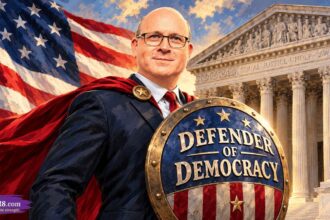
Trump is the arsonist who started the fire. Now he's trying to be the firefighter who puts it out.


Who gets paid
JBS, Cargill, Tyson and National Beef — have controlled more than 80 percent of U.S. cattle processing since 1995.
They buy the cattle. They sell the beef. Cheap imported trimmings lower what packers pay for raw material. Nothing in Friday's announcement requires that savings to reach the checkout line.
There's also no mandatory country-of-origin labeling on beef, which means shoppers can't reliably tell imported product from domestic. A rancher in Nebraska is being asked to compete on price with meat the customer can't distinguish from hers.
In October 2025 the administration expanded tariff-free Argentine beef; ranchers objected; in February Trump signed an executive order adding another 80,000 metric tons anyway. Beef prices did not come down.
The election part
Trump has been losing ground with rural voters since the start of his second term, and the midterms are less than three months out.
Inside Elections shifted 10 of 11 races toward Democrats on August 17, including Senate contests in Iowa and Texas. In Nebraska, independent Dan Osborn, running against Ricketts, told the president to scrap the deal and said it isn't America First.
That's the trap. Working families are paying record prices at the meat counter and need help now. Ranching families are finally seeing a profitable stretch after a brutal decade and are watching the White House undercut it.