



American taxpayers spent roughly $1 trillion on U.S. military protection this year. In August, the four-star general responsible for forces in Europe said something that should outrage every American: there are only enough warships to shield Israel or America from ballistic missiles.
He wasn't asking for advice. He was asking the Pentagon to tell him which one to defend.
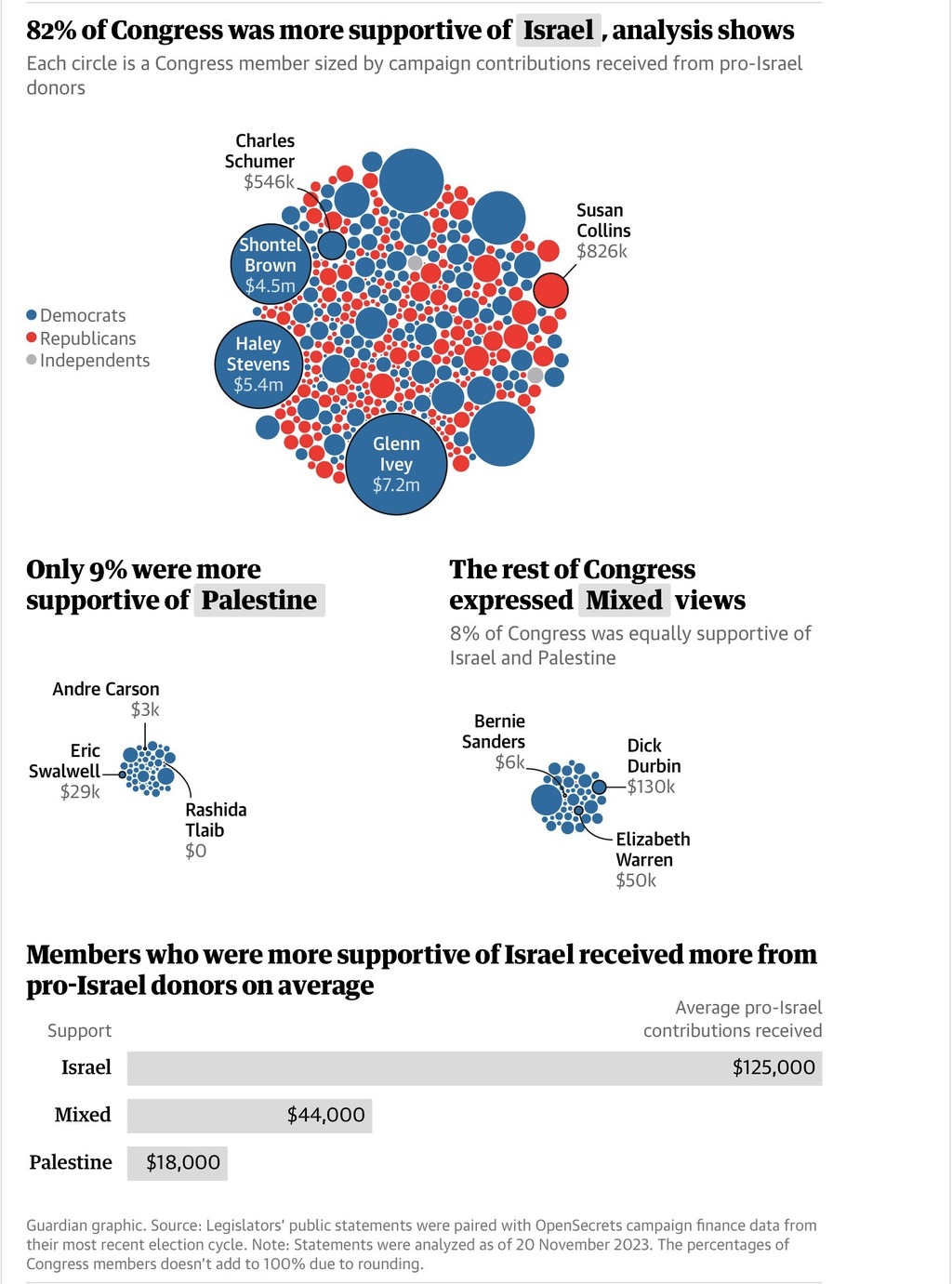
This is when the fact that the Israeli lobby pays 95% of Congress becomes a huge problem.
Can we trust that our politicians will make the right decision when they’re forced to choose: should the military protect Israel or America?
It’s a valid question. A majority of Americans want to stop sending money to Israel, yet members of Congress continue to vote to send money to a country that is committing genocide.
There’s also a revolving door between AIPAC and the federal government.
An analysis by DAWN showed that 66 former AIPAC staffers are currently working in the U.S. government, from Congress to the White House to different branches of the military; over 20 current AIPAC employees previously worked inside the U.S. government.
The General Who Needs a Decision

That general is Alexus Grynkewich, head of U.S. European Command and NATO's supreme allied commander.
On August 1, the Washington Post reported that Grynkewich had notified senior Pentagon officials, in writing, that without at least one more Navy destroyer he would be forced to prioritize defending the U.S. homeland over defending Israel.
European Command has five destroyers homeported in Rota, Spain.
As of that week, two were in the Mediterranean, where American ships have spent months knocking down projectiles fired at Israel by Iran and the Houthis.
Those same ships are supposed to be watching Russia — a country whose long-range missiles can reach American soil.
Five destroyers can’t be in three places.
The orders book leaked
Grynkewich wasn't alone, and that became clear a month later.
On August 30, the Post published details from the August 14 edition of the Secretary of Defense Orders Book, a classified document that tracks where American military resources are and what they're being asked to do.
Inside it, the heads of the Army, Navy, and Air Force — plus multiple four-star combatant commanders — told Pete Hegseth that stretching the Iran war any further is not sustainable.
The commanders of European Command, Pacific Command, and Southern Command, along with Chief of Naval Operations Adm. Daryl Caudle, all filed a formal "non-concur."
In Pentagon language, that means they disagree with the order and will carry it out anyway.
Caudle's warning was reportedly the most straightforward of the group: the Navy "cannot sustain its current level of support" when nobody will say when the war in Iran ends.
The orders book keeps some troops in the Middle East through September and others into 2027.
The Pentagon's public response was not to address any of it.
Chief spokesman Sean Parnell called the reporting fake news, said non-concurs are routine, insisted "We are in great shape around the world," and accused the Post of hating Trump and Hegseth more than it loves America.



He also called publishing the material a crime — a claim that runs straight into the Supreme Court's 1971 Pentagon Papers ruling.
What Americans got for that $1 trillion
Congress enacted a $1 trillion defense topline for fiscal 2026.
For 2027, the administration has requested about $1.5 trillion — a 44% jump that budget analysts say would be the largest military budget in American history even after adjusting for inflation.
Bigger than the Reagan buildup and bigger than the peak of World War II. And the interceptors are still running out.
U.S. forces have burned through more than half of the Patriot interceptor stockpile during this war, and Pentagon assessments earlier in the conflict found the U.S. was spending more of its own defensive missiles protecting Israel than Israel was spending of its own.
Rebuilding those stockpiles will take years. The Pentagon announced a long-term production deal in late August, which is good news — but it arrives several years too late.
Meanwhile, the only thing standing between the American people and a long-range missile is 44 interceptors in Alaska and California.
That's the Ground-based Midcourse Defense system, the only hit-to-kill defense the country has against ICBMs (intercontinental ballistic missiles).
The Pentagon's own Missile Defense Review says it "is neither intended for, nor capable of, defeating" the missile arsenals of Russia or China.
It was built for a limited strike by a smaller adversary, and its flight-test record is basically a coin flip, which is why the procedure is to fire several interceptors at a single incoming warhead.
The administration's answer is Golden Dome, pitched at $175 billion and three years.

The Congressional Budget Office priced a comparable system at $1.2 trillion over twenty years.
The Pentagon has since walked back the promise of an impenetrable shield.
So: a trillion a year now, and a trillion-dollar promise later, for defenses that senior commanders say already can only cover Israel or America, or any single ally.
National security protections have been dismantled
Missile defense is one layer. The administration has been busy dismantling the others.
A 37-page report from Democrats on the Senate Homeland Security Committee, released July 30, concluded that the administration has "dismantled critical national security agencies and programs" since day one of the second term.
It found nearly $1 billion in national security and public safety grants cut from state and local agencies. Federal analysts, agents, and lawyers were pulled off counterterrorism work and reassigned to immigration enforcement.
CISA — the agency that hunts for weaknesses in power grids, hospitals, water systems, and election infrastructure — has lost roughly a third of its workforce.
The fiscal 2027 request would cut another $707 million and zero out bombing prevention, chemical security, and the national cybersecurity protection system.
The FBI's Foreign Influence Task Force was dissolved on Attorney General Pam Bondi's first day. She also disbanded Task Force KleptoCapture.

The intelligence agencies are shedding thousands of positions.
The chairman of the Joint Chiefs was fired, the head of NSA and Cyber Command was fired, and eighteen inspectors general were fired, all of which Time described as weakening the country's security infrastructure in the name of efficiency.
Add the churn at the top: Army Secretary Dan Driscoll resigned August 31 after months of friction with Hegseth.
And nearly the entire Pentagon press corps handed back their credentials last year rather than accept new restrictions on what they could report — which is a large part of why a leaked orders book is now how the public finds out anything at all.
The uncomfortable bottom line
Strip away all of the politics and the story is simple. Career military officers, people with no partisan reason to sandbag this administration, said that the current war is burning through ships, missiles, and people faster than the country can replace them, and that homeland defense is one of the things that’s not very strong as a result.
The civilian leadership's response was to call it fake news and threaten the messengers.
You’re paying about a trillion dollars a year for this. The generals you're paying are telling you what that money pays for, and what it doesn't.
It's worth listening to them before the American people are left unprotected. Especially when it comes down to the choice: Israel or America.