



You’re having an argument, and somebody says something that’s obviously wrong. You can feel that it's wrong, but can't say why fast enough to stop it, so twenty seconds later you're the one on the defense, explaining a position you never held.
That gap — between knowing an argument is broken and being able to point out what's broken about it — is where logical fallacies do their work. This entry in our Psychology of Trumpism hub is about closing that gap.
What Is a Logical Fallacy
A logical fallacy is a flaw in the wiring of an argument. It's different from a lie. A lie gets a fact wrong. A fallacy gets the connection wrong — the part where facts are supposed to produce a conclusion.
It's possible to construct an argument entirely out of accurate statements, yet still have it be worthless if those statements fail to actually back up the conclusion the arguer claims they support.
This is not a new problem. Aristotle catalogued roughly a dozen of these tricks in Sophistical Refutations around 350 BCE, specifically because professional debaters in Athens were using them to win arguments they deserved to lose.
University writing centers still teach basically the same list.
Fallacies are not weak arguments. They are powerful arguments that happen to be invalid. They've survived 2,400 years because they work on human beings.
Fallacies That Attack the Person
Ad hominem
Attack the speaker so you never have to deal with what the speaker said.
In December 2020, Attorney General Bill Barr — one of Trump's most loyal appointees — told the Associated Press that the Justice Department had found no fraud on a scale that could have changed the election's outcome.
The response was not a competing set of evidence. The response was that Barr was a disappointment who hadn't looked hard enough.
Notice what never happened: nobody engaged the finding. The finding just got buried under the attack on the man who delivered it.
Whataboutism
Answer an accusation with a different accusation. Formally this is tu quoque — “you too.”
The cleanest example on record: Bill O'Reilly told Trump in 2017 that Putin was a killer. Trump's reply was that there are a lot of killers, and did O'Reilly think our country was so innocent.
American foreign policy has produced enormous real-world horror, and saying so is fair. But that wasn't the question. Whataboutism is seductive to people on either side of the aisle because it’s dressed up as accountability while doing the opposite job: it ends the conversation instead of starting one.
Fallacies That Rig the Question
Straw man
Turn your opponent's position into something stupider, then destroy the position you just made up.
Trump has said for years that Democrats support “execution after birth” — a claim fact-checked to death every time he makes it.
Killing a newborn is illegal in all fifty states. What actually exists is abortion access up to fetal viability, and palliative care for infants born with conditions that give them minutes to live.
The straw man wins twice. It gives the other side something monstrous to defend, and the real policy is never discussed at all.
False dilemma
Present only two options when more exist.
Nine days after 9/11, George W. Bush told the world, “either you are with us, or you are with the terrorists.” That sentence eliminated every middle position — support the goal but doubt the method, back the response but oppose the invasion, agree on the enemy but not the war.
You hear the updated version constantly now. Question an ICE raid and you're pro-criminal. Object to a strike and you're pro-enemy. The trick is always the same: two doors into a building with twelve.
Slippery slope
Treat a small step as the first domino to fall in a chain that ends in a catastrophe that nobody can explain.
In 2023, one commissioner at the Consumer Product Safety Commission said the agency was studying gas stove emissions. Within days this had become a federal plan to seize Americans’ gas stoves. The CPSC chair clearly stated that he wasn't looking to ban gas stoves and the agency had no proceeding to do so.


Didn't matter.
Slippery slopes are nearly unkillable, because the evidence against them is always a future that hasn't happened yet.
Fallacies That Fake the Evidence
The anecdote standing in for data
One vivid story, treated as proof of a pattern.
The claim that Haitian immigrants in Springfield, Ohio were eating people's pets came from a Facebook post about a neighbor's daughter's friend's missing cat. The city and its police department said they had no credible reports of anything of the sort. It was repeated on a presidential debate stage anyway.

Set that against the actual record. Economists at Stanford, Princeton, Northwestern and UC Davis went through 150 years of census data and found immigrants have never once been incarcerated at a higher rate than people born here — and today are about 60% less likely.
A story that never happened beat a century and a half of data.
Correlation wearing a cause costume
Two things happen close together, so one is said to have caused the other.
In August 2026, HHS released a report claiming support for trans people predicts “left-wing authoritarianism” and willingness to justify political violence.
The authors conceded the correlation problem in the text. The press release told a causal story regardless, which is why the Human Rights Campaign called the whole thing junk that wasted taxpayer money.
Circular reasoning
The conclusion is hidden inside the premise, so the argument proves itself.
“The election was stolen, because there's no way we lost — and we lost because it was stolen.” There’s no way into that loop from the outside. It’s sealed.
That's precisely why dozens of court losses and Barr's own Justice Department findings changed nothing: circular arguments aren't created to be tested, they're created to be repeated.
Why This Works on Intelligent People
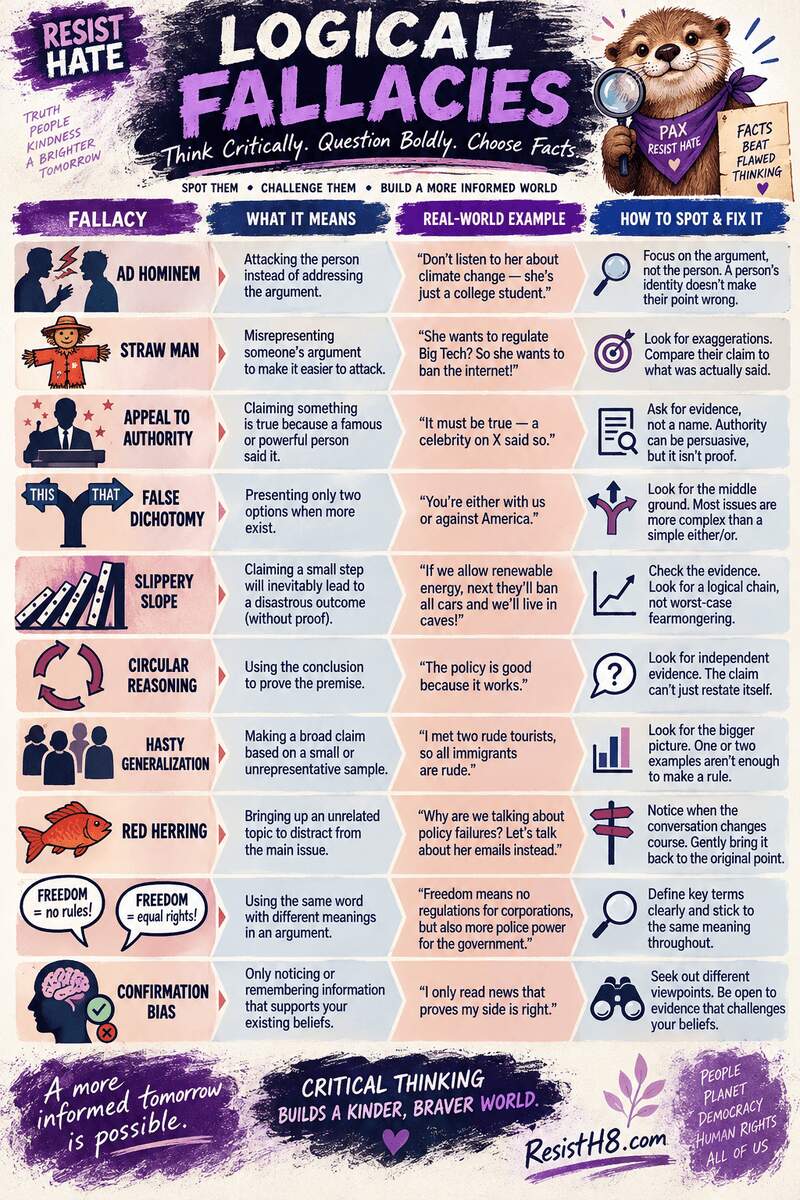
None of this is about stupidity. Fallacies exploit speed. We make most judgments in seconds, using shortcuts that are usually good enough, and a well-built fallacy is like a shortcut.
Repetition does the rest — familiarity registers in the brain as truth, which is the illusory truth effect. And once someone has publicly defended a position, cognitive dissonance makes abandoning it feel like a personal loss rather than an update.
Stack those on top of gaslighting and you have a perfect propaganda system.
How to Spot Logical Fallacies While They’re Happening
Four questions, short enough to use mid-conversation:
- Did they answer the question, or replace it?
- Is the position they're attacking one an actual person holds?
- Are those really the only two options?
- Does the evidence measure the thing they say it measures?
You don't have to win the argument. You just have to name the tactic out loud once, in front of other people. When you point out a fallacy, it stops working on everybody in the room — which is the whole point of this hub.