
Trump wanted to use the Insurrection Act in 2020, and the adults in the room stopped him. Now he's talking about it again, and the adults have left the toddler unattended.
In June 2020, Americans filled the streets in protest after a Minneapolis police officer murdered George Floyd. President Trump wanted to send active-duty troops to deal with them. His own Defense Secretary stood in the way. "I do not support invoking the Insurrection Act," Mark Esper told reporters.
Six years later, Trump brought it up again.
In a TIME interview published Oct. 1, 2026, he was asked if he'd rule out declaring a state of emergency before the midterms. "I don't rule anything out or in," he said. Then he asked if they meant the Insurrection Act. "I've never used it. I could use it. A lot of people think I should use it sometimes."
So what is this law, and what does it do?
What is the Insurrection Act?
Normally, the military stays out of local law enforcement’s business. The Posse Comitatus Act of 1878 bans federal troops from enforcing laws on American soil.
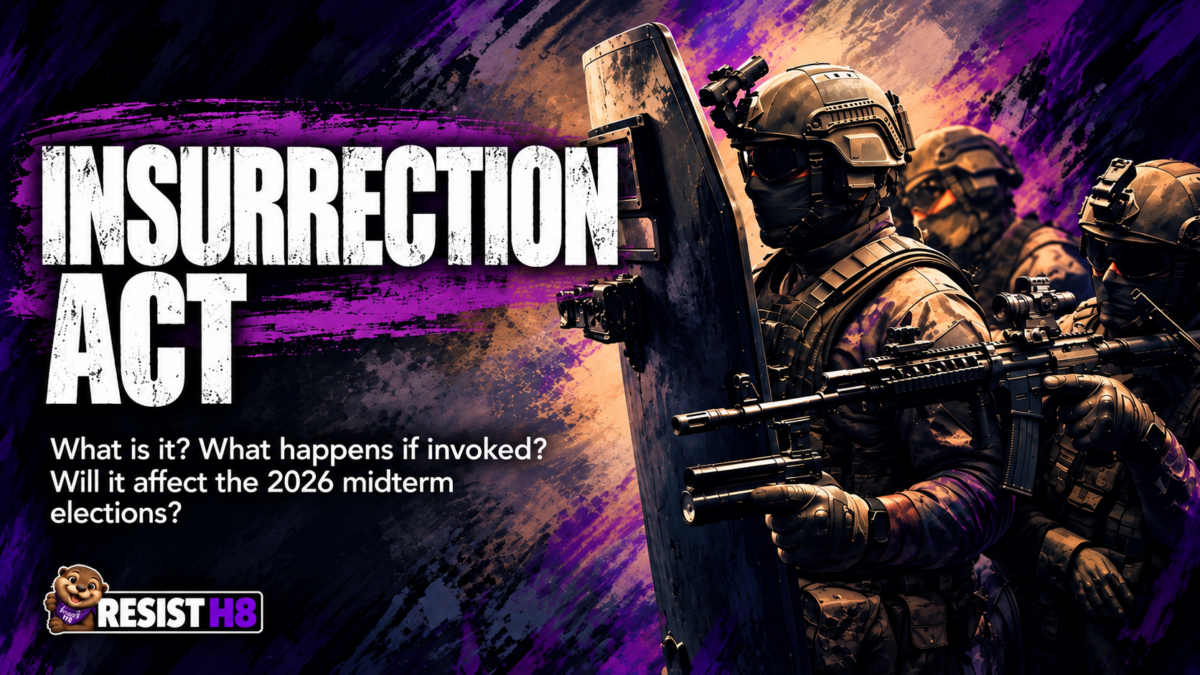
The Insurrection Act is the biggest exception. Once a president invokes it, soldiers can make arrests and search people, cars, anything a police officer can legally do.
The president can use it in three situations:
- A state asks for help to stop an insurrection.
- Federal law can't be enforced the normal way, through the courts, because of a rebellion or people blocking it.
- A state can't or won't protect people's constitutional rights.
The law never clearly defines "insurrection," so the president mostly gets to decide. Elizabeth Goitein of the Brennan Center warns that an army turned inward can quickly become a tool of tyranny.
Using soldiers against protesters is one of the classic warning signs of fascism.
Where did it come from?
Congress passed the first version in 1792. Thomas Jefferson signed the Insurrection Act in 1807, partly over fears that former Vice President Aaron Burr was plotting to build his own nation in the West.
After the Civil War, Congress expanded it so presidents could step in when Southern states refused to protect the rights of Black Americans.
When has it been used?
Not every use was noble. In the 1800s, presidents sent troops to break up labor strikes, almost always siding with employers.
Its most famous uses protected civil rights:
- 1957: Eisenhower sent the 101st Airborne to Little Rock, Arkansas, so nine Black students could attend Central High.
- 1962–1965: Kennedy and Johnson used it in Mississippi and Alabama over the objections of segregationist state officials.
- 1992: George H.W. Bush sent troops to Los Angeles during the Rodney King riots, after California's governor asked for help.
No president has used it without a state's cooperation since 1965. That time, it was to protect civil rights marchers. Trump keeps threatening to use it against protesters.
Has Trump used it?
Not yet. But he really wants to.
- June 2025: He sent National Guard troops and Marines into Los Angeles during protests against ICE raids, using a narrower law. Asked about the Insurrection Act, he said it "depends on whether or not there is an insurrection."
- October 2025: As judges blocked Guard deployments to Portland and Chicago, he said he'd use it "if it was necessary."
- December 2025: The Supreme Court ruled 6–3 that he likely had no authority to federalize the Illinois National Guard. Advocates warned that with that door closed, he might turn to the Insurrection Act.
- January 2026: After an ICE agent killed Renee Good, a 37-year-old Minneapolis woman, Trump threatened to "institute the INSURRECTION ACT" against protesters. The next day, he backed off, for "right now."
The pressure from his allies is real. In August, right-wing broadcaster Wayne Allyn Root urged him to declare a "national security emergency for elections."
Could Trump use the Insurrection Act to cancel the midterms?
No. Here's why.
It can't move Election Day. The act doesn't suspend the Constitution, and federal law sets the date. Only Congress can change it. The midterms are Nov. 3.
Troops at the polls are a crime. Under 18 U.S.C. § 592, sending troops or armed federal agents, including ICE, to polling places can mean up to five years in prison. The only exception is fighting off armed enemies of the United States. Legal experts writing for Lawfare say the Insurrection Act doesn't override that.
The military says it has no plans. On Aug. 31, Joint Chiefs Chairman Gen. Dan Caine told Sen. Elissa Slotkin there are no plans to send troops to polling places or seize ballots and voting machines. Defense Secretary Pete Hegseth never answered her.
There's a catch. Caine's letter doesn't cover an Insurrection Act order. The bigger danger is troops filling a city days before an election, scaring voters into staying home, or "unrest" becoming an excuse to challenge the results.
What can we do?
Pennsylvania Rep. Chris Deluzio and Senate Democrats introduced the Insurrection Act of 2025. It would require presidents to consult Congress, end deployments after seven days without congressional approval, and let people sue over abuse. It's been stuck in committee since June 2025.
Until then, the best defense is one no president can invoke away. Show up.
- Find your polling place and early voting options.
- If you see intimidation, call the nonpartisan Election Protection hotline at 866-OUR-VOTE (866-687-8683).
- Volunteer to help get out the vote.
In 2020, the guardrails held because people inside the government said no. In 2026, that job falls to the rest of us.