

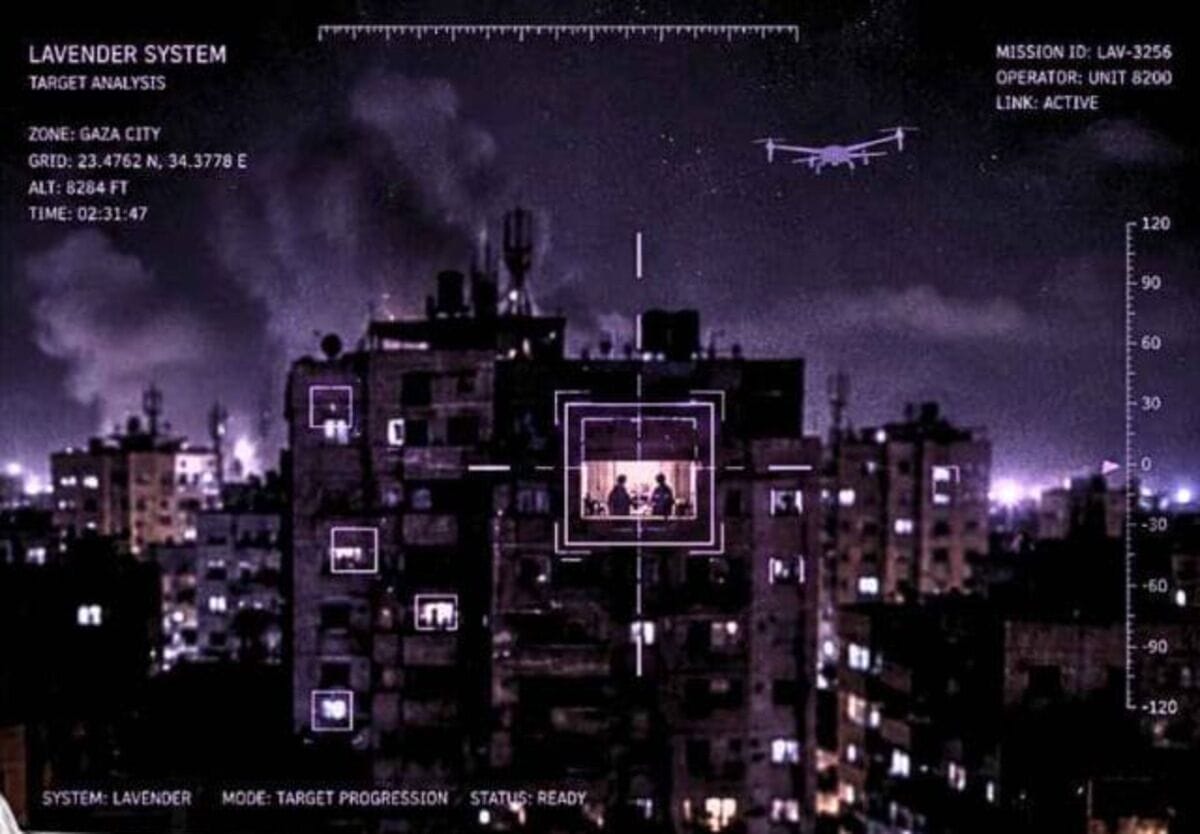

When +972 Magazine and Local Call published Yuval Abraham’s investigation into a piece of software called Lavender in April 2024, the response from people who had been paying attention was not exactly shock. It was confirmation.
The mechanism of mass slaughter in Gaza had a name now. The math had a name. The reason entire families kept dying in their sleep had a name.
More than two years later, with the death toll in Gaza now staggering and the International Court of Justice deep into genocide proceedings against Israel, the Lavender story has only grown more important.
It is the closest thing we have to a technical blueprint for how a modern military decides who is allowed to live and who is not — and how that decision can be made in twenty seconds, by a machine, with a known error rate, while a man’s family is in the same room.
This is what we know.
What is Lavender?
Lavender is an artificial intelligence system developed by Israel’s Unit 8200, the military’s elite signals intelligence wing. It was built to do one thing: scan the data Israel collects on the roughly two million people living in Gaza and assign each of them a number between 1 and 100.
The number is the system’s estimate of how likely that person is to be a member of the armed wings of Hamas or Palestinian Islamic Jihad.
According to the six Israeli intelligence officers who spoke to Abraham — all of whom had served during the current war and had direct experience using the system — Lavender was trained on data from people the military already considered militants.
It then looked for similar “features” in the rest of the population. The features were not made public. They included things like being in a WhatsApp group with a known militant, changing your phone often, or moving between addresses. They are the kinds of behaviors that describe most young men in a war zone.
In the first weeks after October 7, 2023, Lavender marked roughly 37,000 Palestinians as potential targets. That figure is not from a leaked Palestinian source. It is from Israeli intelligence officers describing their own system.
The Twenty-Second Rule
The most damning part of Abraham’s reporting was not the existence of the system. It was the policy around it.
Officers told +972 that during the early weeks of the war, the army gave sweeping authorization to use Lavender’s outputs as targeting decisions, with no requirement to look at the underlying intelligence.
One source said human personnel functioned as a “rubber stamp.” Another said they personally spent about twenty seconds reviewing each name before signing off on the bombing.
Their job was essentially to confirm that Lavender had identified a man rather than a woman.
This was the policy despite the Israeli military’s own internal acknowledgment that Lavender produced errors in about ten percent of cases — meaning that roughly one in ten people on the kill list either had no meaningful connection to a militant group or had been confused with someone else entirely.
With 37,000 names on the list, the implication is mathematically simple. Thousands of people who were not what the system claimed had been marked for death anyway.
Where’s Daddy
Lavender did not work alone. It was paired with a second system called “Where’s Daddy?” — a tracking program designed to alert intelligence officers when a marked target entered their family home.
That detail is the one that bears the most weight. It was not an oversight. It was not an unfortunate consequence of imperfect targeting. The Israeli military built a system specifically designed to wait until a person was home with their wife and children, and then strike.
Officers told +972 that this was preferred because it was operationally simpler — it was easier to confirm someone’s location when they returned to a known address than to track them through Gaza in real time.
The name of the system is not a coincidence. The engineers who built it knew exactly what they were doing. A child asks where their father is.
The system answers.
The Math of “Acceptable” Civilian Deaths
In every modern military, there is a concept called proportionality. It is the principle that a strike’s military value must be weighed against the harm done to civilians, and that the harm cannot be excessive.



It is the bedrock of international humanitarian law — the line that separates a war from a massacre.

According to the officers who spoke to Abraham, that line was effectively erased in the early weeks of the war. For a low-ranking suspected militant marked by Lavender, the military authorized killing up to fifteen or twenty civilians as “acceptable collateral damage.”
For a senior commander, the authorized number reached into the hundreds. One source described a strike in which roughly 300 civilians were killed in a single bombing of residential buildings. The military was aware of the number of civilians it was going to murder in advance.
Compare that to historical practice. Before the current genocide in Gaza, the Israeli protocol for striking a senior operative in their home — already considered an extreme measure — required careful review and was reserved for the most senior commanders.
After October 7, the threshold collapsed. Junior operatives, identified by an algorithm with a ten percent error rate, became eligible for strikes that took out entire apartment blocks.
The Pattern Confirms Itself
In the time since the Lavender investigation was published, the broader picture has only sharpened. A separate +972 investigation revealed an internal Israeli intelligence database showing that 83 percent of those killed in Gaza were civilians — a number the military itself was tracking even as its spokespeople denied the scale of civilian harm publicly.
A third system, called “The Gospel,” was used to mark buildings and infrastructure rather than people, accelerating the destruction of apartment complexes, universities, mosques, and hospitals. A former intelligence officer described the combined operation as a “mass assassination factory.”
And the supply chain matters. Reporting from +972 and other outlets has documented how major American and European tech firms have provided cloud infrastructure, surveillance products, and computing power to the Israeli military.
The genocide in Gaza is not just an Israeli operation. It is a global supply chain, with engineers, executives, and shareholders in Silicon Valley, Seattle, and elsewhere with their hands on the controls.
Why This Story Still Matters
It would be easy to file Lavender away as one more horror in a war full of them. That would be a mistake.
What Abraham and his colleagues exposed is the operating logic of a particular kind of warfare — one where the moral weight of killing a person is offloaded onto a piece of software, where a twenty-second review by a tired soldier is treated as meaningful oversight, and where the deaths of children at the dinner table become an “operational” decision rather than a moral one.
The technology is not the problem. The technology is doing exactly what it was built to do. The problem is the chain of human decisions that built it, deployed it, set the thresholds, signed off on the strikes, and approved the math that made a child’s life worth less than the convenience of striking their father at home.
International law experts have argued for over a year now that what happened in Gaza, with Lavender at its center, meets the legal definition of genocide. The International Court of Justice is weighing that question now.
Genocide scholars, Amnesty International, the European Center for Constitutional and Human Rights, an article from The Guardian, “The Consensus is Clear: It’s a Genocide. Now Will International Law Die in Gaza, Too?” have all publicly declared that what is happening in Gaza is indeed a genocide.
Watch: What is taking the ICC so long to determine that the mass slaughter in Gaza is a “genocide?”

Governments that have continued to arm Israel through this period — including the United States, which provided the bombs, the intelligence sharing, and the diplomatic cover — will eventually have to answer for that record.
Ordinary people across borders did not build Lavender. Ordinary people in Tel Aviv did not vote for “Where’s Daddy?” The mothers in Gaza and the mothers in southern Israel both want their children to come home at night.
The leaders who built and deployed these systems chose this. They should be the ones who answer for it.
Until then, the names on the list — the real names, of the real people in Gaza who died — keeps getting longer.