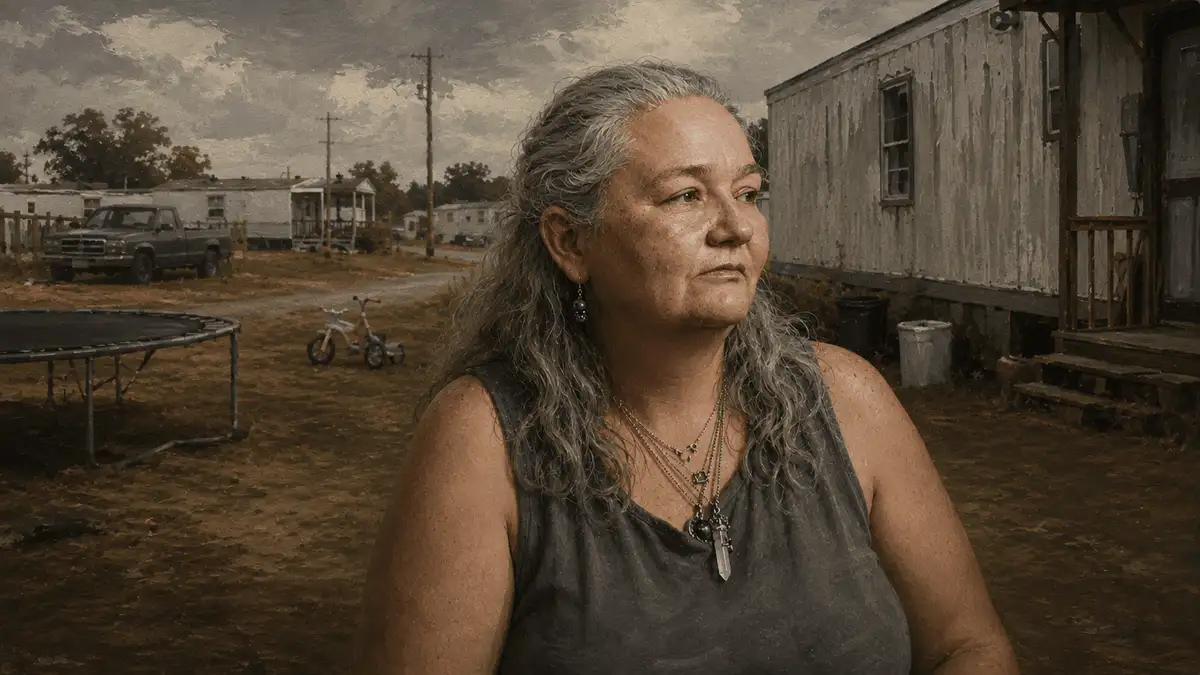

Trinity Goodman is one of those forgotten Americans in poverty. Her total net worth is less than 4 bucks.
She has $3.78 in her checking account. She keeps exactly one cent in her savings account, because the bank will close it if the balance drops down to $0.
There are six pennies in her wallet. She survives by selling her own blood plasma.
Goodman is one of the Oklahomans that New York Times columnist Nicholas Kristof met on a 1,000-mile road trip through Arkansas, Kentucky, and Oklahoma — a trip he's taken in some form every year for two decades. The resulting column, published August 1, is the kind of reporting you get emotional reading.
What $298 a Month Doesn't Buy
Goodman gets $298 a month in SNAP benefits (Supplemental Nutrition Assistance Program), financial assistance the government deposits into a special account each month. Each account is linked to a debit card provided to recipients. It can only be used to buy food that has not been prepared (like warm, ready-to-eat deli food items).
The fact that benefits can’t be used to buy non-food items is what makes it is so incredibly frustrating to hear politicians talk about SNAP “fraud” or claim that people receiving food assistance are using the benefits to buy cigarettes, alcohol, or illegal drugs instead of food.
People who haven't had to rely on federal assistance probably aren't aware of how benefits are distributed, who is eligible, or which documents are required to determine eligibility.
That lack of understanding can make people vulnerable to disinformation from Republican politicians.
Some people don’t understand that it's not possible to purchase non-food items or anything on the list of ineligible food products.
If you swipe a SNAP-issued EBT card to pay for a case of beer, it gets declined. (The debit cards issued to SNAP recipients in Pennsylvania are called EBT — Electronic Benefits Transfer cards.
Instead of mailing out checks and physical food stamps to recipients, the government transitioned to electronic disbursements of all financial assistance.
Trinity’s Situation
There are some things SNAP benefits won’t pay for: toilet paper. Tampons and pads. Soap. Diapers. Any of the essentials you can buy at a grocery store.
So Trinity, the woman with 6 pennies in her wallet, hunts for those items at church-run pantries which, in large parts of the country, function as a safety net.

Haircuts are out of the question. Goodman told Kristof she has never once been to a barber or a salon. "Never. I don't have that luxury."
For five years before she found assistance with housing, Goodman avoided homelessness by living in the home of a man who wasn't her partner — a man who, she said, expected sex in exchange.
A local nonprofit, HOPE Community Services, eventually helped her into low-income housing that costs her $50 a month.
Without that group, her choices would still be unwanted sex or the street.
In the wealthiest country on earth, a woman's housing situation was a sexual transaction, and the thing that finally rescued her was a single Oklahoma City nonprofit that has been scraping by since 1980.
Selling Plasma is Now a Normal Way to Pay Rent
Goodman's plasma income isn't unusual anymore. Roughly 200,000 Americans a day sit in a recliner and let a machine drain and sort their blood for $30 to $70 a pop.
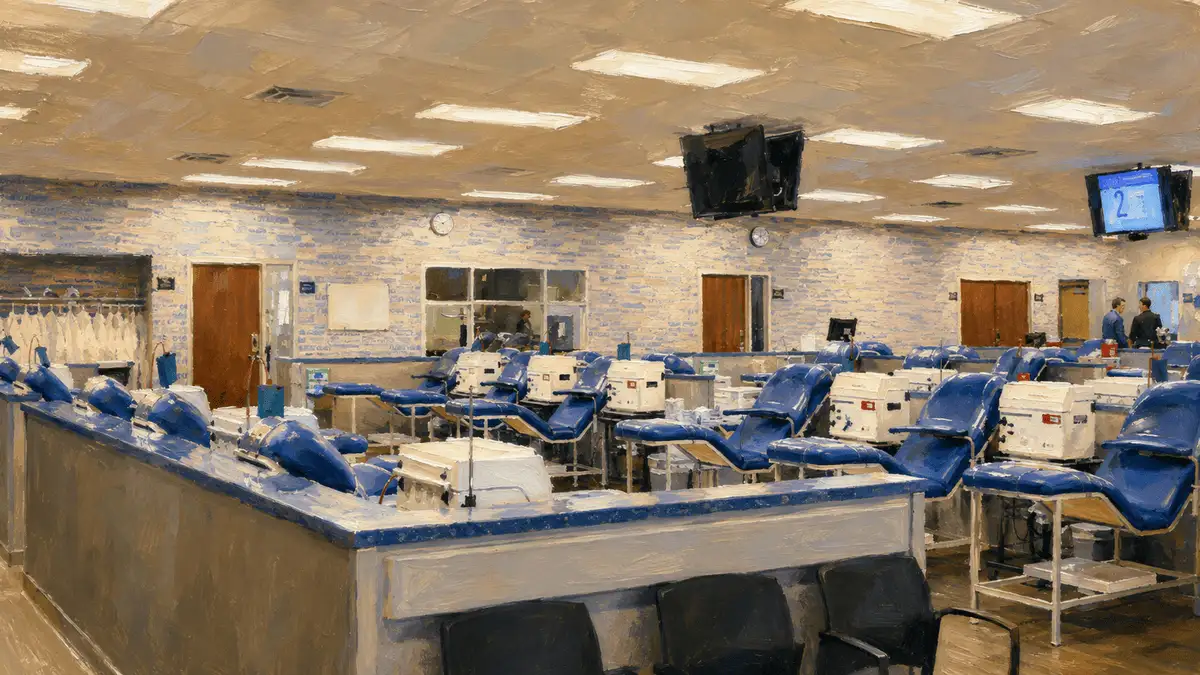
Americans earned about $4.7 billion selling their blood plasma in 2025 — up more than 30 percent since 2022.
There are now more plasma centers in the United States than Costco stores.
That's not a health statistic. That's an economic one.
The Cuts on Top of All of This
The people Kristof met aren’t struggling for no reason. They're absorbing the One Big Beautiful Bill Act, signed July 4, 2025, which cut $186 billion from SNAP over ten years — the largest cut to food assistance in American history.


The results are already measurable. SNAP enrollment has fallen by more than 4 million people between July 2025 and April 2026, an 11 percent drop nationwide.
Many of them are children.
The law raised the work-requirement age ceiling from 54 to 64, slashed the age at which a dependent child exempts a parent from 18 to 7, and buried applicants in new documentation requirements.
Arizona's participation dropped by half.
Work requirements sound reasonable in a soundbite.
In practice they cost a fortune to administer, catch very little fraud, and mostly just kick people off benefits for paperwork failures — right as low-wage jobs got harder to find.
Meanwhile the grocery bill keeps climbing. A Washington Post-Ipsos poll released in July found 66 percent of Americans now call groceries unaffordable — up from 45 percent in February, before the Iran war.
Among households earning under $50,000, it's 82 percent.
The "Undeserving Poor" is a Story Rich People Tell About Americans in Poverty
The official justification for all of this is fiscal restraint.
That argument gets harder to make with a straight face next to the cost of the Iran war, $1 billion (taxpayer’s portion) for the Qatari jet security upgrade, Trump’s $275 billion Trump-class war ships, $900 million (+ $500/month for maintenance) to replacethe grass in every D.C. park, $14 billion for the reflecting pool renovation, and trillions in tax cuts for billionaires.
Video: President Trump reveals his Golden Fleet of warships

The unofficial justification is the one people actually believe: that poor people are gaming the system.
Kristof points to a stubborn piece of evidence against that.
As of 2019, ProPublica found the most heavily audited county in America was Humphreys County, Mississippi — a majority-Black rural county in the Delta with a median household income around $26,000, where more than a third of residents live below the poverty line.
It was audited at a rate 51 percent higher than the richest county in the nation, Loudoun County, Virginia.
Not because Humphreys is full of tax cheats. Because so many of its residents claim the Earned Income Tax Credit, and the IRS finds it cheaper to audit poor people than rich ones.
Which age group is most likely to be poor in America? Children. Specifically, children two years old and younger.
Nobody has ever caught a toddler committing benefits fraud.
Kristof Doesn't Let Democrats Off the Hook Either
Kristof argues that the blindness to Americans like Trinity isn't partisan.
The three states with the highest rates of unsheltered homelessness are California, Oregon, and Hawaii — all blue.
On education, some of the most striking gains have come from Alabama, Louisiana, and Mississippi; by his account, a Black fourth-grader in Mississippi is now two and a half times as likely to read proficiently as one in California.
And Palo Alto, where four out of five voters backed Kamala Harris, offers its excellent public schools to any child whose family can swing an average home price of $3.6 million.
That's not an attempt to defend the people gutting SNAP. It's a harder point: structural poverty gets ignored by everyone, because fixing it requires giving something up.
The Thing Kristof Keeps Doing
He's been at this a long time. Back in 2016, he went to Tulsa and reported on Oklahomans in extreme poverty — households living on less than half the poverty line, about 95,000 of them children.
A decade later, he's back in the same state, and the safety net is even thinner.
Kristof wants to put a name and a face on a number so people don’t just scroll past it.
Trinity Goodman is a name. $3.78 is a number. Both are true at the same time, and only one of them will show up in a budget hearing.
The 2026 midterms are three months out. Every person who voted for that bill is going to campaign on affordability.