


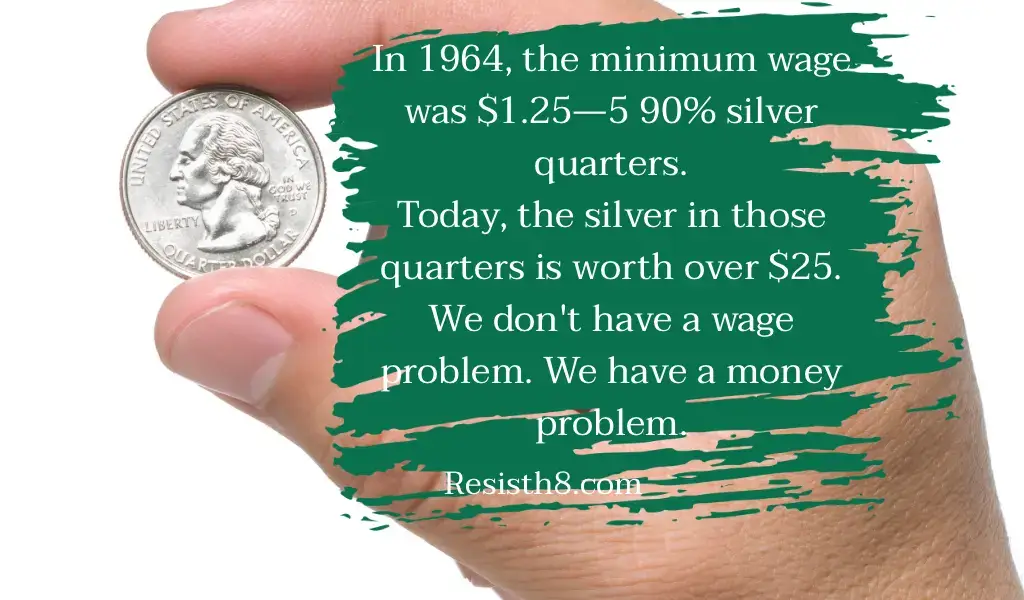
The author of an article on stagnant wages has an interesting view of the issue. He claims the wage problem isn't actually about wages, but money—the U.S. quarter in particular. He claims: “We don't have a wage problem, we have a money problem.”
Let's hear him out.
The push to raise the minimum wage is relentless.
For a while, it was “Fight for $15,” but with rampant price inflation, a $15 an hour minimum wage isn’t sufficient. Now it’s “Fight for $20.” Heck, it might even be “Fight for $25” at this point.
I understand people’s frustration with wages. Their pay doesn’t keep up with rising prices.
But here’s the dirty little secret – we don’t have a wage problem.
We have a money problem!
Our “wage problem” is actually a money problem. What have they done to our money?
Before 1964, quarters were 90% silver.
That all changed in 1965 with the passage of the Coinage Act.
Under the law signed by President Lyndon B. Johnson, the U.S. Treasury removed all of the silver from dimes, quarters, and half-dollars. Instead, the government mints coins from “composites, with faces of the same alloy used in our 5-cent piece that is bonded to a core of pure copper.”
You will sometimes hear coins minted before 1965 referred to as “junk silver.”
In reality, we should call modern American coins junk.
Johnson promised removing silver would have no impact on the value of U.S. coinage, asserting that “[The] Treasury has a lot of silver on hand, and it can be, and it will be used to keep the price of silver in line with its value in our present silver coin.”
You’ll be shocked to learn he was lying.
The minimum wage reveals the ugly truth about our money problem
In 1964, the minimum wage stood at $1.25 per hour. That’s the equivalent of five silver U.S. quarters. Remember, they were 90% pure silver.
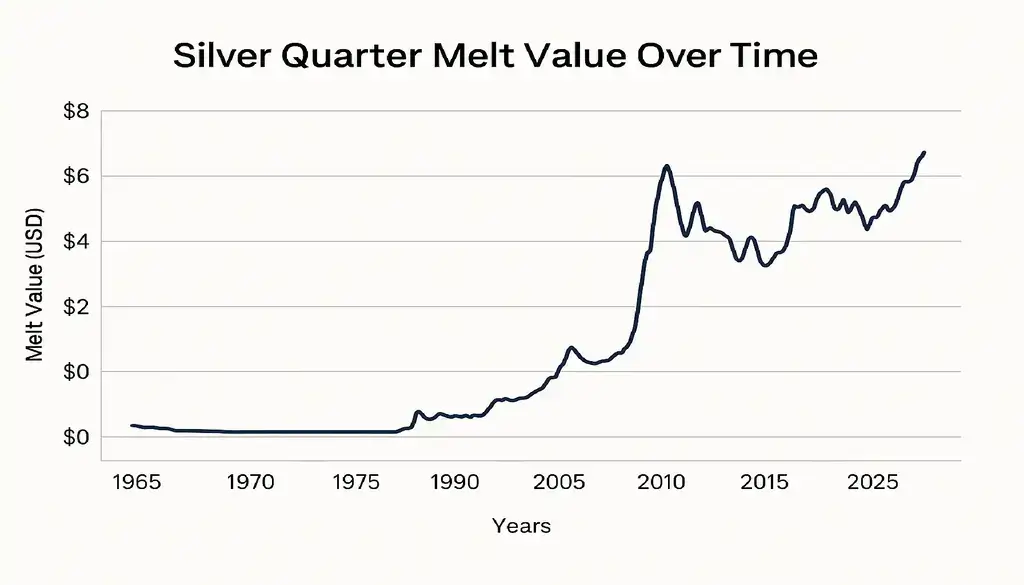
Today, the melt value of a 1964 silver quarter is $5.13.

That means if you got paid five pre-1965 quarters today, you would hold $25.65 in your hands.
There’s your living wage.
So no, we don’t have a wage problem. We have a money problem.
And the government caused it!

Mike Maharrey
Mike Maharrey is a journalist and market analyst for MoneyMetals.com with over a decade of experience in precious metals. He holds a BS in accounting from the University of Kentucky and a BA in journalism from the University of South Florida.