
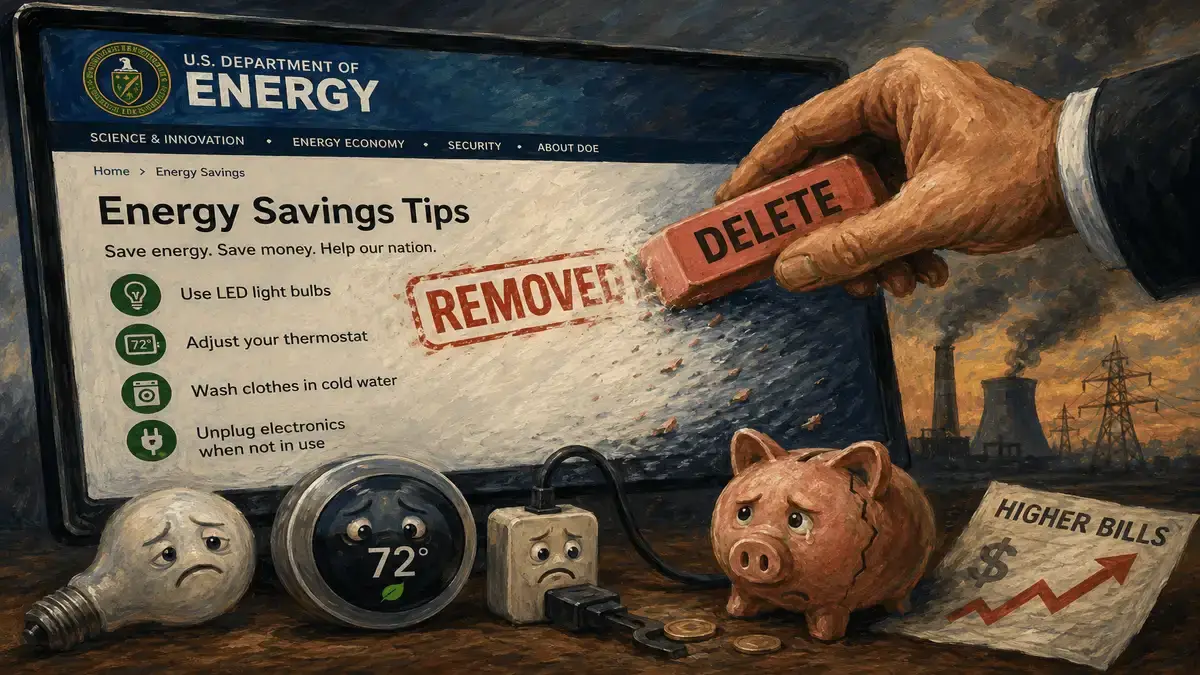

In the first days of July, Central Park hit a record 100 degrees. Heat advisories stretched from D.C. to Philadelphia, power grids strained, and millions of Americans cranked the air conditioning and braced for the bill. The U.S. Department of Energy picked that exact moment to delete the federal government's best free advice on how to stay cool without going broke.
By July 3, more than 1,600 pages had vanished from Energy Saver, the DOE's plain-language guide to cutting home energy costs, with earlier reporting putting the broader purge across energy.gov at roughly 6,000 pages.
Guides to do-it-yourself home energy assessments, professional energy audits, efficient appliance shopping, insulation, and "cool roofs" now land on "Page not found."

These weren't cobwebbed corners of a website nobody visited.
The Guardian's analysis found that more than 300 of the deleted pages drew about 160,000 views in a single 30-day stretch this summer — while the heat waves were happening.
People were using these pages, in real time, to get through it.
First, the thermostat tantrum
The timing is hard to ignore.
As the heat wave bore down on New York, Mayor Zohran Mamdani asked residents and businesses to set their air conditioners to 78 degrees to keep the grid from buckling.
Republicans reacted like he'd proposed seizing the means of production, mocking the request as "socialism" — with Rep. Nancy Mace reportedly calling it "an act of war against women in menopause."
One problem: the Department of Energy's own website had recommended keeping summer thermostats between 75 and 78 degrees for years — the same advice Texas officials have pushed during their own grid emergencies.
Internet sleuths quickly noticed that this guidance had just been scrubbed.
The federal government agreed with Mamdani right up until it deleted the evidence.
Then, follow the rulemaking
There's a second clock running here. On July 2, the DOE announced a proposed rule designed to make it much harder for any future administration to set efficiency standards for household appliances — in a press release promising to "permanently end Green New Scam appliance mandates."
It's one front in the administration's broader war on energy efficiency, which has turned dishwashers, shower heads, and light bulbs into culture-war props.
The Environmental Data and Governance Initiative, which tracks changes to government websites, has documented a pattern under Trump: agencies tend to strip public information from their sites right around the time they announce related rollbacks — during the exact window when the public is legally entitled to weigh in.
EDGI's Izzy Pacenza told Grist she couldn't recall another case where an entire DOE domain went dark like this.
In fairness to the facts: Andrew deLaski of the Appliance Standards Awareness Project notes that the technical pages for the appliance standards program itself are still online.
So this may be less about burying a rulemaking docket and more about erasing the message itself — that using less energy is possible, easy, and saves you money.
As deLaski put it, the administration is "only trying to go backwards."
The DOE didn't answer questions about why the pages came down.
It didn't have to — the pattern answers for it.
Last summer, the administration killed the website hosting the National Climate Assessment, the congressionally mandated reports explaining how climate change hits your region.



Climate.gov, which translated NOAA's science into everyday language, disappeared around the same time.
Now Energy Saver.
Notice what keeps getting deleted: not the dense technical archives, but the accessible pages — the ones that turned government research into things an ordinary renter or homeowner could actually do.
That's not an accident.
Under Trump's "energy dominance" framing, burning more is patriotic and conserving is suspect.
A government page showing you how to shrink your electric bill is off-message.
Efficiency used to be boring — and bipartisan
We've run this experiment before.
During the 1979 fuel crisis, Jimmy Carter ordered public and commercial buildings to set summer thermostats no cooler than 78 degrees.
Ronald Reagan scrapped the rule in 1981 as "an excessive regulatory burden" — then, six years later, signed the National Appliance Energy Conservation Act, the law that created minimum efficiency standards for refrigerators and freezers in the first place.
For four decades, making appliances waste less was one of the least controversial things the federal government did.
Now a thermostat number is a loyalty test.
And the people who lose aren't pundits.
They're seniors on fixed incomes choosing between air conditioning and groceries, renters in leaky apartments, families opening record summer electric bills.
The deleted pages were free, practical, and already paid for with their tax dollars.
They can delete the pages — not the physics
Here's the good news: archivists move faster than censors.
The End of Term Web Archive, EDGI, and the Internet Archive preserved Energy Saver before it vanished.
You can browse the full list of deleted pages or pull up the DIY home energy assessment guide exactly as it looked.
Sealing air leaks still cuts your bill.
Insulation still works.
Seventy-eight degrees still eases the grid.
The Department of Energy can take down a website, but it can't repeal thermodynamics.