


While American troops are still dying in the Middle East, President Donald Trump gathered hand-picked Latin American leaders at his Florida golf resort on Saturday to announce a new military coalition aimed at destroying Latin American cartels — and to issue thinly veiled threats against Cuba.
The “Shield of the Americas” summit, held at Trump National Doral Miami, brought together leaders from 12 countries who were invited to sign on to what the administration calls the “Americas Counter Cartel Coalition.”
At least 17 nations have agreed to the framework so far. But the gathering was defined as much by who wasn’t there as by who was.
A Coalition of the Willing — Minus the Region’s Biggest Players
Brazil, Mexico, and Colombia — the hemisphere’s two largest economies and the country historically at the center of U.S. anti-narcotics strategy — all declined to attend.
Both Brazil and Mexico are governed by left-leaning presidents who have resisted Trump’s more aggressive posture in the region.
Colombia, under President Gustavo Petro, has pursued a negotiation-based approach to disarming cartels and rebel groups, a strategy Trump openly mocked during his remarks.
The contrast was not lost on observers.
Richard Feinberg, who helped organize the first Summit of the Americas in 1994 under President Clinton, noted the dramatic difference between that 34-nation gathering built on inclusion and consensus and Saturday’s smaller affair.

He described the Shield of the Americas as a “crouched defensiveness, with only a dozen or so attendees huddled around a single dominant figure.”
The leaders who did show up were largely from right-leaning governments aligned with Trump’s worldview, including Argentina’s Javier Milei, El Salvador’s Nayib Bukele, and Ecuador’s Daniel Noboa.
“We’ll Use Missiles”
Trump’s remarks at the summit were characteristically blunt and combative.

Trump’s full remarks on Latin American cartels and more at the Shield of the Americas summit in Florida
He urged attending leaders to deploy their own militaries against cartels and framed the fight in stark terms, comparing it to the campaign against ISIS in the Middle East.
He dismissed diplomatic alternatives to military action, taking an implicit swipe at Colombia’s Petro without naming him.
Trump told the assembled leaders he would deploy American missiles into the region if asked, describing them as precision weapons that could strike cartel members in their homes.
(Opinion: Further evidence that Trump and Hegseth are “playing war” with military weapons they view as “toys.”)
Defense Secretary Pete Hegseth, who spoke at the inaugural Americas Counter Cartel Conference earlier in the week, reinforced the message that the U.S. was willing to act alone if necessary, though the administration preferred regional cooperation.
The administration’s record in the region already reflects that willingness.
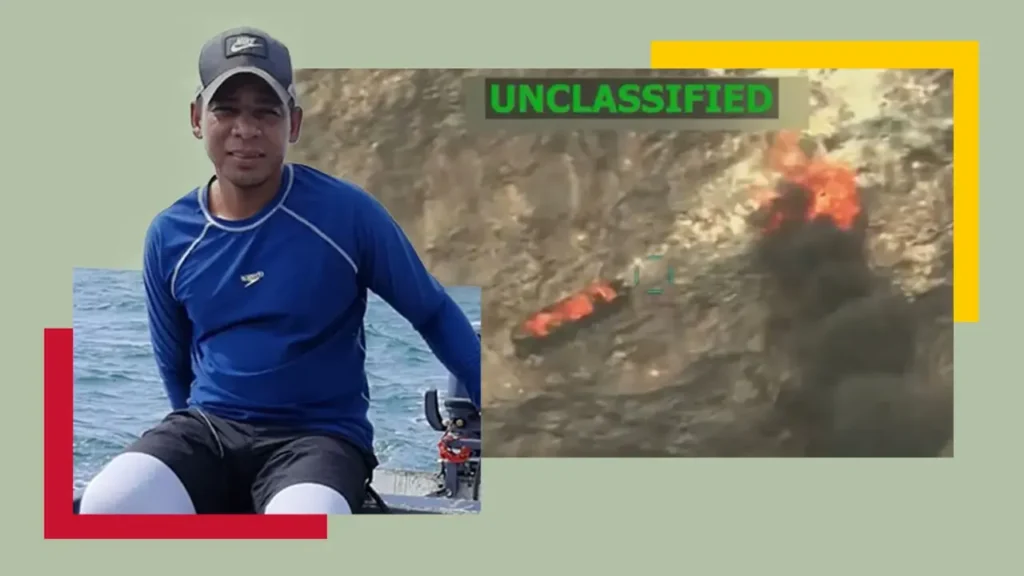
Since September, the U.S. has conducted at least 44 aerial strikes on boats in the Caribbean Sea and eastern Pacific Ocean, killing nearly 150 people.
The identities of the dead have never been publicly confirmed, and no evidence has been released to justify the strikes.
Credit: The Sunday Times
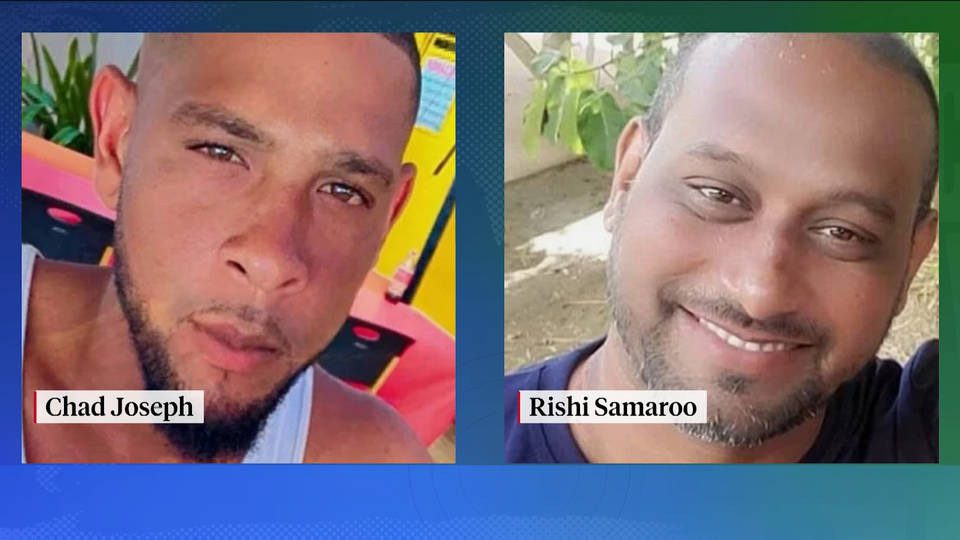
Families in Colombia and Trinidad and Tobago have come forward claiming the victims were fishermen or informal workers traveling between islands — not cartel operatives.
Multiple Fronts, Mounting Questions
The summit unfolded against the backdrop of an escalating war with Iran.
Trump briefly addressed the conflict during his remarks, telling the Latin American leaders that “tremendous progress” had been made.
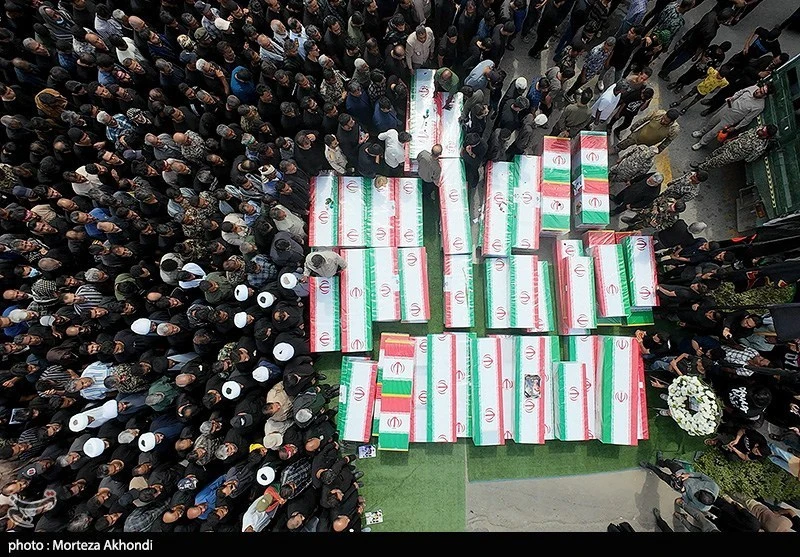
But the war’s costs were immediate and personal: Trump left the summit to travel to Dover Air Force Base in Delaware for the dignified transfer of six U.S. service members killed in a drone strike on a command center in Kuwait, just one day after the U.S. and Israel launched their military campaign against Tehran.
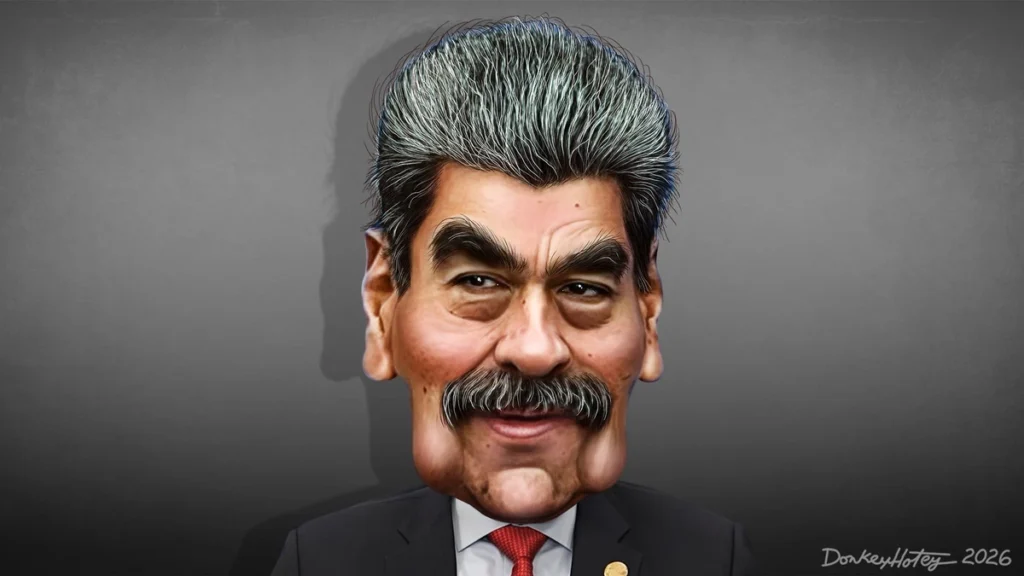
The simultaneous military engagements — a full-scale war in the Middle East, ongoing boat strikes in the Caribbean, joint operations with Ecuador, the January abduction of Venezuelan President Nicolás Maduro, and now a hemisphere-wide anti-cartel coalition — have raised serious questions about whether the U.S. military is being stretched too thin.
Stephen Miller, one of the architects of Trump’s hardline immigration and foreign policy agenda, told reporters at the conference that Latin American cartels would remain a top military priority regardless of what was happening in the Middle East.
But experts have questioned whether the rhetoric can match reality when American forces are already committed to a hot war on another continent.
Cuba in the Crosshairs
Perhaps the most striking moment of the summit came when Trump turned his attention to Cuba.
He told the assembled leaders that “great change will soon be coming to Cuba,” describing the island nation as being “in its last moments of life as it was.”
He suggested the U.S. would turn its full attention to Cuba once the war with Iran concludes.
(Congress, can you please do something about this out-of-control dictator before he completely destroys the U.S.?)
Cuban officials have repeatedly expressed willingness to engage in dialogue with Washington, provided it respects Cuban sovereignty.
But the administration’s tone — combined with the recent military capture of Venezuela’s Maduro — suggests diplomacy is not the primary tool under consideration.
And therein lies the problem. International and domestic laws mandate an attempt to solve issues through diplomacy before immediately launching a war against another country.
Mohammad Yaghi, a political scientist specializing in the Middle East explained how former presidents handled the idea of war with Iran:
“Previous U.S. presidents—George W. Bush, Obama, and Biden—refrained from striking Iran’s nuclear facilities primarily out of concern over Iran’s likely response.
For this reason, President Bush resisted Israeli pressure to escalate and, in Obama’s case, turned to negotiation and a formal agreement, the Joint Comprehensive Plan of Action, having concluded that the alternative was a war whose costs were well understood and deemed unacceptable.”
Netanyahu hated the Iran Nuclear deal (Joint Comprehensive Plan of Action), because he had been pushing the U.S. to go to war with Iran on Israel’s behalf for decades.
Related News
The deal removed the threat he had been using as pretense for war with Iran. That’s why he asked Trump to tear it up in his first term.
Regarding diplomacy and negotiation, even if Iran had given President Trump everything he wanted and more, it wouldn’t have prevented this war. Negotiations were never taken seriously.
The Noem Shuffle
The summit also served as a soft landing for Kristi Noem, who was removed as Secretary of Homeland Security after a difficult congressional grilling that revealed she had spent $220 million on ads that featured her.
She told Senator John Kennedy that President Trump knew about — and approved — the expense. He did not.
Her blaming him for spending that much money on ads is what led him to remove her as DHS Secretary.
Trump named her as the first Special Envoy for the Shield of the Americas, a newly created position that effectively reassigned her from a Cabinet-level post to a diplomatic role focused on the hemisphere.
Noem framed the move as a continuation of her national security work and said her last day at DHS would be March 31.
Trump nominated Oklahoma Senator Markwayne Mullin to replace her.
A Region Hedging its Bets
While the administration framed the summit as a show of hemispheric unity, the reality is more complicated.
China has been steadily expanding its economic influence across Latin America through trade and investment, and many countries in the region see value in maintaining relationships with both Washington and Beijing.
Kevin Gallagher, director of Boston University’s Global Development Policy Center, put it plainly: the U.S. is offering the region tariffs, deportations, and militarization, while China is offering trade and investment.
Leaders in the region, he suggested, would be wise to remain neutral and use the rivalry between the two powers to their own advantage.
For an administration that has framed its Latin America policy in terms of dominance and control, that calculation may prove to be the biggest obstacle of all.