Israeli Prison Torture Files | Sufian Abu Saleh, 49
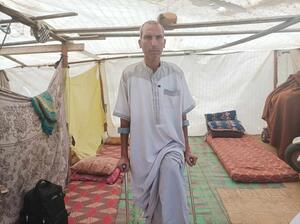
“I’m married to Hanaa Abu Saleh and we have four children, ‘Abd a-Rahman, 14, Iman, 13, Aya, 12, and ‘Issam, 10. Before the war, I worked as a taxi driver, but now I’m unemployed and live with my family in a tent in the al-Fukhari area in Khan Yunis, near the European Hospital.
On 7 October, we left our house in the ‘Abasan al-Kabirah area of Khan Yunis, because it’s close to the border and there were a lot of bombings there. At first, we moved to my parents, who live one kilometer away from our house. We stayed with them for about three days, and then moved to a relative’s house in downtown Khan Yunis and stayed with them for almost 50 days.
During the ceasefire, at the end of last November, we went back home and stayed there for about a week. When the ceasefire ended, the city of Khan Yunis came under heavy bombardment. We moved to a mosque far from the border, and stayed there for five days, and then we went to an IDP camp at the Harun a-Rashid school in al-Amal neighborhood, in the western part of the city of Khan Yunis. We stayed there for two months in very difficult conditions, because it was extremely crowded. There was no water or electricity, and there was hardly any food.
On 14 February 2024, the army surrounded the school, and the soldiers ordered the women to go with the children to the al-Mawasi area in western Khan Yunis. They kept the men inside the school. The soldiers divided us into groups of ten men each and ordered us to strip down to our underwear and hold up our ID cards. They checked our names against the ID cards, and then scanned each one with a device, tied our hands in front of us, blindfolded us and led us to what I think were warehouses that they converted into detention facilities. They forced us to kneel in the prayer prostration position on the ground until the evening.
Then we were taken to an interrogation center. I think it was in the Japanese neighborhood in downtown Khan Yunis. In the interrogation, they asked my name, where I was on 7 October and what my affiliation was, about Hamas and about the Jihad. During the interrogation, they beat us with a stick and kicked us, especially in the back and neck area. There were about 80 of us there. They kept us naked, in the same position, until midnight. It was very cold. The
Then they gave us white see-through clothing (like the clothes from Covid times) and put us all on a truck – about 80 people piled one on top of the other. We weren’t allowed to move or talk. If the soldiers sensed any movement, they beat us. I felt they’d injured my left leg, nothing serious.
Then they transferred us to another truck, tied our hands behind our backs and took us to an interrogation center that I understood was inside Israel. I felt weak and lost sensation in my legs, but I didn’t move so I wouldn’t get beaten. Then they took us to another place, where they told us to take off the Covid clothes and gave us prisoner uniforms to put on.
On the first day in detention, we were kept on gravel all day long, with our hands and feet tied. I only slept two hours at night. Soldiers took our information and scanned my eye. They gave me a number and took me to a doctor for a checkup. The soldiers laughed and made fun of us. The doctor asked if I had any medical conditions. I told him I had none.