


A major new study from the Cato Institute — a libertarian think tank, not a progressive one — found that immigrant workers generated a $14.5 trillion fiscal surplus for U.S. government budgets between 1994 and 2023.
Every single year over that three-decade period, immigrant workers paid more in taxes than they received in government benefits at the federal, state, and local levels.
The findings land as the Trump administration pours billions into mass deportation operations and promotes the idea that immigrants are draining American resources.
“Even if the government had not spent a dollar on immigrants, while somehow still getting all their tax revenue, the US government at all levels would still have run a $20 trillion deficit. Immigrants are not to blame for government deficits. Indeed, they reduced the deficit by about $14.5 trillion.”
The data says the opposite is true.
What the Study Found
The white paper, titled “Immigrants’ Recent Effects on Government Budgets: 1994–2023,” was authored by David Bier, Michael Howard, and Julián Salazar.
It builds on a fiscal model originally developed by the National Academies of Sciences, Engineering, and Medicine and represents the first-ever analysis of the cumulative fiscal impact of immigrant workers across three decades of government budgets.
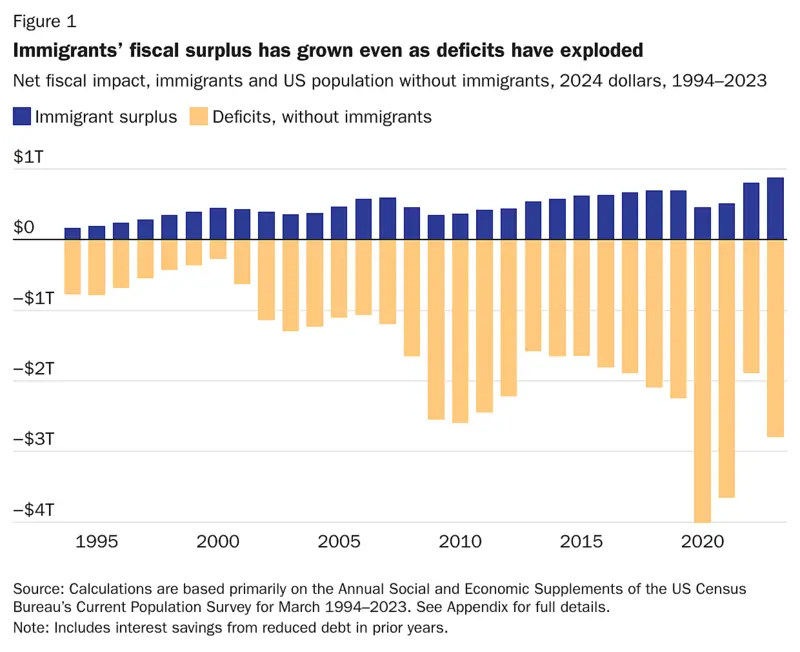
The headline numbers are striking. Immigrant workers generated nearly $10.6 trillion more in federal, state, and local taxes than they caused in total government spending.
When the study accounts for $3.9 trillion in savings on interest payments — money the government didn’t have to borrow because immigrants were covering their share — the total surplus rises to $14.5 trillion in real 2024 dollars.
Without immigrants, U.S. public debt at all levels of government would already exceed 205 percent of GDP — nearly double the actual 2023 level.
Many economists consider that a threshold that would trigger a full-blown debt crisis.
Immigrant workers cut U.S. budget deficits by roughly one-third over the 30-year period.
By 2023, the annual fiscal savings from immigrants had reached $878 billion — their highest level ever.
How is That Possible?
The study explains a concept that rarely gets airtime in political debates about immigration: a huge portion of the U.S. government budget goes to “pure public goods” — things like the military, NASA, and interest payments on debt accumulated before immigrants arrived.
These costs are fixed. They don’t increase when more people show up.
That means any new person who pays taxes and doesn’t dramatically increase the cost of scalable programs — like education, healthcare, or Social Security — is a net fiscal positive.
Immigrants clear that bar, and then some.
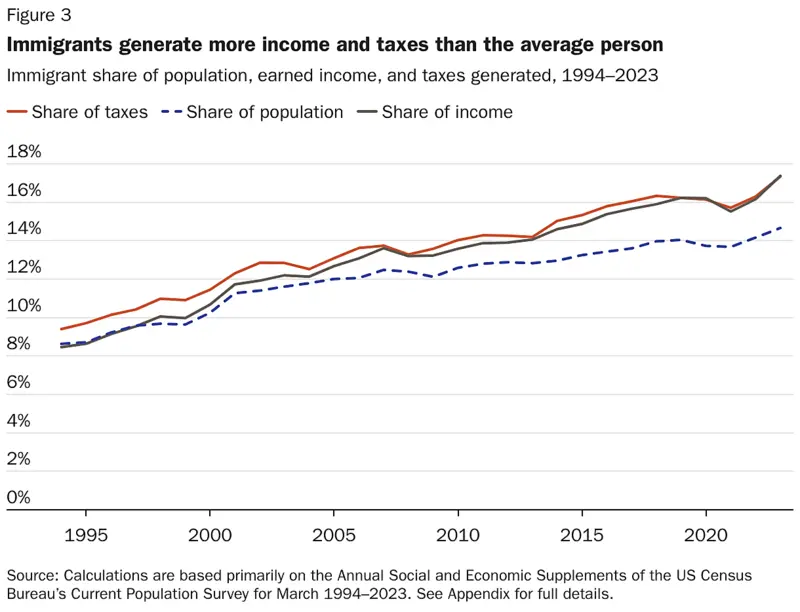
Immigrant workers accounted for 14 percent of all tax revenue from 1994 to 2023 but only 7 percent of government spending.
They paid more in taxes than the average person because their employment rate was higher — immigrants were more than 12 percentage points more likely to be working than the U.S.-born population.
They also cost the government less per person on the biggest budget items: old-age benefits, education, and public safety.
As the study’s co-author David Bier put it: “Even if the government had not spent a dollar on immigrants, while somehow still getting all their tax revenue, the US government at all levels would still have run a $20 trillion deficit. Immigrants are not to blame for government deficits. Indeed, they reduced the deficit by about $14.5 trillion.”
Even Low-Skilled Immigrant Workers Helped
One of the most politically charged claims in the immigration debate is that low-skilled immigrant workers are a drain on taxpayers. The Cato study directly addresses this.
Related

Immigrants without bachelor’s degrees — the group often labeled “low-skilled” — reduced public debt by $2.8 trillion over the study period.
“For years, nativists in Congress and the administration have wrongly claimed that immigrants are behind the growth in debt and that the US immigration system allowed foreigners to take advantage of Americans’ generosity. Our data completely repudiates this view.”
Every category of educational attainment, including immigrants who didn’t finish high school, lowered the deficit-to-GDP ratio.
The study found that even the lowest-skilled group, which had a net-negative annual fiscal flow (meaning they received slightly more in benefits than they paid in taxes), still reduced the debt-to-GDP ratio because they contributed to economic activity without adding to fixed costs like military spending and debt interest.
The researchers calculated that you would have to increase government spending on immigrants by 51 percent — nearly $4.9 trillion — before even the lowest-skilled immigrant population became more costly than the U.S.-born population relative to the economy.
What About Undocumented Immigrants?
The study estimates that undocumented immigrants reduced the national deficit by at least $1.7 trillion over the 30-year period, contributing more than 11 percent of the total fiscal gains from immigration.
Noncitizens overall — a group that includes undocumented immigrants, visa holders, and legal permanent residents who haven’t naturalized — contributed $6.3 trillion in fiscal savings.
Many undocumented workers have taxes withheld from their paychecks by employers, and they pay sales taxes and property taxes (directly or through rent) like everyone else.
But they are ineligible for most federal benefits, including Social Security, Medicare, food stamps, and Medicaid (except emergency care).
That combination — paying in while being locked out of benefits — is a major driver of their positive fiscal impact.
Under Trump’s “One Big Beautiful Bill,” eligibility for government benefits has been restricted even further for immigrants without permanent legal status, which means their net fiscal contribution is only likely to grow.
The Cost of Deportation
The study’s findings raise uncomfortable questions about the economics of mass deportation. If immigrant workers are collectively reducing the deficit by hundreds of billions of dollars a year, removing them doesn’t save money — it costs money.
The Congressional Budget Office projected that Trump’s immigration crackdown would shrink the U.S. labor force.
Cato calculated that the enforcement spending in Trump’s spending bill — roughly $170 billion, including tripling ICE’s annual budget — could grow the deficit by approximately $900 billion when accounting for deportation costs, lost tax revenue, and enforcement overhead.
Meanwhile, net migration to the U.S. has turned negative for the first time since the Great Depression, according to Brookings Institution research.
Goldman Sachs economists reported that immigration policies over the past year have produced an 80 percent decline in net migration compared to historical averages.
“At a time when native-population growth is slowing due to persistently low fertility rates, declining immigration is poised to weigh heavily on labor supply, debt sustainability, and long-term economic growth,” researchers at the Deloitte Global Economics Research Center wrote in a recent analysis.
Why This Study Matters
The Cato Institute is not a progressive organization. It’s a libertarian think tank that advocates for limited government, free markets, and individual liberty.

When Cato publishes a 95-page study concluding that immigrants are “subsidizing the U.S. government,” it’s not because they’re trying to score points for the left. It’s because that’s what the data shows.
The study directly confronts claims made by figures like Stephen Miller, who has asserted that immigrants have “sucked us dry.”
The researchers’ response is blunt: “For years, nativists in Congress and the administration have wrongly claimed that immigrants are behind the growth in debt and that the US immigration system allowed foreigners to take advantage of Americans’ generosity. Our data completely repudiates this view.”
Polls consistently show that many Americans believe immigrants are a net drain on government budgets. This study, using 30 years of the best available federal data and a model developed by the National Academies of Sciences, shows the opposite — and it’s not close.