
The Trump administration told a federal court on Friday that it is unable to comply with an order to begin sending roughly $166 billion in tariff refunds that the Supreme Court ruled illegal two weeks ago.
U.S. Customs and Border Protection says it needs at least 45 days to build a system capable of handling the tariff refunds — and critics say the delay is by design.
What Happened
On February 20, the Supreme Court ruled 6-3 in Learning Resources, Inc. v. Trump that the International Emergency Economic Powers Act (IEEPA) does not give the president the authority to impose tariffs.
The decision invalidated the sweeping tariffs Trump had imposed on imports from nearly every country in the world — including the “Liberation Day” reciprocal tariffs from April 2025 and the fentanyl-related tariffs on Canada, Mexico, and China.
The ruling meant that every dollar collected under those tariffs was collected illegally.
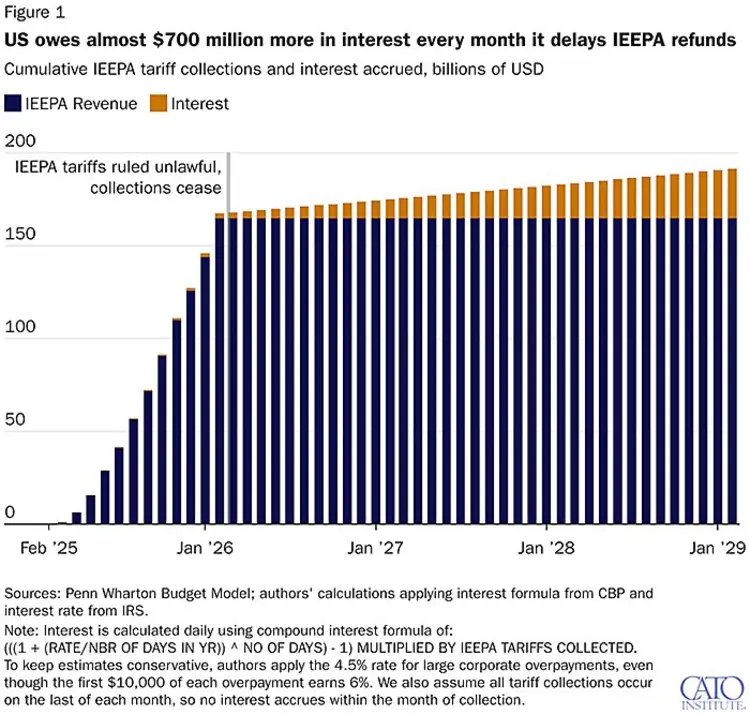
According to CBP’s own court filing, the agency has taken in about $166 billion from more than 330,000 importers across 53 million individual entries since the tariffs took effect.
On Wednesday, Judge Richard Eaton of the U.S. Court of International Trade ordered the government to begin processing refunds immediately, with interest.
Eaton said the law was clear: every importer hit by the now-illegal tariffs was entitled to get their money back.
“We live in the age of computers,” he told the courtroom, pushing back on the government’s suggestion that the task was too complex.
But on Friday, CBP told Eaton it couldn’t do it — at least not yet.
The Government’s Argument
Brandon Lord, executive director of CBP’s trade programs directorate, filed a declaration saying the agency’s existing technology and procedures “are not well suited to a task of this scale.”
He wrote that processing the tariff refunds manually would require redirecting staff from “responsibilities that serve to mitigate imminent threats to national security and economic security.”
Lord said the agency is developing new automated functionality within its system that could handle the volume.
He estimated it would be ready in 45 days and would save roughly four million hours of manual labor.
The new process, he said, would require “minimal submission from importers.”
But there’s a catch.
CBP currently issues refunds only electronically, and the vast majority of importers haven’t signed up for the electronic system.
Of the 330,566 importers who paid tariffs, only 21,423 have completed the setup process.
Lord warned that until importers register, “the refunds will be rejected.”
A federal appeals court earlier this week had already denied the administration’s request for a 90-day delay on the refund process.
Related

Why the Delay Matters
Every day the government holds onto the money, it costs more. Interest is accruing on the $166 billion at a rate of approximately $23 million per day, according to the Cato Institute.
There’s also a ticking clock built into the customs system itself.
Tariff entries have what amounts to an expiration date: once they “liquidate” — the process by which CBP finalizes the cost of a shipment — recovering the money becomes significantly more difficult.
The longer refunds are delayed, the more entries pass that point, and the harder it gets for businesses to get their money back.
Trade attorneys say this isn’t an accident.
“The administration has a reason to make people jump through hoops, because every person who doesn’t jump through the hoops ends up leaving money behind,” trade attorney Greg Husisian of Foley & Lardner told Axios.
Who Gets the Money
The refunds go to importers — the businesses that actually paid the tariffs when their goods crossed the border.
But many of those companies passed the costs along to consumers through higher prices, and the government keeps no records of what was passed through and what wasn’t.
Some companies have already pledged to return savings to their customers.
Costco said Thursday it intends to pass recovered tariff charges back to shoppers through lower prices.
FedEx has made a similar commitment. But there’s no requirement that companies do so, and for many businesses, the tariff costs were absorbed as losses that cut into earnings.
The vast majority of the 330,000-plus importers are smaller businesses. Many have told Reuters they might abandon their refund claims entirely if the process requires filing lawsuits or navigating a complicated administrative system.
More than 2,000 companies have already sued the government to recover what they’re owed.
The Bigger Picture
The Supreme Court’s ruling didn’t end Trump’s tariff agenda. Within hours of the decision, Trump signed a proclamation imposing a new 10% global tariff under Section 122 of the Trade Act of 1974 — a different legal authority.
He quickly raised that rate to 15%.
Treasury Secretary Scott Bessent said that combining Section 122, Section 232, and Section 301 tariffs “will result in virtually unchanged tariff revenue in 2026.”
In other words, the administration is working to replace the illegal tariffs with new ones imposed under different laws, while simultaneously dragging its feet on tariff refunds for the money it collected under the old ones.
The Section 122 tariffs come with a built-in expiration: they must end in 150 days unless Congress votes to extend them.
That vote would land just months before the 2026 midterm elections — forcing lawmakers to go on the record about tariffs that research from the Federal Reserve Bank of New York found were overwhelmingly borne by American businesses and consumers.
The Tax Foundation estimated the tariffs added roughly $1,000 to $1,300 to annual household costs.
Twenty-three states have already filed a lawsuit challenging the Section 122 tariffs, arguing the legal conditions for their use don’t exist.
Judge Eaton has been designated as the sole judge on the Court of International Trade handling all tariff refund cases. He has made clear he intends to move the process forward. The Trump administration is expected to appeal.