


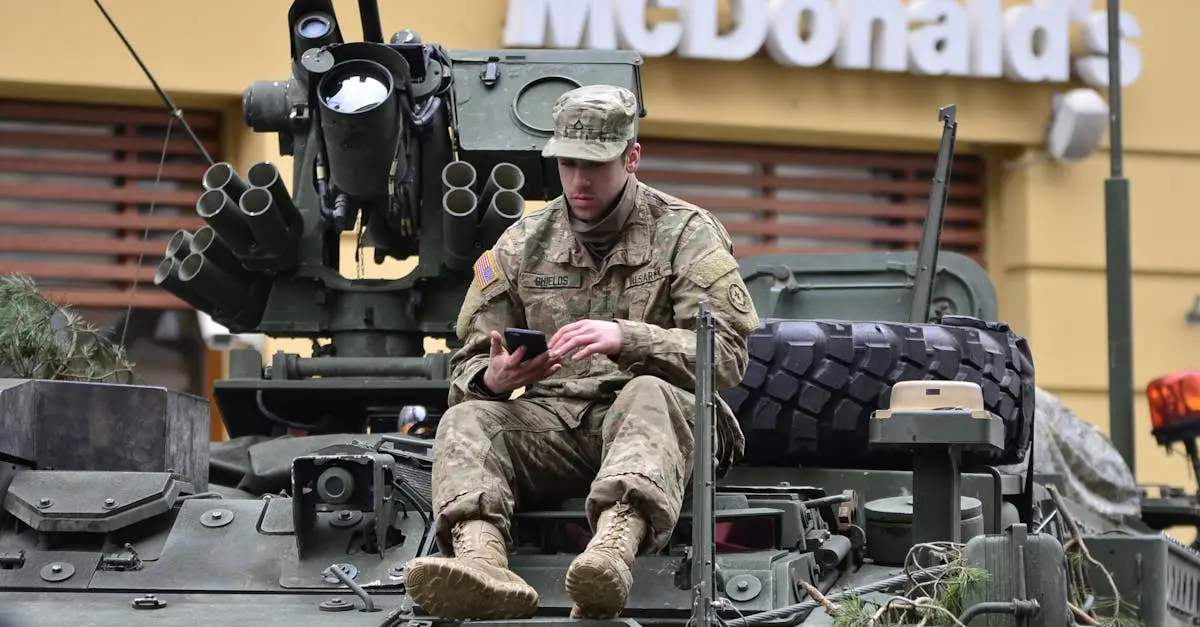
When crime spikes or civil unrest captures national headlines, government leaders often reach for a dramatic solution: deploying the National Guard into U.S. cities. The imagery is powerful. Armored vehicles, fatigues, and boots on city streets signal urgency and control. But behind the optics lies a critical question taxpayers rarely get to ask. What’s the cost of sending the National Guard to cities?
As you read about the actual costs involved in troops being stationed in U.S. cities, think about the services and and opportunities that would benefit the American people that our tax dollars could be paying for. Instead, money that could pay the health insurance plan premium for a woman with cancer who’s about to lose her ACA coverage is paying a soldier in uniform to pick up trash in the park.
The reality is that the cost of sending the National Guard to cities is frequently far higher than the cost of strengthening local police departments that already exist, already know their communities, already have the training, and already have legal authority to handle crime. When examined through a budget lens, National Guard deployments look less like a cost saving solution and more like an expensive detour away from sustainable public safety.
The True Cost of Sending the National Guard to Cities
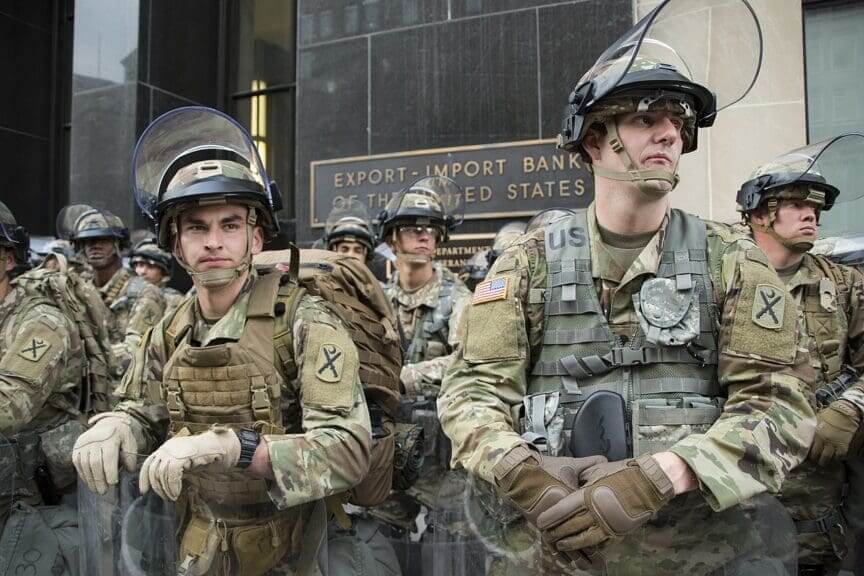
Deploying the National Guard is not cheap. Even short term activations involve a cascade of expenses that add up quickly. These costs typically include:
- Pay and benefits for Guard members, often at active duty rates
- Overtime and hazard pay
- Transportation of personnel and equipment
- Housing and meal allowances
- Fuel, vehicle maintenance, and logistics
- Equipment wear and replacement
Depending on the size and duration of the deployment, costs can reach tens of millions of dollars in a matter of weeks. Some large scale city deployments have exceeded $30 million in under a month. That same amount could fund a mid-sized police department for several months or pay the salaries of hundreds of officers for an entire year.
The cost to deploy National Guard troops to cities is also front loaded. Governments must spend heavily upfront, often with little opportunity to redirect funds once a deployment is underway. In contrast, police funding can be allocated strategically, scaled gradually, and adjusted to real time needs.
Deploying troops to Portland for 60 days would cost around $4 million—And that’s just in soldier pay alone. It doesn’t include the travel and lodging expenses, equipment, food, etc.
Having National Guard troops wandering around DC costs about $1 million a day. Imagine what that money could pay for. Obamacare subsidies? Better yet, single-payer health insurance? Money for D.C. since President Trump cut the city’s funding?
“The cost to deploy troops to a city for one month could fund a mid-sized police department for several months or pay the salaries of hundreds of officers for an entire year.
Police Departments Are Already There and Trained
Local police officers are not a blank slate. They are embedded in the cities they serve. They understand neighborhood dynamics, local crime patterns, and community relationships in ways that outside forces simply cannot replicate.
Funding police departments allows cities to:
- Hire additional officers to reduce response times
- Expand community policing programs
- Increase patrol coverage in high crime areas
- Invest in training focused on de escalation and crisis response
- Retain experienced officers who might otherwise leave
Hiring more officers costs far less than activating the National Guard. The average annual cost of employing a police officer, including salary and benefits, is often equivalent to the cost of deploying a single Guard member for a fraction of that time. In practical terms, one month of Guard deployment can equal the annual cost of hiring multiple local officers.
Temporary Force vs Long Term Public Safety
Another overlooked issue is duration. National Guard deployments are inherently temporary. They arrive, they stabilize a situation, and they leave. Crime, however, does not disappear when the uniforms change.
When governments repeatedly rely on the National Guard, they create a cycle of short term responses rather than long term solutions. Local police funding, on the other hand, builds capacity over time. Each new officer hired strengthens institutional knowledge, improves continuity, and reinforces trust between law enforcement and residents.
The cost of sending the National Guard to cities delivers a brief show of force. The same money invested locally builds infrastructure that lasts for years.
Fiscal Responsibility and Smarter Policy Choices
From a taxpayer perspective, the math is hard to ignore. Spending millions on deployments that last weeks while police departments struggle with staffing shortages is not fiscally efficient. It also shifts responsibility away from local governance and toward emergency measures that should be reserved for true disasters.
A smarter policy approach would prioritize:
• Federal and state grants for police hiring and retention
• Funding for training and mental health resources
• Support for community based crime prevention
• Strategic use of existing law enforcement resources
This does not mean the National Guard has no role. They are invaluable during natural disasters and extreme emergencies. But using them as a routine crime control tool is an expensive workaround for underfunded local systems.

The cost to send the National Guard to cities is often justified as a necessary expense, but a closer look reveals a missed opportunity. For the same money, governments could fund police departments for months, hire more officers, improve training, and strengthen the very institutions designed to keep communities safe.
Public safety works best when it is local, consistent, and sustainable. Investing in police departments is not just cheaper than deploying the National Guard. It is smarter, more effective, and better aligned with long term community stability.
In an era where every public dollar matters, the choice should be clear. Spend less on temporary force. Spend more on lasting solutions.
Don’t Miss Our Life in Trump’s America series explaining martial law, Posse Comitatus, Habeas Corpus, Thought Police, How to Suevive a Mass Shooting, and more.
What Will Happen If President Trump Invokes Martial Law?

American Dystopia: After the Constitution

From democracy to police state: How it happens (and why it feels familiar)

Whispers of freedom: Life under “Thought Police” control
Life in Trump’s America: The story of a once free country